Discover proven social media marketing tips for local service businesses. Learn how to set goals, choose platforms, and convert followers into customers.
What Is Organic Search Engine Optimization: A 2026 Guide
Many business owners pour money into digital ads, only to watch the leads vanish the moment they stop paying. This feels like trying to fill a bucket with a large hole in the bottom. The constant spending is exhausting, and the results are temporary.
This experience is not a sign that digital advertising is ineffective. It is a sign that the overall marketing strategy lacks a stable, permanent foundation.
Table of Contents
Why Digital Ads Can Feel Like a Leaky Bucket

The cycle of paying for online visibility creates a common and valid frustration. This approach ties your ability to attract customers directly to your daily ad budget. When the spending stops, the phone stops ringing.
This model is defined by high costs and low long-term sustainability. You are effectively renting a temporary spot at the top of Google or on a social media feed. The core problem is not the ad itself but the absence of a permanent digital asset supporting it.
The alternative to renting visibility is to build an asset that attracts customers on its own merit. This is the purpose of organic search engine optimization. It is the strategic process of earning, not buying, your position in search results. For a deeper look at the fundamentals, see this guide on What is Search Engine Optimization.
The Real Cost of Rented Visibility
The true cost of a paid-only strategy extends beyond the monthly ad invoice. It includes the significant opportunity cost and the failure to build a lasting marketing asset.
- High Customer Acquisition Cost (CAC): Relying solely on ads often inflates the cost to acquire each new customer, which directly impacts profit margins.
- No Lasting Value: The moment a campaign ends, all visibility you paid for disappears. The investment leaves no residual benefit.
- Platform Dependency: Your business growth becomes subject to the changing algorithms and rising costs of platforms like Google and Meta.
An effective digital strategy does not require a choice between paid ads and organic SEO. It uses a solid organic foundation to make paid advertising more effective and less expensive over time. It plugs the leaks in the marketing budget.
This strategic shift separates frantic, short-term campaigns from calm, predictable growth. It is the transition from renting attention to owning an audience.
Organic SEO as a Permanent Business Asset

When business owners consider digital marketing, their first thought is often paid ads. This is logical, as the results appear to be instant. This focus on immediate gains, however, frequently overlooks the more significant opportunity: building a real, long-term asset.
So, what is organic search engine optimization in practical business terms? It is the methodical work required to earn free, high-quality visibility in search results, as opposed to renting it.
Consider this contrast. Paid advertising is like renting a pop-up kiosk in a busy city square. You pay a fee for the location, people see your sign, and you may generate some business. The moment you stop paying the rent, the kiosk is removed. Your presence was entirely temporary.
Organic SEO, in contrast, is the process of designing and constructing a permanent flagship store in that same prime location. It requires more upfront planning and effort. But once built, it becomes a valuable asset that your business owns, attracting consistent traffic without a daily rental fee.
Organic SEO vs. Paid Search: A Business Comparison
This distinction between building an asset and renting visibility is central to creating a predictable, scalable growth engine. Here is a direct comparison between investing in organic SEO and spending on paid search ads.
| Attribute | Organic SEO (Building an Asset) | Paid Search (Renting Visibility) |
|---|---|---|
| Cost Over Time | An upfront investment that becomes more cost-effective as returns compound. | A constant, ongoing expense. Costs often rise with competition, and traffic ceases when payment stops. |
| Long-Term Value | Creates a permanent digital asset that generates compounding returns and builds brand equity. | Delivers short-term traffic with no lasting asset. It is a transactional expense. |
| Customer Trust | Earns high levels of trust. Users perceive organic results as more authoritative. | Often viewed with skepticism. Users recognize them as advertisements and may be less inclined to click. |
| Return on Investment (ROI) | Delivers sustainable, long-term ROI that grows as authority and relevance are established. | Provides immediate but often lower long-term ROI. Performance is tied directly to ad spend. |
While paid ads can provide a quick surge of traffic, organic SEO builds the foundation for durable success.
Earning vs. Renting Your Digital Presence
The difference between earning and renting a digital presence is the core of a sustainable marketing strategy. An earned presence through SEO builds on itself, creating compounding returns that paid ads cannot replicate.
The data confirms this. As of 2026, 53% of all website traffic originates from organic search. This makes it the single largest driver of online visibility, surpassing paid search, social media, and direct traffic. You can explore the data to understand why organic traffic is so dominant.
A strong organic presence does more than drive traffic. It builds trust. Customers view organic results as more credible than sponsored ads, which leads to higher-quality inquiries and a stronger brand reputation.
Making this mental shift, from renting ad space to building a permanent digital asset, is the first step toward creating a reliable system for generating leads. Your website can become your most effective salesperson, working 24/7 to connect with customers already looking for your services.
The Three Pillars of Earning Trust on Google
Effective SEO is not a collection of secret tricks. It is a structured approach built on three core pillars that work in concert to earn Google’s trust, and by extension, the trust of your customers.
When marketing efforts fail to produce results, it is almost always because one of these pillars is weak or missing. This leaves business owners feeling frustrated by a lack of visibility.
The Technical Foundation
The first pillar is your website’s technical foundation. This is analogous to the structural integrity, plumbing, and electrical systems of a building. If the structure is not sound, its contents are irrelevant.
The same principle applies to your website. If search engines cannot efficiently crawl, understand, and index your pages due to slow load times, broken links, or a confusing site structure, your visibility will be compromised. No amount of quality content can overcome a flawed technical foundation.
Content and Relevance
The second pillar is content and relevance. This is the substance within your digital "building". It includes the valuable expertise, helpful answers, and clear service descriptions that prove you are an authority in your field.
This is how you demonstrate to both Google and your customers that you understand their problems and offer the correct solutions. Quality content directly answers the questions your audience is asking. Learn more about this by understanding what Google wants from your website.
Authority and Reputation
The third pillar is your authority and reputation. This relates to your business’s credibility as measured by external signals. The most powerful of these signals are high-quality backlinks from other reputable websites and strong local signals, such as a consistent stream of positive reviews on your Google Business Profile.
A backlink from a trusted industry website functions as a professional referral. A stream of positive reviews acts like strong word-of-mouth. Without these trust signals, Google is less likely to recommend your business, even if your technical and content elements are strong.
This three-pillar system is not arbitrary. It is designed to mirror how humans determine who to trust. As noted in these in-depth SEO statistics, factors like high-quality content, authoritative backlinks, and user intent have become critical for earning sustainable visibility.
How Search Visibility Translates to Real Revenue
Ranking on Google is not about vanity metrics. It is about connecting with customers at the precise moment they are ready to make a purchase. A high ranking is the digital equivalent of having a storefront on the busiest street in town.
However, not all digital locations are equal. The difference between appearing on the first page of Google and the second is not a small step. It is a cliff.
The data is clear. The top organic result on Google captures 39.8% of all clicks. The entire first page attracts the vast majority of traffic, leaving almost nothing for the second page and beyond. You can explore more of these critical SEO statistics to see the full impact.
From Keywords to Customers: A Practical Scenario
Let's apply this to a real business. Imagine you own a med spa in Florida. A potential client searches for "microneedling near me" or "best med spa in Miami." If your business appears on the first page, you are now visible to someone who is actively looking to book an appointment.
This is where the true value of organic SEO becomes apparent. It creates a direct connection between a person's need and your business's solution. This is not random traffic; it is qualified, motivated traffic. These inquiries convert at a higher rate because the customer initiated the search.
A well-executed SEO strategy ensures your business is consistently the answer to these queries. To see how this effect compounds, it is useful to understand the true ROI of SEO.
Building the authority required to capture this high-intent traffic requires a balanced approach across the three pillars.
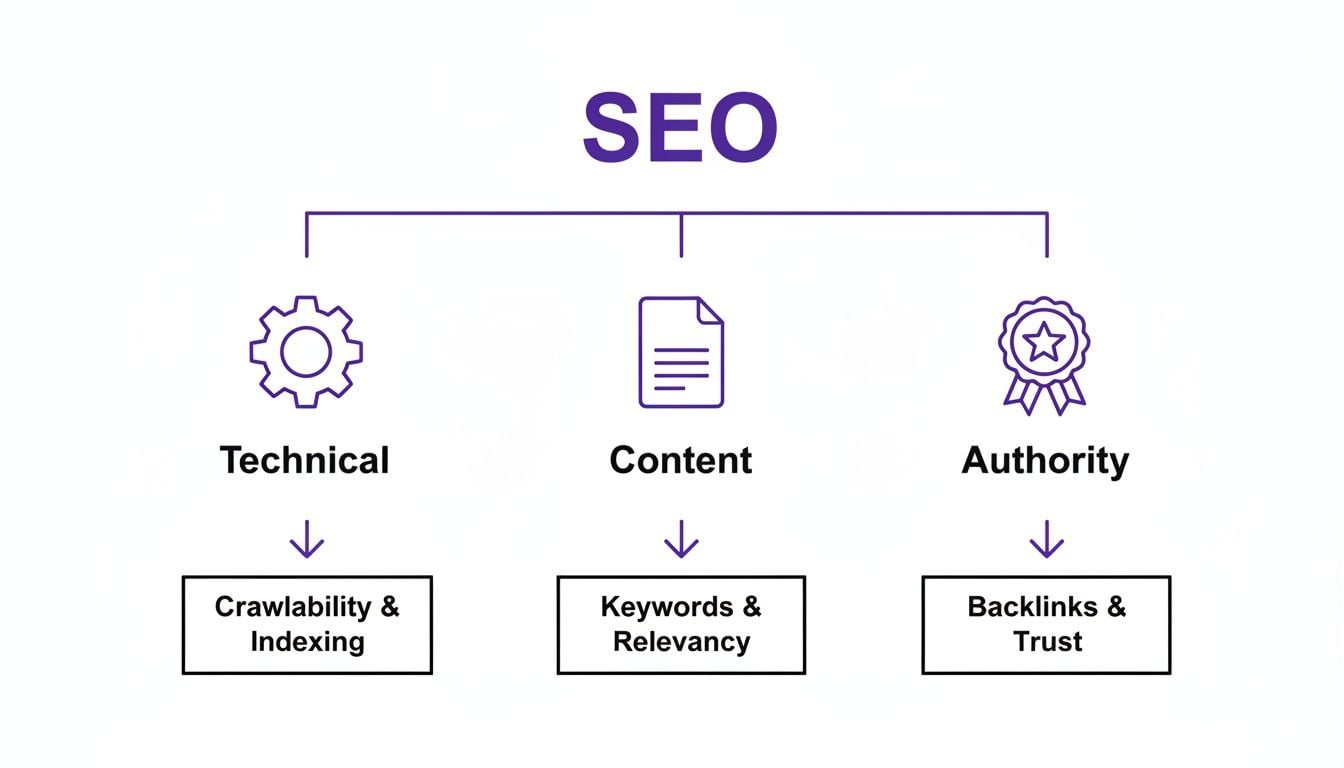
This structure shows that revenue-generating results do not happen by accident. They are the outcome of a deliberate focus on your site's technical health, content quality, and online authority.
A first-page ranking for a term like 'emergency AC repair Denver' does not just generate a click. It generates a phone call, a dispatched technician, and immediate revenue. That is the tangible outcome of a properly executed organic search strategy.
This is the fundamental shift in thinking. It is about moving from chasing visibility to building a predictable stream of revenue by strategically placing your business in the path of customers who are ready to buy.
Common Misconceptions That Sabotage SEO Results
We often hear from business owners who have invested in what they believed was SEO, only to be left with wasted money and no tangible results. This frustration is almost always rooted in misconceptions and outdated tactics.
To achieve success with SEO, it is important to first understand what to avoid.
One of the most significant errors is treating SEO as a one-time project. It cannot be "set and forgotten." Google’s algorithm evolves, competitors adapt, and customer search behavior changes. Real SEO is an ongoing process of asset management, not a one-off task.
Myth 1: Guaranteed First-Page Rankings
If an agency ever promises a guaranteed #1 ranking, that is a clear signal to disengage. No one can guarantee a specific position on Google. The algorithm is complex, constantly changing, and outside of any single entity's control.
A credible SEO partner understands this. Instead of making impossible promises, they focus on controllable factors: building a sound technical foundation, creating expert content, and earning authentic trust signals. These actions drive high rankings, but the rankings themselves are an outcome, not a commodity.
Myth 2: Keyword Stuffing Is a Viable Tactic
In the past, some practitioners attempted to manipulate search engines by repeating a target keyword excessively on a page. This practice is known as keyword stuffing. Today, it results in penalties, not improved rankings.
Google's algorithms now understand context, synonyms, and natural language. Forcing keywords into text creates a poor user experience and signals low quality to search engines.
The objective is no longer to be the most keyword-optimized page. The objective is to provide the most helpful and satisfying answer to a user's query. Google measures this through user engagement signals that indicate whether your site solved their problem.
Myth 3: SEO Is All About Tricks and Loopholes
A persistent myth suggests that SEO is a collection of secret "hacks" designed to trick search engines. This thinking leads to temporary gains at best and a penalized website at worst.
Sustainable, long-term growth is the result of a transparent, methodical approach focused on genuine value. It is about earning trust, not exploiting weaknesses. This means systematically improving your website's performance, demonstrating expertise with helpful content, and building authority through credible signals.
Building Your Strategic Organic Growth Engine
Moving past the myths and understanding the principles of organic SEO is a turning point for many businesses. It is where you stop allocating budget to ineffective marketing and start building a predictable system for growth. The focus shifts from chasing rankings to building a sustainable business engine.
A well-designed SEO strategy does more than drive traffic. It builds a pipeline of qualified leads, establishes your brand as an authority, and creates a digital asset that appreciates in value over time. This is how you gain a durable advantage over competitors who remain dependent on renting their visibility.
Putting the Pieces Together
Lasting visibility is not the result of a single tactic. It is the outcome of an integrated system where each component works together to build momentum.
A Rock-Solid Foundation: Your website must be fast, secure, and easy for search engines to crawl and understand. This is the non-negotiable base upon which all other efforts are built.
Expert Content: You must consistently create content that directly answers your customers' most urgent questions, proving your expertise and building trust.
Real Authority: You need to earn external signals that validate your business as a legitimate expert. This includes acquiring backlinks from reputable websites and cultivating a strong local reputation through positive reviews.
When these three elements work in synergy, they create a powerful compounding effect. Each part reinforces the others, leading to steady, measurable results.
From Good Idea to Expert Execution
The principles of building a growth engine are logical. The challenge lies in execution. A critical component is in-depth keyword research. Knowing how to find low competition keywords can provide a significant strategic advantage.
An organic growth engine is not just about being found on Google. It is about being found by the right people, at the right time, with the right message. This creates a predictable flow of ideal customers.
While the concepts are straightforward, expert execution is what separates a plan that looks good on paper from one that drives revenue. It requires deep technical knowledge and consistent work over time. This is where a strategic partner can provide the structure to ensure your investment leads to tangible growth.
Frequently Asked Questions About Organic SEO
Understanding the principles of organic SEO often leads to more specific questions. How does this apply to my business? How long does it take? What is the investment? These are common inquiries from business owners.
Here are direct answers to help you make an informed decision.
How Long Does It Take to See Results?
The honest answer is that SEO is a long-term growth strategy, not an overnight fix. It is comparable to building any significant business asset. It is not like activating a paid ad campaign that stops when the budget is depleted.
Initial positive indicators, such as improved keyword rankings and a modest increase in traffic, can often be seen within three to six months. However, the significant, revenue-driving results that create a predictable flow of new customers typically require six to twelve months of consistent, strategic effort.
The results compound over time, making it one of the most powerful investments for your business's future.
Can I Do Organic SEO Myself?
Yes, business owners can and should manage certain foundational SEO tasks. Actions such as updating your Google Business Profile, encouraging customer reviews, and ensuring your website's contact information is accurate are excellent starting points.
The complexity increases, however, when the goal shifts from simply having an online presence to actively outranking competitors. Advanced technical optimization, strategic content creation, and authority building require specialized expertise and a significant time commitment.
When the objective is to transform your website into a reliable lead-generation system, partnering with a specialist becomes a strategic decision.
How Is Local SEO Different?
For any service-area business, local SEO is the most critical component of an organic search strategy. While general SEO may target broad topics, local SEO is focused on dominating search results within a specific city or region.
It zeroes in on the signals Google uses to identify a local authority. The single most important factor is your Google Business Profile (GBP).
A fully optimized GBP, a steady flow of positive reviews, and consistent business listings across the web signal to Google that you are the primary expert in your service area. This is what secures placement in the "Map Pack" for high-intent searches like "plumber near me," which is precisely where your most valuable customers are looking.
Understanding these principles is the first step. The next is to translate that knowledge into a predictable system for business growth. At City Web Company, we specialize in building these strategic growth engines for businesses like yours.
If you are ready to transition from inconsistent marketing efforts to a clear, sustainable path for attracting new customers, let's have a conversation. Schedule your free discovery call with our team at City Web Company.
These articles were popular with other readers too: