
Pass Google Business verification with a video-first checklist. Film one continuous 30 second take, fix flagged issues, and know when to hire help.
What Is Off-Page SEO? A 2026 Guide for Small Businesses
Off-page SEO is defined as every action taken outside your own website to improve its authority, credibility, and position in search engine results. Think backlinks from other sites, brand mentions across the web, customer reviews, and social signals. Off-page SEO accounts for roughly 50% of search ranking factors, making it equal in weight to everything you do on your own pages. For small business owners and marketers, that means half your ranking power lives in places you do not directly control. Tools like Google Search Console, Ahrefs, and Moz can help you track these external signals, but earning them requires a deliberate strategy built around reputation, relationships, and relevance.
Table of Contents
What is off-page SEO and why does it matter?
Off-page SEO is the discipline of building your website’s reputation through signals that originate outside your domain. On-page SEO covers what you publish and how your site is structured. Off-page SEO covers how the rest of the internet responds to it. The simplest analogy: on-page SEO is what you say about yourself, and off-page SEO is how others vouch for you through links and mentions.
Search engines treat external signals as votes of confidence. When a respected local news outlet links to your plumbing company’s blog post, Google interprets that as a credibility signal. When dozens of customers leave five-star reviews on Google Business Profile and Yelp, that social proof reinforces your authority in local search. Neither of those signals lives on your website, yet both directly influence where you rank.

The importance of off-page SEO extends beyond traditional search. Off-page SEO influences AI-powered search and generative answer engines like Google’s AI Overviews and Perplexity. These systems pull citations from pages that already rank well organically, which means your off-page authority determines whether AI tools recommend your business at all.
Search engines evaluate E-E-A-T (experience, expertise, authoritativeness, and trustworthiness) when scoring content quality. Off-page activities feed directly into every one of those four factors. A backlink from an industry publication signals expertise. A pattern of positive reviews signals trustworthiness. Consistent brand mentions across authoritative platforms signal authoritativeness.
Pro Tip: Do not treat off-page SEO as a separate project from your marketing. Every press mention, podcast appearance, community sponsorship, and customer review is an off-page SEO event. Build the habit of capturing and tracking them all.
Here is how off-page SEO compares to on-page SEO at a glance:
- On-page SEO: Title tags, meta descriptions, content quality, internal links, page speed, schema markup
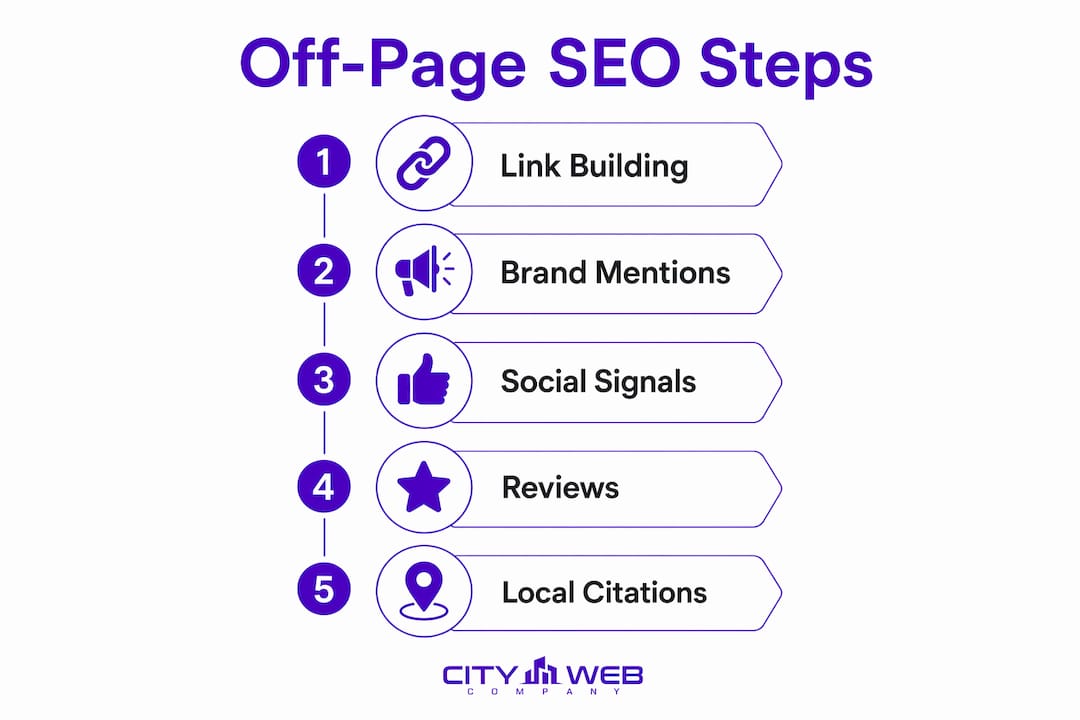
- Off-page SEO: Backlinks, brand mentions, reviews, social signals, local citations, influencer coverage
- Technical SEO: Site architecture, crawlability, indexation, Core Web Vitals
All three categories work together. Strong on-page content gives other sites something worth linking to. Strong technical SEO makes sure search engines can find and index what you publish. Off-page SEO amplifies the authority of everything else.
Core off-page SEO techniques every small business should know
Off-page optimization methods range from link building to reputation management, and each one plays a distinct role in how search engines score your site. The following techniques represent the most impactful activities for small businesses and local service providers in 2026.
Link building: quality over quantity
Link building is the practice of earning hyperlinks from other websites that point back to yours. Links remain the core of off-page SEO but should be approached as a PR campaign focused on earning editorial coverage rather than chasing raw volume. A single link from a regional business journal carries more weight than fifty links from low-quality directories.
The most effective link building tactics for small businesses include:
- Guest posting on industry publications. Write a practical article for a trade publication in your niche. A pest control company contributing a seasonal pest prevention guide to a home improvement blog earns a relevant, editorial backlink.
- Digital PR and local press. Pitch story angles to local news outlets, neighborhood blogs, and community websites. Sponsoring a local event and getting a mention on the organizer’s site counts as a legitimate off-page signal.
- Resource page outreach. Many city government sites, chambers of commerce, and industry associations maintain resource pages. Getting listed on those pages earns authoritative, locally relevant links.
- Broken link building. Find broken links on relevant websites using tools like Ahrefs or Screaming Frog, then offer your content as a replacement. This gives site owners a reason to link to you.
- Unlinked brand mentions. Use Google Alerts or Mention.com to find places where your business is referenced without a link. Reach out and ask the author to add one. These conversions are often easy wins.
Pro Tip: White-hat link building strategies like digital PR and resource outreach consistently outperform bulk link schemes in long-term ranking stability. Google’s spam filters have become sophisticated enough to devalue or penalize manipulative link patterns.
Brand mentions and social signals
Brand mentions are references to your business name, products, or services across the web, even without a hyperlink. Search engines track these mentions as part of your entity profile. A landscaping company mentioned repeatedly in neighborhood Facebook groups, local Reddit threads, and community newsletters builds a pattern of recognition that reinforces its authority in local search.
Social media engagement does not directly influence rankings in the way backlinks do, but it creates indirect benefits. Content shared widely on LinkedIn, Instagram, or Facebook reaches more people, which increases the probability that someone with a website will link to it. SEO builds brand awareness and drives growth precisely because visibility and authority compound over time.
Reviews and local citations
For local service businesses, online reviews on Google Business Profile, Yelp, Angi, and HomeAdvisor function as off-page authority signals. A consistent stream of genuine, positive reviews tells both search engines and prospective customers that your business delivers on its promises.
Local citations are mentions of your business name, address, and phone number (NAP) across online directories. Consistent NAP information across directories improves local SEO as part of a broader off-page strategy. Inconsistent listings, where your address appears differently on Google versus Yelp versus your Chamber of Commerce profile, create confusion for search engines and suppress your local rankings. City Web Company’s guide on consistent online listings explains exactly how this affects your visibility.
| Off-page technique | Primary benefit | Difficulty |
|---|---|---|
| Editorial backlinks | Domain authority, ranking power | High |
| Local citations (NAP) | Local search visibility | Low |
| Customer reviews | Trust signals, local rankings | Low |
| Brand mentions | Entity recognition, AI visibility | Medium |
| Social media sharing | Reach, indirect link acquisition | Low |
| Digital PR coverage | High-authority links, brand credibility | High |
How off-page SEO has evolved with AI and modern search
The off-page SEO of 2016 was largely a numbers game. Agencies competed on link volume, domain authority scores, and anchor text ratios. That model is obsolete. Modern off-page SEO is a campaign-based reputation strategy rather than a numbers game of link quantity. The shift reflects how search algorithms and AI systems now evaluate authority.
Topical relevance now outweighs domain authority
Topical relevance of backlinks has become more important than domain authority for their ranking weight in 2026’s search algorithms. A link from a mid-sized HVAC industry blog carries more ranking power for an HVAC company than a link from a high-authority general news site with no topical connection. This means your link building efforts should prioritize relevance to your specific service category, not just the prestige of the linking domain.
This shift rewards small businesses that build genuine relationships within their industry communities. A disaster restoration company that contributes to emergency preparedness forums, gets cited in local fire department resources, and earns links from insurance industry blogs builds a topically coherent backlink profile that modern algorithms reward.
AI search demands stronger entity profiles
Google’s AI Overviews almost exclusively cite websites already ranking in the organic top 10, which creates a compounding advantage for businesses with strong off-page authority. If your business does not appear in traditional organic results, it will not appear in AI-generated answers either. This makes off-page SEO the foundation of AI search visibility, not just traditional ranking.
AI systems like Google’s Search Generative Experience and Perplexity build entity profiles for businesses based on what the broader web says about them. Consistent brand mentions across authoritative sources, a coherent set of backlinks from relevant sites, and a strong review presence all contribute to a recognizable entity profile. Businesses with thin or inconsistent off-page footprints are effectively invisible to these systems.
“Off-page SEO is no longer just about links. It is about whether the internet recognizes your business as a legitimate, authoritative entity in your category. AI systems are accelerating that shift.” — Search Engine Land
Community presence and off-page authority signals like brand mentions and social sentiment are increasingly factored into AI search results and generative answers. For a local moving company or med spa, this means showing up in local Facebook groups, earning mentions in community newsletters, and maintaining an active presence on platforms where your customers spend time.
The E-E-A-T framework and off-page proof
Google’s E-E-A-T framework requires external proof of expertise and trustworthiness. You cannot claim authority on your own website and expect Google to take your word for it. Off-page SEO provides the third-party validation that makes those claims credible. A med spa that publishes expert skincare content earns E-E-A-T credit when dermatology publications link to that content, when licensed practitioners are quoted in industry media, and when patient reviews consistently reference the quality of care.
For a deeper look at how SEO shapes brand authority and local trust, City Web Company’s branding guide covers the intersection of reputation and search visibility in detail.
Practical steps to improve off-page SEO for your business
Improving off-page SEO requires consistent effort over time. Off-page SEO typically requires 3 to 6 months before measurable ranking shifts appear, and up to 12 to 24 months to build mature, durable authority. That timeline is not a reason to delay. It is a reason to start now.
The following steps give small businesses and marketers a clear path forward:
- Audit your current backlink profile. Use Ahrefs, Semrush, or Google Search Console to identify who already links to you, which pages attract the most links, and whether any toxic links need to be disavowed.
- Claim and optimize your local listings. Verify your Google Business Profile, Yelp, Bing Places, and any industry-specific directories. Standardize your NAP information across all of them. Review City Web Company’s local SEO best practices for a structured approach.
- Build a review generation system. Ask satisfied customers for reviews immediately after a job is completed. Use a simple follow-up text or email with a direct link to your Google review page. Aim for a steady cadence rather than a one-time push.
- Identify link-worthy content opportunities. Create resources that other sites in your industry would naturally reference. A roofing company could publish a local storm damage guide. A landscaper could create a seasonal planting calendar specific to their region.
- Pursue digital PR with local media. Identify two or three local journalists or bloggers who cover home services, local business, or community topics. Pitch them story angles that tie your expertise to current events or seasonal needs.
- Monitor brand mentions weekly. Set up Google Alerts for your business name, owner name, and primary service keywords. When you find unlinked mentions, reach out and request a link. When you find negative mentions, address them professionally and publicly.
- Engage in relevant online communities. Participate in local Facebook groups, Nextdoor, Reddit threads, and industry forums. Answer questions, share expertise, and build name recognition without spamming links.
- Track progress with the right metrics. Monitor referring domain growth, domain rating trends, review volume and average score, and branded search volume in Google Search Console. These metrics tell you whether your off-page efforts are compounding.
For competitive markets, City Web Company’s competitive SEO strategy guide outlines how to build off-page authority in industries where established players already dominate the search results.
Key takeaways
Off-page SEO is the single largest driver of search authority, and no amount of on-page optimization compensates for a weak external reputation.
| Point | Details |
|---|---|
| Off-page SEO weight | Off-page signals account for roughly 50% of search ranking factors. |
| Quality over quantity | Topically relevant backlinks outperform high-volume, low-relevance link schemes in 2026. |
| AI visibility depends on it | Google’s AI Overviews cite pages already ranking organically, making off-page authority critical for AI search. |
| Timeline is long | Expect 3 to 6 months for initial ranking shifts and 12 to 24 months for durable authority. |
| Local citations matter | Consistent NAP data across directories directly improves local search rankings for service businesses. |
Why small businesses consistently underestimate off-page SEO
Most small business owners I work with at City Web Company spend 90% of their SEO energy on their own website. They obsess over page titles, blog posts, and site speed. Those things matter. But they are building a house with no street address. Nobody can find you if the rest of the internet does not know you exist.
The businesses I have seen break through in competitive local markets share one trait. They treat off-page SEO as relationship building, not a technical task. The HVAC company that sponsors the local little league team and gets a mention on the league’s website. The pest control operator who answers questions in a neighborhood Facebook group every week. The moving company whose owner gets quoted in a local news story about moving trends. None of those people were thinking about backlinks. They were thinking about their community. The links and mentions followed naturally.
The other mistake I see constantly is treating reviews as an afterthought. Reviews are one of the most accessible off-page SEO tools available to any local business, and most companies collect them inconsistently or not at all. A structured review generation process, even a simple one, compounds over 12 months into a meaningful ranking advantage.
The hardest part of off-page SEO is patience. You will not see results in week two. You might not see them in month three. But the businesses that commit to a consistent reputation-building strategy are the ones that own page one two years from now. That is the only timeline that matters.
— Matt
Ready to build your off-page authority with expert support?
Off-page SEO is not a one-time project. It is an ongoing reputation management effort that compounds over time. City Web Company works with local service businesses, from HVAC companies to med spas to disaster restoration contractors, to build the external authority that drives real search rankings and local leads.
If you are ready to stop guessing and start building a sustainable off-page strategy, City Web Company’s local lead generation services are built specifically for service businesses that need results. From link building and reputation management to local citation cleanup and digital PR, the team handles the work so you can focus on running your business. Explore the full range of digital marketing services and see what a structured off-page strategy looks like in practice.
FAQ
What is off-page SEO in simple terms?
Off-page SEO refers to all activities outside your website that influence your search engine rankings, primarily backlinks, brand mentions, reviews, and social signals. It tells search engines how the rest of the internet perceives your authority and trustworthiness.
How is off-page SEO different from on-page SEO?
On-page SEO covers what you publish and optimize on your own website, including content, title tags, and internal links. Off-page SEO covers external signals like backlinks, citations, and reviews that other sites and platforms generate about your business.
How long does off-page SEO take to show results?
Off-page SEO typically takes 3 to 6 months before measurable ranking improvements appear, with full authority building taking 12 to 24 months. Consistency matters more than speed.
What is link building and why does it matter?
Link building is the process of earning hyperlinks from other websites that point to yours. Links signal credibility to search engines, and editorial backlinks remain the core of off-page SEO authority in 2026.
Does off-page SEO affect AI search results?
Yes. Google’s AI Overviews cite pages already ranking in the organic top 10, so strong off-page authority is the primary driver of visibility in both traditional and AI-powered search results.
Recommended
These articles were popular with other readers too: