

Use website DNI, connect call reports to Google Ads and your Google Business Profile, then tie calls to booked jobs. City Web Company can handle setup.
What Is Good Domain Authority? Expert Guide 2026
Most business owners are taught to treat Domain Authority like a scoreboard. Raise the number, win the game.
That sounds logical. It is also where a lot of SEO budgets get wasted.
If your last agency kept pointing to a rising DA score while your phone did not ring more often, the problem was not your patience. The problem was the metric. What is good domain authority depends far less on some universal benchmark than most reports suggest, especially for local businesses that need calls, form fills, booked appointments, and qualified leads.
A higher score can signal stronger backlink authority. But local visibility is not built on score chasing alone. A plumber, chiropractor, roofer, or med spa does not grow because a third-party tool says the website looks stronger in theory. That business grows when it shows up in the right local searches, earns trust quickly, and turns that visibility into revenue.
For many owners, that gap is the primary frustration. Money goes into SEO. Reports get more technical. Yet the business outcome stays cloudy.
The better way to think about authority is practical. Not “How high can this score go?” but “What level of authority is enough to beat the competitors that matter and produce more local demand?”
Table of Contents
The Domain Authority Score Your Last Agency Obsessed Over
A lot of agencies present Domain Authority as if it were the final grade for your marketing.
It is not.
That misunderstanding creates a familiar pattern. A business invests in link building, sees a nicer-looking report, and still wonders why lead quality feels inconsistent. The score improves. The business does not always improve with it.
Why the obsession creates bad strategy
When DA becomes the target, strategy often drifts toward whatever moves the number.
That can mean chasing broad backlinks, publishing content with weak local intent, or comparing a local contractor to national brands that operate on a completely different playing field. The report looks active. The market impact stays limited.
For a local service company, the true cost is not just wasted spend. It is missed visibility where buyers are ready to act.
If someone needs an emergency HVAC repair, a garage door fix, or a dentist nearby, they are not grading websites like analysts. They are looking for a trusted local option that appears fast, looks credible, and makes it easy to call.
A cleaner report can hide a broken strategy. If SEO activity does not improve local visibility and lead flow, the metric is not the business result.
What business owners usually assume
The common assumption sounds reasonable.
- Higher DA means higher rankings
- Higher rankings mean more traffic
- More traffic means more leads
In practice, that chain breaks often.
A local company can have a modest authority score and still outrank stronger domains for local intent searches. Another company can build authority on paper and remain weak in map visibility, local trust signals, or conversion paths.
That is why many owners feel they have been “doing SEO” without feeling its commercial impact.
If that sounds familiar, this breakdown of SEO myths hurting your rankings will feel accurate. Many of the most expensive mistakes start with treating one metric as a proxy for the whole system.
The better lens
Domain Authority has value as a comparison tool.
It becomes a problem when people confuse it with business performance.
A score can support visibility. It does not replace local relevance, buyer intent, trust, or conversion. For local businesses, that distinction matters because the wrong target can consume months of effort that should have gone toward the signals that drive calls and revenue.
Demystifying Domain Authority and Other SEO Scores
Domain Authority, usually shortened to DA, is best understood as a reputation estimate for your website.
Consider it a credit score for search visibility. It is not issued by Google, and it does not decide rankings by itself. It is a third-party metric created by Moz to estimate how likely a domain is to rank compared with other sites.

What DA measures
According to ALM Corp’s explanation of Domain Authority, Moz developed DA in the early 2010s as a predictive metric for ranking potential on a 1 to 100 logarithmic scale. New sites start at DA 1, and scores in the 21 to 40 range are realistic for solid small to mid-sized businesses.
The important word there is predictive.
DA is trying to estimate authority based largely on your backlink profile. In plain language, it looks at who links to your site, how many unique sites link to you, and how trustworthy those linking sites appear.
A link from a respected local newspaper, trade association, or recognized industry site generally carries more weight than a pile of weak directory links.
Why the scale confuses people
The DA scale is logarithmic.
That means growth gets harder as the number climbs. The same ALM source notes that moving from DA 20 to 30 is much easier than moving from 70 to 80. This difference in difficulty often misleads business owners. They see a competitor with a much higher score and assume they need to catch it exactly.
They usually do not.
For a local company, the competitive gap that matters is often much narrower than the headline number suggests.
DA is not the only authority metric
Moz is not the only company scoring websites.
Ahrefs uses Domain Rating, or DR. Other tools have their own versions too. They are all trying to answer a similar question. How strong does this domain look based on links and authority signals?
That is useful for benchmarking. It is not the same as saying Google uses these exact scores.
What these tools are good for
Used correctly, authority scores help you compare websites in the same market.
They can help you spot patterns like:
- Competitive weakness: Your local rivals may have far fewer quality links than you assumed.
- Link profile strength: A regional competitor may be winning because reputable local organizations link to them.
- Growth realism: Your site may not need a national-level score to perform well in a city or service area.
If you create content in newer formats, the same principle applies. A strong content asset can earn links and authority over time. For businesses exploring audio content, this guide to podcast SEO is a useful example of how discoverability and content repurposing can support broader search visibility.
Treat DA like a diagnostic tool, not a destination. It helps you evaluate competitive strength, but it does not tell you whether your marketing is producing revenue.
What Is a Good Domain Authority Score Really
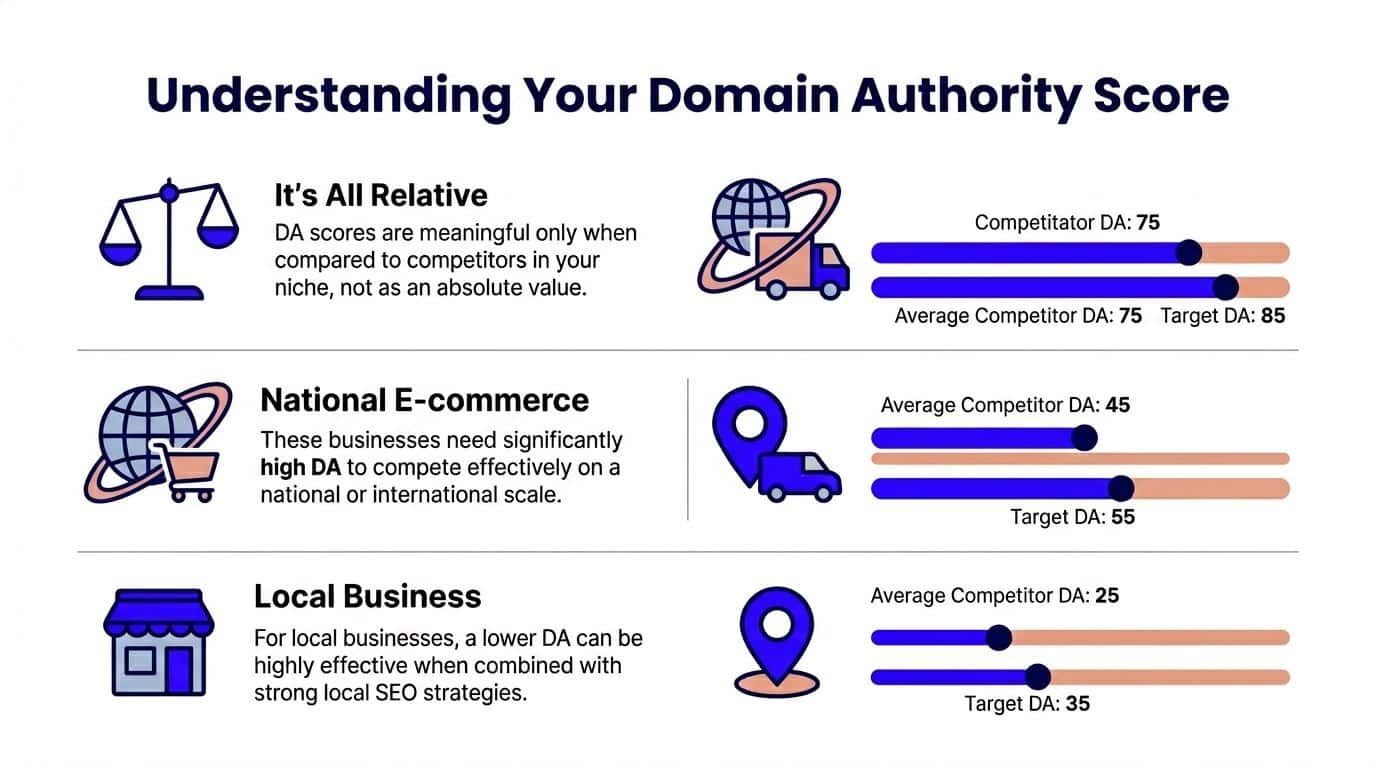
A good Domain Authority score is not a universal number.
It is a number that is strong enough for the market you compete in.
That is the part most business owners never hear. They get handed a benchmark with no context, then feel behind before the strategy even begins.
Good compared to whom
A local plumber is not competing with Home Depot.
A med spa in one metro area is not competing with every beauty brand in the country. A municipal recruitment site is not trying to outrank major news publishers. Yet businesses get compared to giant domains all the time, and that comparison torts priorities.
The better question is this. What authority level is common among the websites already winning your money keywords?
For local and regional businesses, the answer is usually much more attainable than broad SEO advice suggests.

Realistic benchmarks by business type
The source data around DA and DR gives a helpful framework.
First Page Sage’s DR benchmarks report that a DR of 20 to 35 enables top 3 Google rankings for competitive keywords in 27% of industries, while DR 35 to 50 reaches top 3 positions in 39% of competitive local queries. That matters because many local businesses do not need elite domain strength to become visible where buyers are searching.
Here is a practical way to think about it.
| Business Type | Typical DA Range | What It Means |
|—|—|
| Small local business | 10 to 20 | Often enough to compete locally when maps, citations, reviews, and location relevance are strong |
| Solid small to mid-sized business | 21 to 40 | A realistic range for businesses building stronger search visibility across a city or service area |
| Established growth-stage brand | 41 to 60 | Strong link equity and broader ranking potential across more competitive searches |
| Established authority site | 61 to 80 | Very strong authority, usually beyond what a typical local-first business needs |
These ranges align with the verified benchmark language from the earlier Moz and ALM-based guidance, even though the number only becomes meaningful when tied to direct competitors.
A local example that makes this clearer
Suppose you run an HVAC company serving one metro area.
If the other serious competitors in your market sit in the low-to-mid authority range, your site does not need a massive score to win local intent searches. A site in the high 20s or 30s can be competitive if it also has better service pages, stronger local trust signals, and cleaner conversion paths.
A regional company serving multiple cities may need more authority because the competitive set expands. The search footprint is wider. The content base is broader. The backlink profile usually has to support more pages and more location targets.
That is why “good” changes by context.
Why score envy leads to wasted effort
The biggest trap is chasing a number because it sounds impressive.
That often pulls attention away from narrower, more profitable goals such as ranking for local service terms, improving map visibility, or strengthening high-intent pages that produce calls.
A good DA score is one that helps you beat the right competitors, in the right geography, for the searches that generate revenue.
If your market leaders sit within a reachable range, it makes more sense to build a practical authority edge than to chase a score that only matters in national competition.
Why Domain Authority Is a Flawed Metric for Local SEO
For local SEO, Domain Authority is often treated like the main event when it is really a side indicator.
That distinction matters because local businesses do not win solely on broad domain strength. They win when search engines trust that the business is relevant to a nearby searcher, credible in that market, and easy to verify.

Local search uses signals DA does not capture well
For local intent searches, Google weighs things that DA only touches indirectly or not at all.
That includes:
- Proximity: How close the business is to the person searching
- Google Business Profile strength: Category setup, completeness, activity, and relevance
- Citation consistency: Accurate business name, address, and phone details across directories
- Review profile: Volume, quality, and overall trust signals from customers
A business owner can look at a lower DA competitor and assume they should be easy to beat. Then that competitor outranks them in the map pack because the local signals are tighter.
That is not unusual. It is how local search often works.
The data point most owners need to hear
Moz’s guidance on local relevance makes this much clearer. For local service businesses, a DA of 10 to 20 is often enough to rank well and generate leads, and HVAC or plumbing sites in mid-sized US markets can rank for valuable local terms with DA scores between 15 and 25. The same source notes that local search prioritizes Google Business Profile, citations, and proximity over raw DA. That is why chasing 40+ can be a misuse of resources for local-first businesses, as explained in Moz’s Domain Authority resource.
That single point changes the conversation.
If a local company can perform with a modest score, then a campaign built mainly around inflating DA may be solving the wrong problem.
What a lower-DA competitor may be doing better
A roofing company with a lower authority score can still outperform a stronger domain if it has:
- More complete local listings
- Better alignment between service pages and city-specific searches
- Stronger recent reviews
- A more active and accurate Google Business Profile
- Faster response paths for calls and forms
In other words, the competitor looks more useful and more local to both Google and the customer.
Where agencies often lose the plot
Many SEO programs overvalue what is easy to report and undervalue what produces local demand.
DA is convenient because it is one number. Local visibility is messier. It involves maps, review signals, citation health, landing page quality, and market-level competition. That takes more strategic work to diagnose and improve.
But for a local business, that messier work is often where the revenue lives.
Local SEO is rarely won by the site with the prettiest authority metric. It is won by the business that sends the clearest local trust signals.
A Smarter Strategy to Build True Local Authority
If chasing a score is the wrong goal, what should a local business build instead?
Build the kind of authority that buyers and search engines can both verify in your market.
That means local presence, local trust, and local relevance working together. Not abstract authority in isolation.

Start with the asset most local businesses underuse
Your Google Business Profile is often the first thing a prospect sees before they ever visit your website.
If it is incomplete, poorly categorized, inconsistent, or stale, your local visibility weakens at the source. Many businesses spend months trying to improve website authority while neglecting the profile that shapes map visibility and first-click trust.
If you need a practical starting point, this guide on how to put my business on Google Maps gives a clear primer on the foundational steps.
A stronger local foundation usually includes:
- Accurate core business data: Name, address, phone, hours, categories, and service areas need to match across the web.
- Relevant business details: Services, photos, descriptions, and updates should reflect what you sell and where you sell it.
- A clean user path: The prospect should be able to call, request directions, or reach the correct landing page without friction.
For local service businesses, this foundation often influences results faster than obsessing over authority metrics.
Build citations before chasing clever tactics
Citation work is not glamorous, but it is one of the structural pieces many underperforming local campaigns are missing.
If your business information appears differently across directories, local platforms, and industry listings, search engines get weaker confirmation signals. That uncertainty can limit visibility even if the website itself is decent.
A reliable citation strategy does three things:
- It standardizes your business identity.
- It reinforces your service geography.
- It supports trust across local search ecosystems.
That is one reason resources like this explanation of the impact of a Google Business Profile on local SEO matter. They connect the profile, directory consistency, and real-world visibility in a way many DA-focused conversations ignore.
Earn local backlinks that make business sense
Not all links are equally useful.
For local businesses, the most valuable links often come from organizations that signal real community presence or industry relevance. That may include chambers of commerce, local news sites, neighborhood associations, suppliers, sponsorship pages, trade groups, and niche directories.
A local backlink strategy works best when it follows the shape of the business.
For example:
- A dentist may earn mentions from local health directories or community event pages.
- A groundskeeping service may get listed through home service associations, neighborhood publications, or supplier partnerships.
- A municipality may strengthen authority through trusted public-sector references and regional organizations.
This type of link building supports visibility without drifting into vanity-link territory.
Reviews are authority in buyer language
Backlinks matter to search tools. Reviews matter to people.
A business with steady positive reviews usually communicates trust faster than a business with a stronger DA score but thin social proof. In local markets, that trust can influence both ranking performance and conversion performance.
Focus on a system, not a one-time push.
Ask at the right moment. Make the process simple. Train staff to support it. Respond to reviews professionally. Keep the cadence consistent.
Local authority is built the same way local reputation is built. Through repeated proof, visible trust, and consistency across every touchpoint.
Make the website support local intent
The website still matters. It just needs to support the right goal.
That means clear service pages, city or service-area relevance where appropriate, strong calls to action, mobile usability, and content that answers the questions buyers ask before they contact you.
For a local company, “authority” is not only who links to you. It is whether your site reassures a prospect quickly enough to take the next step.
Measuring What Matters for Sustainable Business Growth
Once you stop treating DA as the end goal, reporting gets simpler and more honest.
The question is no longer “Did the score go up?” The question is “Did local visibility produce more qualified opportunities?”
The metrics that deserve executive attention
A healthy local SEO dashboard should focus on business outcomes and the signals closest to them.
That usually means tracking:
- Rankings for revenue-driving local keywords
- Google Business Profile engagement, such as calls, clicks, and direction requests
- Qualified leads from organic traffic
- Performance by service page or location page
- Conversion behavior on mobile and desktop
These metrics show whether visibility is turning into action.
A DA score may still appear in the background as a benchmarking reference. It just should not dominate the conversation.
What better reporting sounds like
Weak reporting says, “Authority improved.”
Useful reporting says, “More people found the business in local search, visited the right pages, and contacted the company for the right services.”
That shift matters because it ties SEO to revenue logic.
If a campaign raises a score but does not improve inquiry quality, local rankings, or customer actions, the marketing team may be polishing a metric instead of building growth.
A practical decision filter
When reviewing SEO work, use a simple filter:
- Does this improve local discoverability
- Does this strengthen buyer trust
- Does this increase qualified inquiries
If the answer is unclear, the tactic may be too far removed from the business outcome.
That is the heart of what is good domain authority for a local company. Good is not the highest number on the spreadsheet. Good is the level of authority that supports sustainable visibility, stronger trust, and a predictable flow of leads in the market you serve.
If your team wants a clearer way to evaluate SEO, City Web Company helps local and regional businesses build growth strategies around visibility, lead quality, and measurable market performance, not vanity metrics. If that kind of clarity would help you make better marketing decisions, a conversation with their team is a smart next step.
These articles were popular with other readers too: