Use website DNI, connect call reports to Google Ads and your Google Business Profile, then tie calls to booked jobs. City Web Company can handle setup.
What Is an SEO Landing Page? Turn Search Traffic Into Revenue
Many business owners invest in a beautiful website expecting the phone to start ringing, only to be met with silence. The common assumption is that more website traffic is the solution. However, the real issue is often where that traffic is being sent. Directing valuable searchers to a generic homepage is a quiet but significant drain on your marketing budget.
This happens when potential customers, who have a specific need, land on a page that wasn't designed to convert them. They get confused, can't find a clear answer, and click away, often to a competitor. This isn't a failure of your service or brand; it's a structural gap in your digital strategy.
Table of Contents
The Hidden Cost of Misdirected Traffic

This scenario creates a common frustration. You approve a marketing budget and see visitors arriving at your site, yet your phone remains silent. The problem is a fundamental mismatch between what a person is searching for and the webpage they land on.
Consider someone searching for "emergency plumbing repair." This individual is not interested in your "About Us" page or a comprehensive list of every service you offer. They have an urgent problem and require a fast, clear solution.
The Problem with General Pages
When a potential customer with a precise need lands on a broad, generic page, you force them to do all the work. They must navigate through menus, scan irrelevant text, and hunt for the information they need.
This friction is almost always enough to make them hit the back button and contact a competitor whose website provided an immediate answer. It is the difference between having people walk past your storefront versus having them walk inside, ready to make a purchase.
This is precisely where understanding what is an seo landing page becomes a critical advantage. It is the missing component designed to solve this exact problem by aligning your website with specific customer intent.
An SEO landing page acts as a dedicated bridge, connecting a specific search query directly to a highly relevant solution. It eliminates guesswork for the user and streamlines the path from searcher to lead.
This is not just another page on your website. It is a strategic tool, purpose-built to capture your most qualified traffic from search engines and guide them toward a single, profitable action. This is how you stop the cycle of wasted marketing spend and begin turning clicks into clients.
Defining the SEO Landing Page: Your Strategic Tool for Leads
An SEO landing page is best understood not as just another page on your website, but as a purpose-built express lane created exclusively for motivated customers. These are the individuals who know what they want and are ready to act.
It is a standalone web page, engineered to do two things exceptionally well. First, it is designed to rank in search results for a very specific phrase. Second, it guides that visitor toward a single, clear action, such as booking a consultation or requesting a quote. To grasp the full context, it is helpful to understand the fundamentals of What Is a Landing Page? and its role in your overall marketing.
Your main website can be compared to a large supermarket with numerous aisles and options. An SEO landing page, in contrast, is like a specialty shop that sells only what someone needs at that moment. This intentional focus is what makes it so effective. It achieves this by removing all the usual distractions: no main navigation menu, no links to other services, and no competing offers. It is built to answer one question and drive one action.
The Power of Singular Focus
For local service businesses, this laser-focused approach is a significant advantage. Instead of hoping a visitor stumbles upon the right information on your site, you deliver it to them the moment they arrive from a search engine.
This perfect alignment of keyword-optimized content and conversion-focused design is how you turn casual searchers into high-quality leads. A standard website page attempts to do too many things at once. It might introduce the team, showcase a portfolio, and list every service you offer. An SEO landing page has one job: to convert.
An SEO landing page is not just a destination; it is a finely tuned conversion machine. It combines the visibility of search engine optimization with the persuasion of direct-response marketing.
This targeted approach creates a straight line from a search query to a new customer lead, making it an invaluable tool for any service business looking to achieve sustainable growth.
SEO Landing Page vs. Other Web Pages
To fully understand its role, it helps to see how an SEO landing page compares to the other pages on your website. Each page type has a different job, and knowing the difference is key to building a site that generates business.
This table breaks down the fundamental differences in purpose, structure, and traffic source.
| Page Type | Primary Goal | Navigation | Traffic Source | Example for a Roofer |
|---|---|---|---|---|
| SEO Landing Page | Convert a specific search query into a lead. | Removed or minimized to reduce distraction. | Organic search (e.g., Google, Bing). | A page for "emergency roof leak repair". |
| Homepage | Introduce the brand and direct traffic. | Full site navigation is present. | Direct, referral, search, and social. | The main entry point for the roofing company. |
| Blog Post | Educate, inform, and build authority. | Full site navigation is present. | Organic search and social media. | An article titled "5 Signs You Need a New Roof". |
| About Us Page | Build trust and tell the company story. | Full site navigation is present. | Internal site clicks and direct traffic. | A page detailing the roofer's history and team. |
While your homepage or blog posts serve broader goals, the SEO landing page is your specialist. It is designed with a single-minded purpose: turning a searcher with a specific need into your next customer.
The Anatomy of a High-Converting SEO Landing Page
An effective SEO landing page is not just another page on your website; it is a purpose-built asset engineered to turn a specific type of searcher into a customer. Think of it less like a general store and more like a specialist’s workshop. Every element, from the headline to the contact form, works toward one clear goal: to convert visitors who arrive from search engines.
It is helpful to see how this differs from other marketing pages. For example, learning how to create high-converting PPC landing pages offers valuable lessons in focused design. While the traffic comes from a paid ad instead of an organic search click, the core principle is the same: give the visitor exactly what they came for, with zero distractions.
This diagram shows where an SEO landing page fits into your website structure. It is not buried in your site navigation; it is a direct destination for searchers with a specific need.
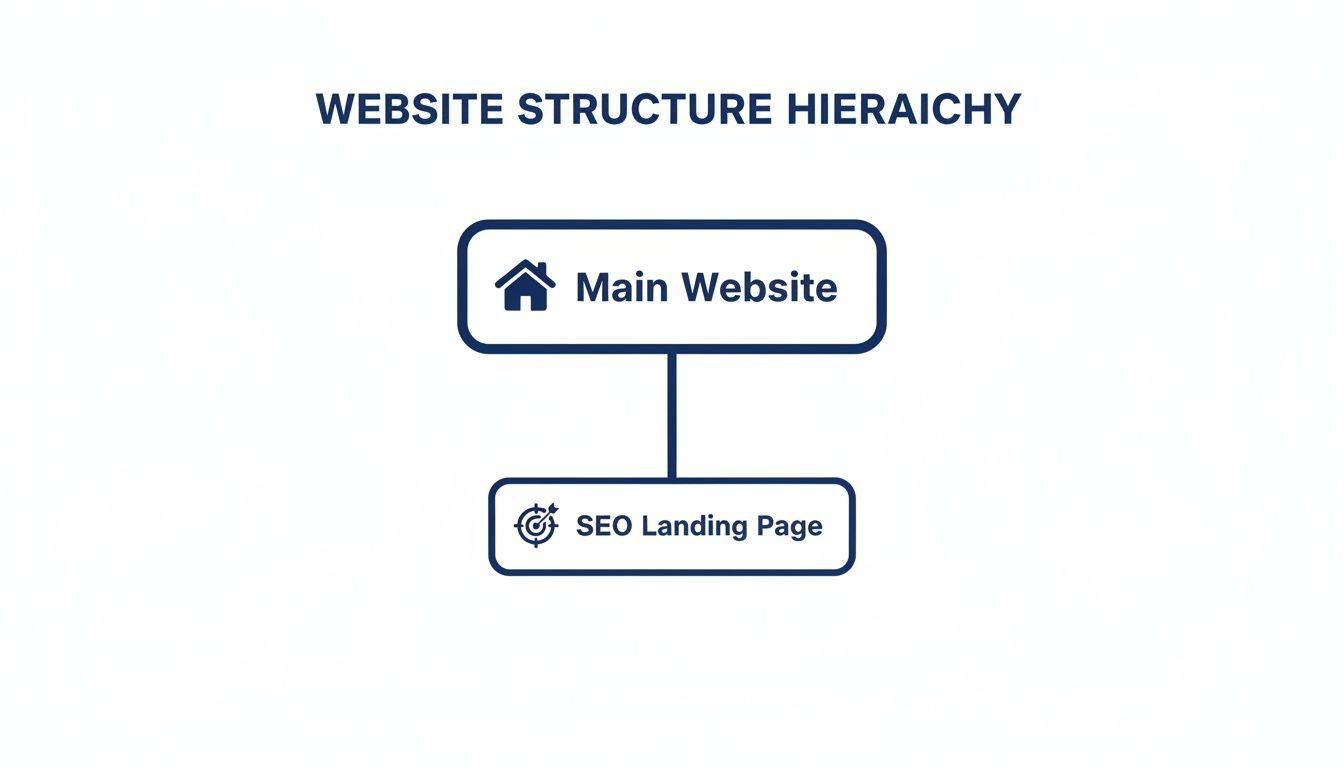
As you can see, your main website serves broader goals, but the landing page is a targeted entry point designed to drive a specific action.
Intent-Aligned Content and On-Page SEO
This is the foundation of the page. The content has one job: to immediately confirm to the visitor that they have landed in the right place. It must perfectly match what they just searched for. If someone searches "emergency AC repair Denver," your page needs to clearly communicate, "We fix AC units in Denver, fast."
This is where the mechanics of on-page SEO are applied. It is how you make your content visible to search engines.
- Title Tag & Meta Description: These act as your advertisement in the search results. They must include your target keyword and provide a compelling reason for someone to click your link instead of a competitor's.
- H1 and Subheadings (H2, H3): Your main headline (H1) should mirror the search query. Subheadings break your content into easy-to-scan sections and can target related keywords, making the page easier for both humans and search engines to understand.
- Keyword-Rich Body Copy: Your main keyword and related terms should be woven naturally into the text. This is not about stuffing keywords; it is about proving your page is the most relevant resource for that topic.
Conversion-Focused Design and a Strong Call to Action
Effective design is not just about aesthetics; it is about building trust and guiding the visitor toward taking action. It uses a clean, uncluttered layout to keep the user focused on the intended outcome. Confidence is built with trust signals like customer testimonials, industry certifications, or a gallery of finished work.
Data shows that while the median conversion rate for landing pages is around 6.6%, a significant portion of marketers achieve rates over 10% by testing and personalizing their pages. For a home service business, an optimized page for a term like "garage door repair Florida" can outperform generic pages by over 200% with personalized calls to action. Page speed is also critical, as every extra second it takes for your page to load can reduce conversions by 4.42%.
Of all the design elements, the call-to-action (CTA) is the most important. This is the button or link that tells the visitor exactly what to do next, such as "Request a Free Estimate" or "Schedule a Consultation." For a full breakdown, see our guide on the importance of a strong call-to-action.
A powerful CTA needs a simple lead capture form. Only ask for the absolute essentials. The easier you make it for a potential customer to get in touch, the more likely they are to do so.
Why Your Generic Service Pages Fail to Convert
Many business owners make a logical but incorrect assumption: they believe their main "Services" page is the ideal destination for all search traffic. On the surface, it seems efficient. It is a neat digital brochure listing everything the business does.
The problem is that this very efficiency is what hinders conversions. A page built to serve everyone ends up speaking to no one. This is why qualified visitors from search engines often leave your site without taking action, and why a well-designed website may fail to generate leads.
The Problem of Divided Attention
Consider a common scenario. A homeowner in your city searches for “kitchen remodel contractor” and clicks on your site. Instead of landing on a page that confirms "We are kitchen experts," they arrive at your generic "Home Improvement" page. It lists kitchens, but they are positioned between bathrooms, basements, and decks.
What happens next is predictable. The visitor is forced to search for the specific information they need. They must wade through services they do not care about, which creates immediate friction and doubt. Within seconds, they hit the back button and click on a competitor's site, one that takes them directly to a page focused entirely on kitchen remodeling.
A generic service page asks a motivated buyer to do the work. An SEO landing page does the work for them, presenting a clear solution to their specific problem the moment they arrive.
This is the strategic gap that causes many business websites to underperform. They are structured like an encyclopedia when they should be built like a direct response letter.
Cause and Effect: The Conversion Killer
The failure of a generic services page comes down to simple cause and effect.
- Cause: A visitor with one specific need lands on a page with multiple, competing messages. This mismatch between their search intent and your broad content creates immediate confusion.
- Effect: The visitor feels they are in the wrong place. That uncertainty eliminates their momentum and confidence, causing them to abandon your site for a clearer, more direct answer.
An SEO landing page is designed to prevent this. By creating a dedicated page for "kitchen remodel contractor," you align perfectly with the searcher's intent from the first click. You greet them with focused messaging, relevant images, and a clear call to action about their exact problem. This significantly increases the odds of turning that visitor into a real lead.
Putting It All Together: A Local Business Scenario

Theory is one thing, but seeing how these components work together in a real-world context provides clarity. Let's walk through an example for a fictional business, “Springs Family Dentistry,” located in Colorado Springs. We will show how to build a page that brings in a specific, high-value type of patient.
The process begins with strategy, long before any content is written. We identify a service that solves a real, pressing problem for patients. For a dentist, an excellent candidate is sedation dentistry, a solution for people who delay critical care due to dental anxiety.
This gives us our target search phrase: “sedation dentistry Colorado Springs.” Someone typing that into a search engine is not just browsing. They have a problem, dental fear, and they are actively seeking a local solution.
Building a Page That Speaks to the Patient
With our keyword defined, we can build the page. Every element must be laser-focused on earning the trust of an anxious patient.
The headline (H1) has one job: to offer immediate reassurance. Something like, “Gentle, Anxiety-Free Sedation Dentistry in Colorado Springs,” is effective. It mirrors their search and makes a powerful promise.
From there, the entire page is designed to answer their unspoken questions and calm their fears.
- Real Patient Stories: Instead of sterile text reviews, we would embed short video testimonials from actual patients who can share how pain-free their experience was. This type of social proof is invaluable.
- Meet the Dentist: A short, friendly video introducing the dentist, who explains the sedation process in a calm, reassuring way. This puts a human face on the practice and demystifies the procedure.
- Focus on the Benefits: We use clear, simple bullet points to highlight the patient's advantages: "No more dental fear," "Handle complex procedures in a single visit," and "Enjoy a comfortable, relaxed experience."
Every word and image on the page is there to reduce anxiety and build confidence. It is a critical part of creating location-specific landing pages that convert because it solves a problem for a real person in your community.
Driving the Right Action
Finally, every part of the page guides the visitor toward one clear, easy next step. We avoid a high-pressure CTA like "Book Now," which can feel like too large a commitment for someone who is already nervous.
Instead, the main call-to-action is a simple, no-pressure button: “Request a Private Consultation.”
The contact form is equally simple, asking only for a name, email, and phone number. The entire experience is designed to smoothly convert a nervous searcher into a confirmed lead.
This approach moves a potential patient from problem awareness to solution clarity. It validates their concerns and provides a clear, comforting path forward, which is the core function of a successful SEO landing page.
For local service businesses, this kind of focused strategy is what separates a dead-end page from a lead-generation machine. Our clients in industries like HVAC and landscaping often achieve conversion rates around 9-11% with pages built on trust signals and local SEO. As shown by landing page statistics on Emailvendorselection.com, top-performing pages can exceed 11.45% by maintaining this singular focus and eliminating all distractions.
Measuring Success and Optimizing for Growth
Building an SEO landing page is only the beginning. Real growth comes from what you do after it goes live. Treating the page as a "set it and forget it" asset is a significant mistake. It is a dynamic tool, and you need to know how it is performing to maximize your investment.
Simply watching traffic numbers increase is not enough. You need a system to understand how visitors are behaving and what is driving actual business. This is how you identify opportunities to turn a good page into a great one.
Key Metrics That Matter
To get a clear picture of your page's performance, you must focus on a few crucial metrics. These numbers tell the story of what is working and what is not.
- Conversion Rate: This is the most important metric. It is the percentage of visitors who take your desired action, like filling out a form or calling your business. A high conversion rate means your page is effectively persuading people to connect with you.
- Bounce Rate: This metric shows the percentage of people who land on your page and leave without doing anything else. A high bounce rate is a red flag, often signaling a mismatch between what the searcher expected and what your page delivered.
- Cost Per Lead: For any marketing activity, you need to know what it costs to acquire a new lead. Tracking this metric directly measures the financial return of your SEO landing page and proves its value.
You can find these metrics in tools like Google Analytics. When you combine that data with call tracking software, you can connect specific phone calls back to your landing page. This provides a complete, undeniable view of how the page is generating business.
Continuous optimization is what separates good marketing from great marketing. Small, data-driven adjustments to your page can lead to significant increases in lead volume over time.
This means you should regularly test small changes to see what moves the needle. You might run an A/B test, showing half your visitors one headline and the other half a different version to see which one converts better. You can test anything: button colors, form fields, or even the main image.
By measuring the results, you allow data, not guesswork, to guide your decisions. This process of continuous improvement ensures your SEO landing page does not just work today but becomes an even more powerful asset for your business tomorrow.
From Digital Noise to Strategic Growth
Sustainable growth is not about just having a website. It is about building a system of strategic assets, each with a specific, measurable job. If you have ever felt a disconnect between your marketing budget and your actual results, it is likely because those assets were not built correctly.
Throughout this guide, we have deconstructed what a winning online strategy looks like. You now understand why a generic website is not enough to capture customers who are ready to buy. The SEO landing page is the specific tool that turns passive search traffic into active clients.
Think of it as the critical connection point in your marketing. It finds the right person, with the right problem, and provides them with the right solution at the exact moment they are searching for it. That perfect alignment is what separates effective marketing from simply making noise online.
You now understand what has been missing from your marketing. The path forward is no longer about guesswork; it is about building a clear, intentional system that connects your services to the people who need them most.
An SEO landing page is not just another page to add to your site. It is a fundamental shift in how you approach your online presence, moving from a passive digital brochure to an active lead-generation engine. This is how you stop wasting clicks and start building a predictable pipeline of qualified customers.
The clarity you have been looking for is found in this strategic approach. It is the difference between simply being online and actually growing your business.
If you're ready to build a marketing system that delivers clarity and results, City Web Company can help you develop a strategy that makes sense for your business. Schedule your free discovery call with our team to get started.
These articles were popular with other readers too: