
Use website DNI, connect call reports to Google Ads and your Google Business Profile, then tie calls to booked jobs. City Web Company can handle setup.
A Strategic Guide to Local Landing Pages That Convert
Many business owners invest in a professionally designed website, only to find it remains invisible to customers in the specific towns and neighborhoods they serve. This is not a design failure. It is a fundamental disconnect between a generalist web presence and the precision required for local search.
A single, generic website cannot build the relevance needed to appear for high-intent local searches, where customers are ready to make a purchase.
Table of Contents
Why Your Website Is Invisible to Local Customers
The core issue is that a primary website is built to represent an entire brand, but it speaks a general language. When a potential customer searches for "emergency plumber in Denver" or "best roofer near Cherry Creek," Google’s algorithm seeks the most relevant, location-specific result. A generic "Services" page rarely qualifies.
This mismatch directly impacts revenue. Every time a qualified local customer finds a competitor first, you have lost a tangible opportunity. It also suggests wasted ad spend, as paid traffic is often directed to pages that lack the specificity to convert someone with an immediate, location-based need.
The Problem of Generalization
It is nearly impossible for one website to rank for dozens of different location-based searches. It lacks the specific signals, the combination of city names, neighborhood references, and localized content, that search engines rely on to confirm a business's authority in a particular area.
Consider the results for a search like "emergency plumber denver":
The pages dominating the top positions are not generic homepages. They are pages built specifically for Denver, signaling clear authority to both the user and to Google. Without dedicated local landing pages, a business effectively tells Google it is a generalist, not the local specialist searchers are looking for.
The Missing Strategic Element
The missing piece is a structure designed for local precision. Instead of one page attempting to serve everyone, a strategy built on multiple local landing pages creates specific entry points for each target market. This approach aligns with how real people search and how search engines rank content.
The impact of this shift is significant. Businesses that implement just 10 to 15 dedicated local pages can see conversions increase by as much as 55%. Those that scale to 40 or more can boost conversions by over 500%.
This transition from a broad, one-size-fits-all model to a focused, local one is what closes the gap between being online and being found. To ensure these pages connect with the right audience, a solid understanding of local SEO keywords that drive growth is necessary. This provides the foundation for attracting customers who are ready to buy, turning marketing from hopeful guesswork into a strategic, measurable system.
Architecting Pages for Search Intent and Conversion
A local landing page that performs well is architected long before any copy is written. Many businesses treat web pages as simple containers for information, an approach that misses the structure required to satisfy both search engines and human visitors.
The objective is to match the page's architecture to what a local searcher requires. Someone searching for "Orlando plumber" or "kitchen remodeling in Boulder" has a specific, often urgent, need. A generic "Our Services" page fails because it does not speak directly to that location-based query. This disconnect costs visibility and leads.
To design pages that are effective, mastering landing page conversion rate optimization is essential. The first step in that process is establishing the correct page architecture.
Blueprint for a High-Intent Page
The foundation of an effective local page is built on several non-negotiable on-page SEO elements. These are not tricks; they are clear signals that inform Google about the page's purpose and audience. They function like an address label, ensuring delivery to the right person.
Your page structure must include:
- A Location-Specific URL: The web address itself should state the service and location (e.g.,
yourcompany.com/boulder-kitchen-remodeling). This is one of the first and most powerful signals Google reads. - An Optimized Title Tag: This is the headline in search results. It must include the main service and the target city.
- A Clear H1 Heading: The main heading on the page should mirror the user's search, instantly confirming they have arrived at the right place (e.g., "Expert Kitchen Remodeling Services in Boulder, CO").
This immediate alignment between the URL, title tag, and H1 creates a powerful sense of relevance. It is what separates a purpose-built page that ranks from a generic one that is lost. This is the consequence of a generic website not optimized for local search.
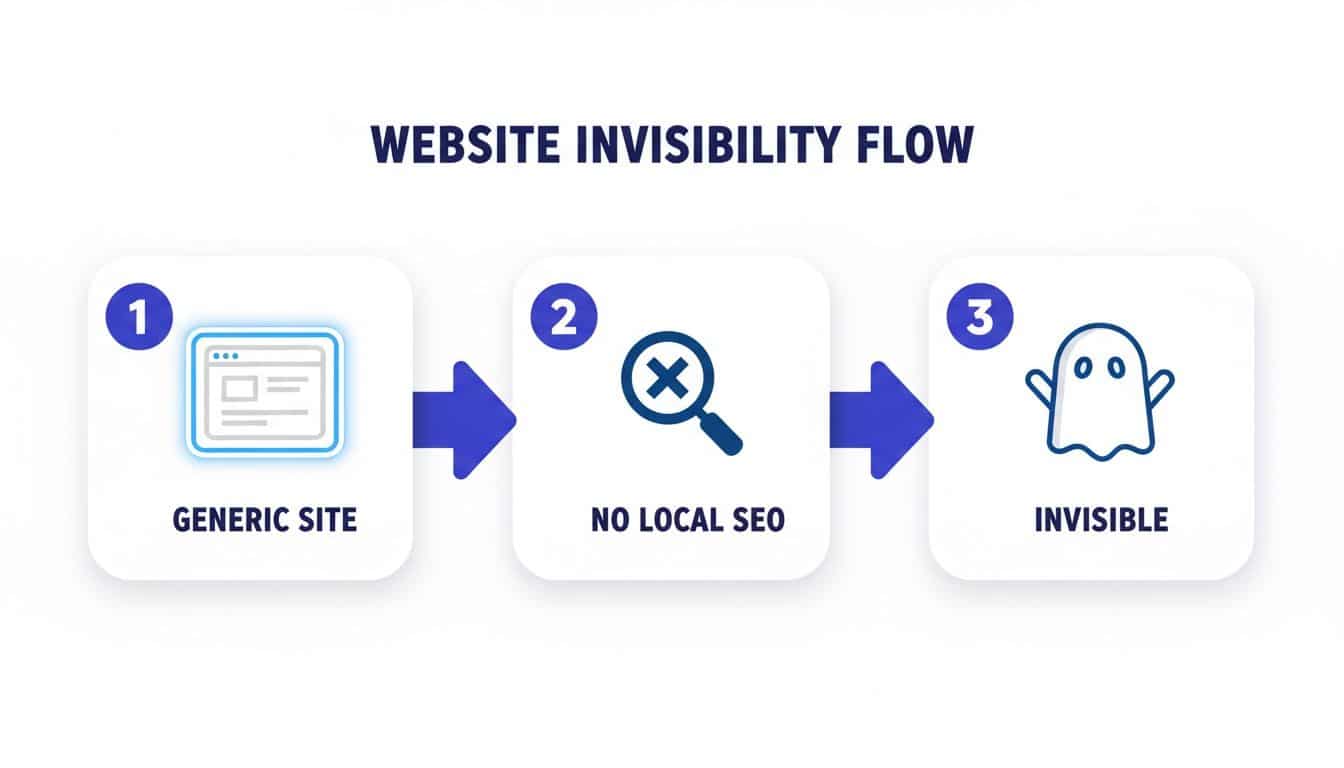
As this illustrates, a generic site structure renders a business invisible to local customers who are ready to buy.
Generic Service Page vs. Strategic Local Landing Page
The performance difference between a standard service page and a true local landing page is stark. One is a passive online brochure; the other is an active lead-generation asset. The distinction becomes clear when comparing their core components.
Here is a breakdown of how they compare.
| Component | Generic Service Page | Local Landing Page |
|---|---|---|
| Title Tag | "Our Services" or "Kitchen Remodeling" | "Boulder Kitchen Remodeling | Free Quote" |
| H1 Heading | "What We Do" | "Top-Rated Kitchen Remodelers in Boulder" |
| Content | General descriptions of services offered. | Mentions local neighborhoods, landmarks, and project examples in Boulder. |
| Testimonials | A mix of reviews from various locations. | Reviews specifically from Boulder-area clients. |
| Call to Action | "Contact Us for More Information" | "Get Your Free Boulder Remodeling Estimate" |
| Trust Signals | General company awards or certifications. | Local awards, BBB rating for the area, and links to the local Google Business Profile. |

This structural difference reveals a critical insight. Research shows that 78% of high-performing landing pages include the location directly in the title tag. For businesses in competitive industries like HVAC, roofing, or dental services, this is a significant advantage.
A dentist in Colorado Springs is unlikely to capture local search traffic with a page simply titled "Cosmetic Dentistry." However, a page built around "Colorado Springs Teeth Whitening," featuring testimonials from local patients, immediately builds trust and relevance. The architecture itself becomes a powerful conversion tool.
To explore this further, you can learn more about the anatomy of a high-converting local website in our article.
Crafting Content That Captures and Converts Leads
An optimized page structure gets you seen by Google, but it is the content on that page that persuades a person to make contact. Many business owners fill their local pages with industry jargon or generic service lists, forgetting that effective copy does not just inform; it persuades.
The key is a shift in perspective: stop discussing "what we do" and start addressing "what we solve for you, right here in your neighborhood." Every headline, paragraph, and bullet point must speak directly to the visitor’s problem in their local context.
This is where you move beyond structure and into the substance of conversion. It is not about listing services, it is about proving you are the logical choice for that customer, in that city, at that moment.
Writing Headlines That Resonate Locally
Your headline is your first opportunity to convince a visitor they are in the correct place. A weak headline creates doubt and encourages a visitor to leave. A strong local headline is direct, benefit-driven, and establishes the location.
Consider the difference for a roofer in Dallas:
- Weak Headline: Our Roofing Services
- Strong Headline: Trusted Hail Damage Roof Repair in Dallas, TX
The first is a passive statement few people search for. The second addresses a specific local problem (hail damage), names the city, and adds a layer of trust. It instantly confirms the visitor’s search was successful and encourages them to learn more.
The Power of Intelligent Lead Magnets
Most local landing pages end with a blunt "Contact Us" form, which can feel more like a demand than an invitation. This creates friction at the moment of decision. A more strategic approach is to offer something valuable in exchange for contact information, turning a direct sales pitch into a helpful exchange.
This is where an intelligent lead magnet is effective. Instead of simply asking for contact, give them a reason.
- An HVAC company could offer a "Homeowner’s Winterization Checklist."
- A chiropractor could provide a free "Guide to Choosing the Right Chiropractor."
- A remodeler might offer an "Austin Kitchen Remodel Budget Planner."
This approach works because it delivers immediate value. One analysis showed that businesses using lead magnets on local landing pages generate 55% of all submissions. Providing expertise first is an effective way to build trust. You can discover more insights about landing page statistics to see how this impacts performance.
The call to action should feel like the next logical step in a helpful conversation, not a final test. Shifting from "Contact Us" to offering a valuable resource achieves this.
Building Trust With Local Proof
Beyond a strong headline and offer, your page needs to be filled with signals that prove you are a real, trusted local business. Visitors are naturally skeptical; local proof is the quickest way to overcome that skepticism.
You need to integrate these trust signals directly into your page content:
- Embedded Local Testimonials: Do not just post a generic review. Feature one from a client in that specific city. For a Dallas page, a quote from a customer in a nearby neighborhood like Preston Hollow is far more powerful.
- Hyper-Local Project Examples: A Scottsdale med spa should show before-and-after photos of local clients. A roofer should have a gallery of homes repaired in a specific subdivision, even mentioning street names.
- Local Affiliations and Awards: If your business is a member of the local Chamber of Commerce, has a high BBB rating for the area, or has won a local award, display those badges on the page. They are instant credibility boosters.
This level of local detail proves you are not just targeting an area; you are part of it. This combination of problem-focused copy, value-first offers, and undeniable local proof is what turns a visitor into a qualified lead.
Managing the Technical Foundation for Local SEO

Persuasive copy and a flawless design are important, but if the technical foundation of your local landing page is flawed, it may remain invisible. Many businesses focus on what the customer sees, forgetting the backend signals that determine whether search engines show the page at all.
This is a significant blind spot, especially for multi-location businesses where a few technical errors can silently undermine an entire local marketing strategy. The backend work enables frontend success. Ignoring it is like building on unstable ground.
The Problem of Digital Echoes
One of the most common technical issues we address is duplicate content across multiple local landing pages. When your pages for Dallas, Fort Worth, and Plano all share 95% of the same text, Google becomes confused. It does not know which is the "master" version and may penalize your site for using thin, repetitive content.
The canonical tag is the solution. It is a simple piece of code that points search engines to the preferred, original page. For a set of similar location pages, you can use a self-referencing canonical on each page to establish its unique value or point them all back to a primary "parent" service page. This resolves the duplicate content problem while allowing each local page to rank for its specific geographic area.
Implementing Local Business Schema
Beyond avoiding penalties, you must actively help Google understand your business. Local Business schema is structured data that achieves this by translating the information on your page into a language that search engines process instantly.
By implementing this code, you explicitly define key details for each specific location, including:
- Business Name: Your official name for that location.
- Address: The physical street address.
- Phone Number: The direct local phone line.
- Operating Hours: The specific hours for that branch.
- Service Area: The geographic boundaries you serve.
Adding Local Business schema is like handing Google a clear fact sheet for each location. It eliminates guesswork and dramatically increases your chances of appearing in high-value search features like the map pack and knowledge panels. This structured data is a powerful signal of legitimacy and relevance.
Page Speed and Mobile Experience
The final technical pillar is performance. The majority of local searches happen on a mobile device, often when someone needs a service immediately. In fact, 88% of mobile local searches lead to a call or visit within 24 hours. If your page takes more than a few seconds to load, that customer is lost.
Your local landing pages must be built with a mobile-first mindset. This means they load almost instantly, the text is easy to read without zooming, and buttons are large enough for a thumb to tap easily. Click-to-call buttons are non-negotiable, as they remove friction for a user ready to make contact.
Your Google Business Profile (GBP) is the other half of this equation. Linking your optimized local landing page directly from its corresponding GBP listing creates a seamless, authoritative connection that both users and Google value. To see how these two assets work together, you can explore the impact of a Google Business Profile on local SEO in our detailed guide.
Scaling Your Strategy and Measuring What Matters
A single local landing page that generates leads is a win. Replicating that success across dozens of cities, however, builds a true competitive advantage. Many businesses achieve success with one page and then stop, leaving market share available because they lack a system for expansion.
This is how a one-off project becomes a growth engine, particularly for a multi-location business or a service provider covering a wide region. The goal is not just to produce more pages. It is to build a repeatable process for identifying, prioritizing, and launching new location pages that generate predictable returns.
Building a Repeatable Rollout Process
Expanding your local footprint requires a methodical plan, not random selection. A structured approach ensures every new page is set up for success from the start.
A smart rollout system includes these steps:
- Prioritize Your Markets: Use data, not intuition. Analyze your Google Analytics and CRM data to find underserved cities or neighborhoods already sending you traffic or leads. These are your initial targets.
- Refine Your Template: Build a master local landing page template. This should include all core conversion elements: local trust signals, a clear call to action, schema markup, and other essentials. This maintains consistency and speeds up development.
- Localize Your Content: This is the most critical part. For each new page, invest in genuinely unique content. This means researching local landmarks, mentioning specific neighborhoods, and using testimonials from customers in that exact area.
With a process like this, creating new pages is no longer a bottleneck. It becomes a streamlined operation that allows you to enter new markets with confidence.
Shifting from Vanity Metrics to Business Growth
A common mistake is obsessing over metrics that look good in a report but do not contribute to the bottom line. High traffic numbers or a top ranking are meaningless if they do not translate into qualified leads, booked appointments, or actual sales.
Real measurement is about attribution. You must connect marketing efforts to concrete business outcomes. For local landing pages, this means tracking the performance of each individual page, not just overall site traffic. The question should be, "How many qualified leads did my Dallas page generate this month?" not "How many visitors did my site get?"
This marks the shift from a disorganized marketing effort to a system where every dollar and hour is accountable. When you track leads per location, you stop spending on underperforming areas and double down on the markets that are actually driving growth.
Key Metrics for Each Local Landing Page
To get a clear picture of what is working, you need to monitor a handful of specific metrics for every location page. This data enables smart decisions about resource allocation.
For each page, monitor these numbers:
- Organic Traffic and Impressions: Use Google Search Console to see how many people are seeing and clicking on your page for target local keywords.
- Keyword Rankings: Track your position for high-intent search terms like "[service] in [city]". A climbing rank indicates your optimization is working.
- Conversion Rate: This is the key metric. What percentage of visitors are taking the desired action, whether filling out a form or clicking "call now"?
- Cost Per Lead: If you are running paid ads to the page, you must know how much you are spending to acquire each lead from that specific market.
Tracking these numbers helps you identify winners and losers quickly. A page with high traffic but a low conversion rate suggests the problem is not visibility but the page itself. This provides a clear target for testing and improvement. This data-first approach removes emotion and guesswork, providing the clarity needed to scale intelligently.
Moving From Theory to Real-World Results
Understanding what a local landing page should do is one thing. Building and scaling them to drive consistent leads is another challenge entirely. Many business owners recognize the need but lack the time or in-house expertise to build a system that works.
This is where the right partner is crucial. The goal is not just to build a few pages but to create a complete growth engine where local SEO, content, and conversion strategy work together to help you dominate your service areas.
The Difference Between a Vendor and a Partner
Many marketing efforts fail not from a lack of trying but because they are built on fragmented tactics instead of an integrated system. A vendor will build you a page. A strategic partner will build you a predictable pipeline of customers. This distinction is critical for long-term growth.
A real system connects every piece:
- Strategic Clarity: We help you decide which markets to target and in what order, using real data, not intuition.
- Systemized Execution: Proven templates and tested processes are used to launch and optimize every page efficiently.
- Unified Measurement: We track performance for each location, so you can make informed decisions about your budget and effort.
This approach moves you from hoping for leads to systematically engineering them. A partner’s job is not just to complete tasks. It is to provide the strategic oversight that ensures those tasks lead to measurable business growth.
At City Web Company, we are that strategic partner. We bring the clarity, systems, and expertise you need to achieve sustainable dominance in your local markets. We invite you to a discovery call to see how a performance-focused strategy can be built around your business goals, moving you from uncertainty to predictable growth.
Frequently Asked Questions About Local Landing Pages
When we discuss a local landing page strategy, the same intelligent questions often arise. Here are the answers to the most common ones we hear from business owners.
How Many Local Landing Pages Do I Need?
There is no magic number. The strategy is straightforward: start by building a dedicated page for each of your most important service cities. If you want to win more business in five specific towns, you need five specific pages.
We often see a significant increase in conversions once a business has 10 to 15 pages live and ranking. The ultimate goal is to have a unique, high-value page for every location-based search you want to dominate.
Can I Use The Same Content And Just Change The City Name?
This is a common and damaging mistake that can lead to penalties from Google. Search engines refer to this as creating "doorway pages," which are low-value, duplicated content offering nothing unique to the user.
While using a consistent template for efficiency is a good practice, the actual content must be specific to each location. Mention a local landmark, discuss a project you completed in a specific neighborhood, or feature a testimonial from a client in that city. Google rewards pages that provide genuine local value.
What Is The Difference Between A Local Page And A Google Business Profile?
They are two sides of the same coin, and both are necessary. Think of your Google Business Profile (GBP) as your storefront in Google’s ecosystem, which gets you seen in the critical Map Pack results.
Your local landing page is the destination for that valuable traffic. It is where you have the space to provide more detail, with persuasive copy, galleries, in-depth testimonials, and clear calls to action. Your GBP attracts the traffic; your landing page converts it into a customer.
Executing a local marketing system that drives predictable growth requires clarity and expertise. At City Web Company, we act as your strategic partner, building the integrated engine your business needs to achieve market leadership. Schedule a discovery call to discuss a performance-focused strategy for your goals at https://citywebcompany.com.
These articles were popular with other readers too: