
A practical playbook to test TikTok ads for local businesses: map each campaign to one outcome, follow the 7 step setup, and test with $300–$500.
How Local Landing Pages Turn Local Searches into Revenue
Many businesses invest in a premium website, expecting it to generate qualified local leads. When the phone fails to ring, the common reaction is to blame the design or the overall marketing message. This overlooks the fundamental structural flaw: treating a homepage as a catch-all for every customer in every location.
That approach creates a critical disconnect. A homeowner in Aurora with a burst pipe isn't searching for a "Denver Metro plumber." They are searching for an emergency plumber in Aurora. If your website does not speak directly to that immediate, location-specific need, you are functionally invisible at the moment of highest purchase intent.
This is not a minor oversight. It is a structural gap in how your website is built, leading directly to missed revenue.
Table of Contents
The Hidden Cost of a Generic Digital Presence
Most digital marketing strategies treat the homepage as the primary entry point for all traffic. For a local service business, this is a significant financial leak. It effectively hides your business from the most valuable, high-intent searches happening in the specific towns and neighborhoods you serve. The absence of a focused local landing pages SEO strategy is costing you real money every day.
The Financial Impact of Low Visibility
Consider a practical scenario. A potential customer searches "AC repair in Littleton." Google’s algorithm seeks the most relevant, authoritative result for that specific query.
If your website only mentions "Littleton" in a list of service areas on your homepage, you have signaled to Google that you are a generalist. Your competitor, however, has a dedicated page focused entirely on their AC repair services in Littleton. That single difference is decisive. Google sees them as the local specialist and ranks them higher.
The consequences of this visibility gap are clear:
- Missed Revenue: You lose profitable jobs in key service areas because qualified customers cannot find you.
- Wasted Ad Spend: Directing paid traffic to a generic page that does not match the ad's location-specific promise results in low conversion rates. You pay for clicks that do not convert into business.
- Stagnant Growth: Competitors who master hyperlocal targeting gain market share, making it difficult for you to expand your operational footprint.
The performance gap between a general homepage and targeted local pages is not subtle; it represents a fundamental strategic advantage.
General Homepage vs. Local Landing Page Effectiveness
| Attribute | General Homepage | Local Landing Page |
|---|---|---|
| Search Intent | Addresses broad, company-level queries. | Matches specific "service in city" searches. |
| Relevance | Low. Tries to be everything to everyone. | High. Speaks directly to a local audience. |
| Conversion Rate | Typically lower due to lack of specific focus. | Significantly higher due to tailored content. |
| User Experience | Forces users to search for location information. | Confirms you serve their exact area instantly. |
| Local SEO Signal | Weak. Dilutes geographic authority. | Strong. Builds authority for a specific town. |

Relying on a homepage for local search is like using a single city-wide billboard to attract customers from a dozen different neighborhoods. The approach is too broad to be effective.
This strategic misalignment becomes clear when you realize the solution isn't a better homepage. It is a more intelligent website architecture that speaks directly to customers where they are. This shift moves your business from being a general option to the definitive local expert.
The Framework for a High-Converting Local Page
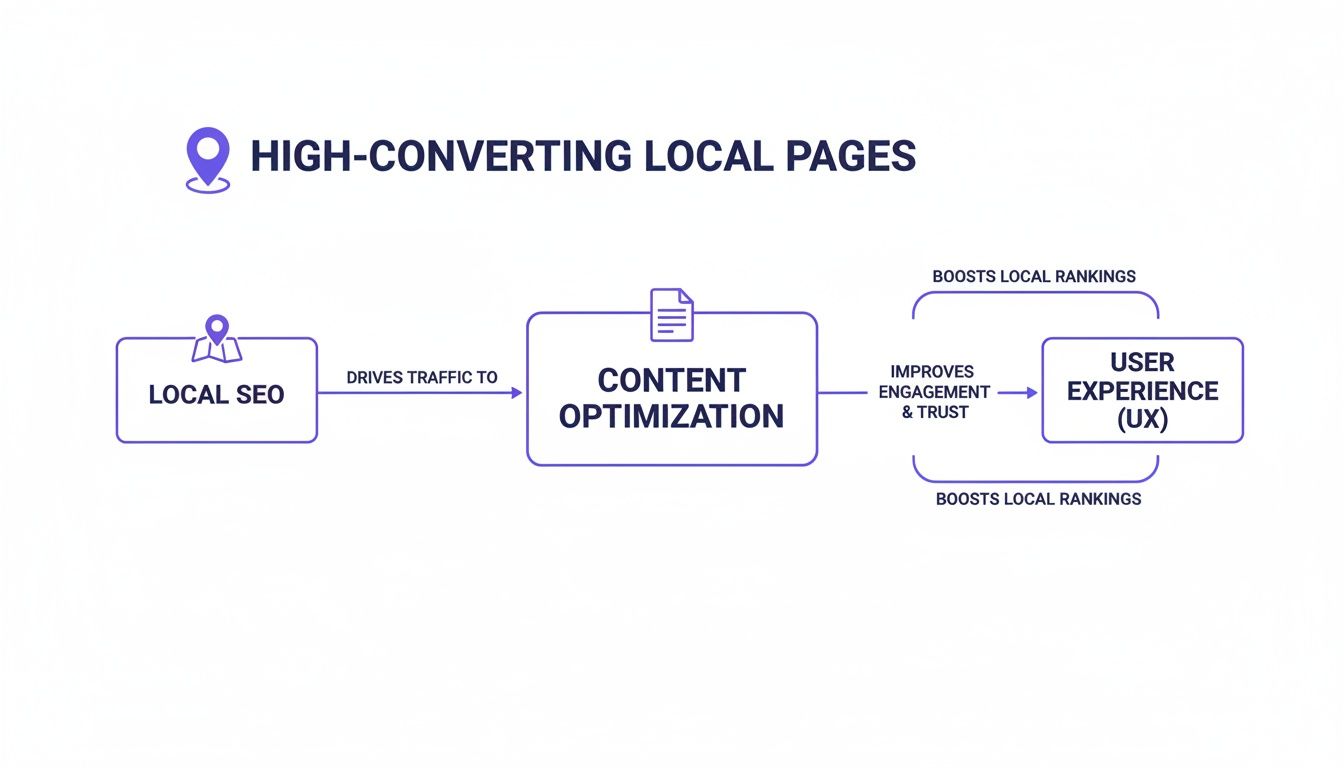
An effective local landing page is not a template with a city name swapped out. It is a carefully constructed asset designed to convert a local searcher into a customer. Each element must reinforce your local authority and build trust. Let's examine the essential components.
Geo-Specific Headlines and Titles
The page title and main headline (H1 tag) are the first elements a user and Google see. They must signal local relevance immediately. A generic headline like "Expert AC Repair" is insufficient.
Changing it to "Expert AC Repair Services in Boulder" immediately confirms to a user in that city that they are in the right place. This simple adjustment reduces bounce rates and builds confidence.
This serves two purposes:
- For the User: It validates their search instantly, positioning you as the logical local choice.
- For Google: It provides a strong ranking signal that perfectly matches your page to the user's location-based query.
Unique and Hyperlocal Content
This is where many businesses fail. They create one piece of content and replicate it across multiple location pages, changing only the city name. This approach offers no genuine value and can be flagged by search engines as thin content.
To differentiate your business, you must demonstrate true local expertise. If you are a plumber in Boulder, write about the specific plumbing challenges of older homes near the Pearl Street Mall. Mention the hard water issues common to the area. This level of detail shows you are an active part of the community, not just a company with a local phone number.
An effective local page feels like it was written for that community because it was. It understands the local landscape and speaks to the specific needs of its residents. We explore this further in our guide on the anatomy of a high-converting local website.
Trust-Building Social Proof
For local businesses, social proof is critical. A potential customer needs to see that their neighbors have hired you and were satisfied with the results. Generic testimonials are adequate, but local testimonials are far more persuasive.
Ensure the social proof you feature is specific to the page's location. This could include:
- Video testimonials from clients in that specific city.
- Reviews that mention a particular neighborhood or landmark.
- Case studies of jobs you completed nearby, complete with photos.
When a visitor sees proof from their own area, the trust barrier diminishes significantly.
Essential Technical Elements
Behind the content and social proof, several technical elements must be in place. These components communicate directly with Google and ensure a seamless user experience.
First, every local page should have an embedded Google Map. It is a simple, visual confirmation of your location or service area.
Second, you must use LocalBusiness schema markup. This is structured data that tells search engines exactly who you are, what you do, and where you operate. This code helps Google display your information correctly in the local pack and other search features.
Finally, your page must have a mobile-first design. The majority of "near me" searches happen on a smartphone. If your page is slow or difficult to navigate on mobile, you have lost the lead. This includes using simple, effective form builders for high-converting landing pages that make it easy for mobile users to contact you.
Connecting Your Pages to the Local SEO Ecosystem
An optimized local landing page is a powerful asset, but it cannot perform in isolation. Many businesses build these pages and then wonder why they remain on the second or third page of search results.
The missing component is integration. Each page must be connected to the broader digital ecosystem to create a web of trust signals that Google recognizes. These connections provide the structural support that tells search engines your business is a legitimate, authoritative player in a specific community. Without them, your pages are like isolated islands, difficult for both search crawlers and customers to find.
Align Your Google Business Profile for Maximum Impact
Your Google Business Profile (GBP) is the cornerstone of your local digital presence. It is often the first interaction a potential customer has with your business, either on Google Maps or in the local search results.
A common mistake is linking a GBP listing to a generic homepage. If a customer in Boulder clicks your website link from your GBP, they should land on your Boulder page, not a general site.
To create this powerful connection:
- Update the Website Link: In your GBP settings for each location, change the primary website URL to the corresponding local landing page.
- Ensure NAP Consistency: Your business Name, Address, and Phone number (NAP) must be identical on your GBP listing and the landing page it links to. Minor variations can confuse search engines.
- Leverage GBP Posts: Use the Posts feature to share location-specific offers or project updates. Always include a link back to the relevant local landing page to drive targeted traffic.
This alignment creates a seamless path for the user and signals strong geographic relevance to Google. You can learn more about the impact of a Google Business Profile on local SEO.
Build Authority with an Internal Linking Strategy
Your website possesses existing authority. An internal linking strategy channels that authority to your new local pages, signaling their importance to Google.
Publishing a new page for "AC Repair in Fort Collins" without linking to it from elsewhere on your site is like building a new room in a house without adding a door.
Identify high-authority pages on your site, such as your homepage or primary service pages, and add relevant, natural links from them to your new local pages. Think of internal links as votes of confidence from within your own website. When an established page links to a new local page, you are telling Google that the new page is important and relevant.
By connecting your local pages to your GBP and implementing a logical internal linking structure, you create a cohesive digital presence that search engines understand and trust. This is what transforms a collection of pages into a powerful, lead-generating network.
How to Scale Your Strategy for Multiple Locations
Expansion into new service areas presents a common marketing challenge. The typical reaction is to copy an existing page, swap the city name, and publish it. While this seems efficient, it is a significant mistake.
This practice creates thin, duplicate content that search engine algorithms are designed to devalue. The result is a collection of pages that fail to rank effectively, undermining your growth efforts.
True scalability requires a system. You need a framework that allows you to produce unique, high-value digital assets for every market you serve. This is the difference between sustainable growth and wasted effort.
Developing a Scalable Content Framework
A content template should provide structure, not encourage shortcuts. The goal is to standardize the layout and core elements of your pages while requiring unique, location-specific details for the most important sections. This systematic approach maintains brand consistency while preventing the copy-paste behavior that harms SEO.
A functional template acts as a blueprint that demands hyperlocal information. This framework ensures every page is distinct and valuable.
Scalable Content Framework for Local Pages
| Page Element | Content Requirement | Example (HVAC in Boulder) |
|---|---|---|
| H1 Title | Must be unique and geo-specific. | "Expert HVAC Repair and Installation in Boulder, CO" |
| Introductory Paragraph | Unique opening addressing a common local problem. | Mentions common issues with older systems in historic Boulder neighborhoods. |
| Local Social Proof | Testimonials or case studies from that specific city. | A video testimonial from a client near Chautauqua Park. |
| Service Descriptions | Unique content describing services in a local context. | Discusses preparing HVAC systems for Boulder's unpredictable weather patterns. |
| Hyperlocal Content | Mention local landmarks, regulations, or community ties. | References a recent project completed near the Pearl Street Mall. |
| Team Section | Photos and bios of technicians who serve that area. | Features the lead technician for the Boulder service area. |
Following a structure like this ensures you are building assets, not just pages. Each one is tailored to its specific audience, providing value to both search engines and potential customers.
Avoiding Keyword Cannibalization
A common side effect of disorganized expansion is keyword cannibalization. This occurs when multiple pages on your own website compete for the same search term.
For example, if you have three generic pages all vaguely targeting "furnace repair in the Denver area," Google becomes confused. It does not know which page is most relevant. As a result, it may not rank any of them well, effectively splitting your authority.
A well-planned local landing page strategy solves this problem by design. Each page is focused on a distinct service and location combination.
Consider this clear structure:
/furnace-repair/denver/furnace-repair/aurora/ac-installation/denver
This hierarchy sends a clear signal to search engines, indicating you have one authoritative page for each specific user need. This gives Google the confidence to rank that page accordingly.
A disciplined, scalable system is about resisting the temptation to take shortcuts. It requires treating each new service area as the unique market it is. Establishing this foundation from the beginning prevents the need to untangle competing pages later and creates a logical site structure that can grow with your business.
Becoming the Logical Choice in Your Service Area

The ultimate goal of local landing pages SEO is to convert clicks into clients. It is the final step where strategy, technical execution, and content converge to make your business the only logical choice for customers in a specific area.
When a potential customer lands on a page that uses local language, mentions their town, understands their problem, and showcases your work in their neighborhood, the decision becomes simple. You are no longer just another search result; you are the local expert who understands their needs. This is how market share is won. We see this principle applied effectively in industries like SEO for real estate, where top agents build their brands by dominating one neighborhood at a time.
This approach is not a short-term tactic. It is about building a sustainable system for predictable, long-term growth. City Web Company works with businesses to implement this architecture, transforming their online presence into a reliable engine for local customer acquisition.
Local Landing Page FAQs
When implementing a local landing page strategy, several practical questions often arise. Understanding the core principles provides clarity and reveals the power of this targeted approach.
Here are answers to some of the most common questions from business owners.
How Many Local Landing Pages Do I Need?
The answer should align directly with your business structure and service areas.
The most effective rule is to create one unique page for each distinct service you offer in each primary city you target. This is the foundation of a local SEO strategy that produces results.
For an HVAC company targeting both Denver and Aurora, a winning strategy requires separate, dedicated pages for "AC Repair Denver," "Furnace Installation Denver," "AC Repair Aurora," and "Furnace Installation Aurora." This approach maximizes relevance for each specific search query and prevents your own pages from competing against each other.
Is It Okay to Just Change the City Name on Each Page?
No. This is a critical mistake that will cost you in the long run.
Copying a page and simply swapping the city name creates what Google identifies as "thin" or duplicate content. This is a negative signal for search engines and can harm your entire website's authority.
Using a consistent template for structure is an efficient practice. However, the core content of the page must be unique. Each page needs to offer distinct value to a user in that specific location. Its service descriptions, customer testimonials, project examples, and local references should be specific to that market. This demonstrates genuine authority and provides a better user experience, which is what search engines are designed to reward.
How Is a Landing Page Different From a Google Business Profile?
This is an excellent question. The two are not competitors; they are essential components of the same team, each with a specific function.
Your Google Business Profile (GBP) is your digital summary. It is designed to get your business seen in the Google Maps Local Pack and attract initial attention.
Your local landing page is the destination where that traffic is sent. This is where you control the narrative. The landing page allows you to provide rich detail, build trust with case studies and reviews, and guide a visitor toward a clear action, such as calling your office or scheduling service. Linking your GBP listing directly to its corresponding local landing page is an essential part of a successful local SEO strategy.
A well-executed local landing page strategy is the foundation of predictable growth. The team at City Web Company specializes in building the digital architecture that turns local searchers into loyal customers. If you are ready to establish your business as the clear choice in your service areas, we can help. Schedule a strategic discovery call with us today.
These articles were popular with other readers too: