
Learn why social media ads matter for local service businesses and how to use them to drive real calls, bookings, and growth with smarter strategies.
Lead Generation for Local Services: 7 Proven Tactics
TL;DR:
- Consistent lead generation relies on a proven, repeatable system including Google profiles, reviews, and SEO.
- Blending organic SEO with paid ads like Google Local Services Ads ensures reliable, long-term growth.
- Tracking tools and quick response times are essential to optimize lead conversion and improve rankings.
Every local service business owner knows the gut-drop feeling when the phone goes quiet for three days straight. You did great work last month, referrals were rolling in, and then nothing. That feast-or-famine cycle is not bad luck. It is a system problem. The good news is that lead generation does not have to feel like gambling. Research-backed strategies used by the fastest-growing plumbers, HVAC companies, pest control operators, and restoration firms show that consistent leads come from a repeatable process, not random effort. This guide walks you through every layer of that process, from foundational setup to paid ads to measurement, so you can build a lead engine that runs whether you are on a job site or sleeping.
Table of Contents
Table of Contents
- Get ready: The proven lead generation toolkit
- Step-by-step: Optimizing Google Business Profile for more leads
- Organic lead generation: Winning with local SEO and content
- Paid leads: Google Local Services Ads and scaling fast
- Measuring and improving lead generation: Tools and playbook
- A fresh perspective: Why blending organic and paid is the local lead growth secret
- Get expert help: Done-for-you lead generation for local services
- Frequently asked questions
Key Takeaways
| Point | Details |
|---|---|
| Optimize GBP for trust | A well-optimized Google Business Profile multiplies leads by boosting visibility and credibility in search results. |
| Balance organic and paid | Mixing local SEO with paid Local Services Ads delivers steady, scalable leads from both quick wins and long-term growth. |
| Track, review, improve | Consistent tracking of leads and reviews lets you refine your system and respond to market changes fast. |
| Speed matters | Responding to leads within one hour dramatically raises your chances of winning new customers. |
Get ready: The proven lead generation toolkit
Before you spend a dollar or an hour on lead generation tactics, you need the right foundation. Skipping this step is like painting a house with rotten siding. The work looks good for a week, then falls apart.
Here is what your foundation needs to include:
- NAP consistency: Your business name, address, and phone number must match exactly across every platform. Google cross-checks these signals. Mismatches hurt your local ranking.
- Google Business Profile (GBP) setup: Claim and verify your profile, then select the most accurate primary and secondary categories. This directly controls which searches you appear in.
- High-quality photos: Upload at least 100 photos of your team, vehicles, completed jobs, and your office or service area. Profiles with photos get 520% more calls and 2,717% more direction requests. Optimized GBP profiles also see 42% more direction requests and 35% more website clicks.
- Review collection system: Set up an automated text or email asking customers for a Google review within 24 hours of job completion.
- Service pages on your website: Each core service and each city or neighborhood you serve should have its own dedicated page.
- Budget and access for paid campaigns: If you plan to run Google Local Services Ads, get your license and insurance documents ready for verification.
- Customer FAQ list: Collect the 10 questions your team gets asked most often. These feed your GBP Q&A section and website content.
Pro Tip: Adding photos and collecting reviews are the two highest-leverage moves you can make in the first 30 days. They cost almost nothing and compound fast. Google Business Profile optimization is the single best free investment a local service business can make.
Also confirm that your business is listed in the major local business citations directories like Yelp, Angi, and the Better Business Bureau. Consistent citations across the web reinforce your credibility with Google.
| Asset | Tool or platform | Priority |
|---|---|---|
| GBP profile | Google Business | Must-have |
| NAP consistency | Moz Local, BrightLocal | Must-have |
| Review automation | NiceJob, Podium | High |
| Call tracking | CallRail | High |
| Service pages | Your website CMS | Must-have |
| Photo library | Google Photos, GBP | Must-have |
Step-by-step: Optimizing Google Business Profile for more leads
Your Google Business Profile is the single most visible piece of digital real estate you own. It shows up in the map pack, in Google Search, and increasingly in AI-powered answer results. Getting it right is not optional.
Here is the exact sequence to follow:
- Claim and verify your profile. Go to Google Business Profile Manager, find your listing, and complete phone or postcard verification.
- Confirm your NAP. Double-check that your name, address, and phone number are identical to what appears on your website and every directory.
- Select your primary and secondary categories. Be specific. “Plumber” is better than “Contractor.” Add secondary categories like “Drainage service” or “Water heater repair” to capture more search types.
- Write your business description. Use 750 characters. Lead with what you do, who you serve, and what makes you different. Include your city and core services naturally.
- Upload 100 or more photos. Cover your team, trucks, before-and-after work, and your service area. GBP photos drive 520% more calls and 2,717% more direction requests compared to profiles without them.
- Add your full services menu. List every service with a short description and price range if possible. This feeds Google’s understanding of what you offer.
- Enable messaging. Turn on the GBP chat feature and commit to responding within one hour. Speed signals trust.
- Post weekly updates. Share offers, completed projects, seasonal tips, or team news. Posts keep your profile fresh and signal activity to Google.
- Manage reviews actively. Respond to every review, positive or negative, within 48 hours. Businesses with at least 10 to 20 reviews and a 4.2-star rating see measurably higher conversion rates.
- Populate the Q&A section. Add the questions your customers ask most, along with clear answers. This reduces friction and pre-qualifies callers.
Pro Tip: If you run a service-area business without a physical storefront, hide your address in GBP settings and instead list the zip codes or cities you serve. This prevents confusion and keeps your profile compliant.
Understanding the impact of GBP on local SEO helps you prioritize which updates to make first. For businesses ready to go deeper, professional GBP optimization services can accelerate results significantly.
Organic lead generation: Winning with local SEO and content
Optimizing your GBP is essential, but your website and organic presence multiply results. Here is how SEO and content marketing fit into your lead engine.
When someone types “water damage restoration near me” or “AC repair in Phoenix,” they are ready to hire. These are high-intent searches, and 76% of local mobile searches result in a business visit within 24 hours, with 28% leading to a purchase. Capturing that traffic requires a website structured for local intent.
Here is how to build that structure:
- Create one page per service per city. A page titled “Drain cleaning in Columbus, Ohio” will outrank a generic “Services” page every time for that specific search.
- Write FAQ content. Answer the questions your customers actually ask. Google rewards pages that directly answer search queries.
- Add blog posts around seasonal or local topics. A post about “what to do after a basement flood in Chicago” attracts homeowners at the exact moment they need help.
- Build citations in local directories. Consistent listings across Yelp, Angi, HomeAdvisor, and niche directories reinforce your authority.
- Earn local backlinks. Sponsor a community event, partner with a complementary business, or get featured in a local news story.
“Organic SEO builds compounding trust over months. Paid ads deliver leads this week. The smartest operators run both.”
Understanding the difference between local versus traditional SEO helps you allocate time and budget more effectively.
| Factor | Local SEO | Paid ads |
|---|---|---|
| Time to first lead | 3 to 6 months | Same day |
| Cost per lead | Low (long-term) | Higher (immediate) |
| Lead quality | Very high intent | High intent |
| Ongoing cost | Low after setup | Continuous spend |
| Trust signal | Strong | Moderate |
Paid leads: Google Local Services Ads and scaling fast
If you need leads now, paid ads deliver. Here is how to use Google Local Services Ads for reliable volume.
Google Local Services Ads (LSA) appear above everything else in search results, including organic listings and standard Google Ads. They show your business name, rating, review count, and a “Google Guaranteed” or “Google Screened” badge. You pay only when a customer contacts you directly through the ad, not per click.

The economics are compelling. LSA delivers a blended cost per lead of around $53, a 44% booking rate, and a return on ad spend of 7.84x across service industries. Emergency services like water damage or locksmithing often see higher costs per lead, but also higher job values.
Here is how to get started:
- Sign up at the Google Local Services Ads portal. Select your business category and service area.
- Complete verification. Upload your license, insurance, and background check documentation. This earns the Google Guaranteed badge.
- Build your LSA profile. Add photos, services, hours, and a strong business description.
- Set your weekly budget. Start conservatively, around $200 to $500 per week, and scale based on booked jobs.
- Focus on reviews. LSA rankings are heavily influenced by your Google review count and rating. More reviews equal lower cost per lead.
- Respond to every lead within one hour. LSA tracks your response rate and penalizes slow responders with lower placement.
Pro Tip: Dispute invalid leads directly in the LSA dashboard. Google will credit you for calls that were wrong numbers, spam, or outside your service area. This alone can reduce your effective cost per lead by 10 to 20%.
For a deeper look at the mechanics, the LSA guide covers setup and optimization in detail. If you want to layer in standard Google Ads alongside LSA, understanding advertising locally on Google is the right starting point. And if you are weighing whether paid search is worth the investment, the case for Google Ads for local services is clear when you see the ROAS data.
Avoid buying leads from third-party aggregators. The quality is inconsistent, you share those leads with competitors, and tracking ROI is nearly impossible.
| LSA metric | Benchmark |
|—|—|—|
| Blended cost per lead | ~$53 |
| Booking rate | 44% |
| Return on ad spend | 7.84x |
| Ideal response time | Under 1 hour |
Measuring and improving lead generation: Tools and playbook
To build a lead machine, you need to track what is working and refine your process continuously. Here is how to measure and improve over time.
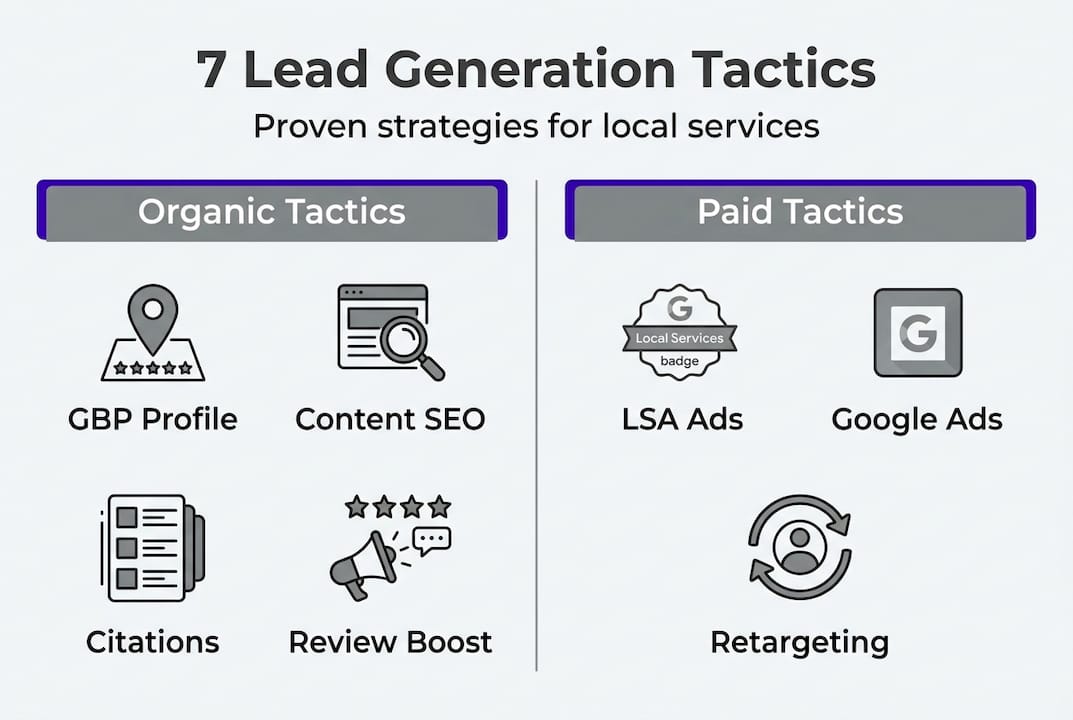
Without tracking, you are guessing. And guessing is expensive. The businesses that grow fastest are the ones that know exactly where each lead came from, what it cost, and whether it turned into a paying job.
Start with these tracking tools:
- Call tracking software like CallRail assigns unique phone numbers to each marketing channel, so you know whether a call came from your GBP, your website, or a paid ad.
- Form tracking in Google Analytics 4 records every time someone submits a contact or quote request form.
- Review dashboards in platforms like BrightLocal or Podium show your review velocity across Google, Yelp, and Facebook in one place.
- UTM parameters on all paid ad links let you trace website sessions back to specific campaigns.
Once tracking is in place, monitor these improvement levers regularly:
- Faster lead response times (under one hour is the standard)
- Review growth rate (aim for at least two to four new reviews per month)
- Website page speed and mobile usability
- GBP post frequency and engagement
- FAQ content additions based on new customer questions
- Landing page conversion rate testing
“AI is now optimizing local service rankings, and lead speed and review volume play increasing roles in which businesses get surfaced first.”
This means the basics, responding fast and collecting reviews, are no longer just good practice. They are ranking signals. Businesses that treat speed and reputation as marketing investments will outperform those that treat them as afterthoughts.
For paid campaigns specifically, resources on improving Google Ads ROI and how to optimize Google Ads for local leads give you the tactical playbook to squeeze more from every dollar. Test one change at a time. Measure for two to four weeks. Then decide whether to keep, scale, or cut.
A fresh perspective: Why blending organic and paid is the local lead growth secret
Here is the conventional wisdom you will hear from most marketing blogs: if you have a tight budget, do SEO because it is free. If you need leads fast, run ads. Pick one and go all in.
We disagree, and a decade-plus of working with local service businesses backs that up.
Businesses that rely entirely on organic SEO are one algorithm update away from a revenue crisis. We have seen it happen. A company spends 18 months building rankings, then Google shifts its local pack criteria, and their call volume drops 40% in a week. Organic is powerful, but it is fragile when it is your only source.
On the flip side, businesses that run only paid ads are on a treadmill. The moment they pause spending, leads stop. There is no compounding asset, no long-term equity, no trust built with the market.
The companies that grow fastest and most sustainably use both. Paid ads provide immediate traction while organic SEO builds the foundation. Over time, as organic rankings improve, the cost per lead from paid drops because the brand is already familiar. Customers who see your LSA ad and then find your website ranking organically convert at a higher rate because the double exposure signals credibility.
The marketing strategies for local business that produce the best long-term results always involve this kind of layered, diversified approach. It is not about choosing a lane. It is about building a system where each channel reinforces the others.
Get expert help: Done-for-you lead generation for local services
Implementing everything in this guide takes time, expertise, and consistent effort. If you are running a service business, your hours are already spoken for.
City Web Company builds and manages complete lead generation systems for local service businesses, covering digital marketing for local leads, local SEO services, and full GBP optimization services. Whether you need your Google Business Profile dialed in, your website ranking for “near me” searches, or a paid ad campaign that actually converts, the team handles execution from start to finish. You focus on delivering great service. We focus on making sure your phone keeps ringing. Reach out today to find out which package fits your business goals and budget.
Frequently asked questions
What is the fastest way to generate leads for my local service business?
Launching Google Local Services Ads is typically the quickest way to turn on a stream of qualified leads. LSA delivers leads above organic results at a predictable cost per lead, often within the first 24 to 48 hours of going live.
How many reviews should my Google Business Profile have to attract more leads?
Aim for at least 10 to 20 reviews with a rating above 4.2 stars. Research shows that 10 to 20 reviews at a 4.2-star rating or higher meaningfully boost customer actions like calls and direction requests.
Is it better to focus on paid ads or organic SEO for lead generation?
Blend both for sustainable growth. Combining organic and paid generates more reliable results than either channel alone, with paid providing immediate leads and SEO building long-term trust.
How can I track if my lead generation efforts are working?
Use call tracking, form tracking, and review dashboards to monitor every inquiry. Tracking tools let you identify which sources and campaigns produce paying customers so you can invest more where it works.
What is the importance of speed-to-lead in local service lead generation?
Responding within one hour dramatically increases your chances of booking the job. Speed-to-lead under one hour is now a critical factor in both conversion rates and AI-driven local ranking systems.
Recommended
These articles were popular with other readers too: