

Test CTV ads for one month on $1,500–$3,500. Follow an 8 step plan for local service businesses: geo targeting, tracking branded search lift.
Book Jobs in 30 Days: Emergency First Restoration Company Marketing
Prioritize five things in this order: Local Service Ads, Google Business Profile and map-pack presence, tightly geo-targeted emergency PPC, a structured referral pipeline with adjusters and property managers, and a website built to convert a panicked phone call. Restoration is an emergency-intent, high-ticket category, so the businesses winning share right now spend where buyers are already searching in the moment, then use referrals to smooth out the slow months. Budget orientation shifts with revenue, but the sequence above rarely changes.
TL;DR:
- Local Service Ads typically provide the lowest cost per qualified customer, with a 1-2 week setup time and a pay-per-lead model that boosts ROI.
- Optimization of Google Business Profiles and map-pack signals can take four to six weeks but greatly enhances organic visibility and reduces reliance on paid channels over time.
- Emergency PPC campaigns, launched within a week, fill gaps left by LSAs and target high-intent keywords with geo-targeted bids and negative keyword filtering.
- Building a structured referral program and establishing commercial outreach can generate steady revenue within 60 to 180 days, especially when tracking and follow-up are rigorous.
- Budget allocation should shift with revenue size, emphasizing emergency channels early on and increasing focus on referral and commercial pipelines as the business grows past $1 million.
Table of Contents
Table of Contents
- What Should Restoration Companies Prioritize in Their Marketing?
- Prioritized Channel Roadmap: What to Start First and Why
- Optimize Google Business Profile, Map-Pack Signals, and City Landing Pages
- Paid Response Channels: Local Service Ads, Emergency PPC, and Paid Lead Sources
- Programmatic Referrals and Building a Preferred-Vendor Commercial Pipeline
- Website and Phone-Flow Tactics to Convert Emergency and Referral Leads
- Long-Form Content, Case Studies, and Reputation Management
- Core KPIs, Dashboard Metrics, and Budget Allocation Examples
- Publisher EEAT: Short Case Examples and Author Proof Points
- 30/60/90-Day Execution Checklist
- Agency Perspective: Trade-Offs, Common Mistakes, and Realistic Expectations
- How City Web Company Can Help You Execute This Plan
- Sources
- FAQ
What Should Restoration Companies Prioritize in Their Marketing?
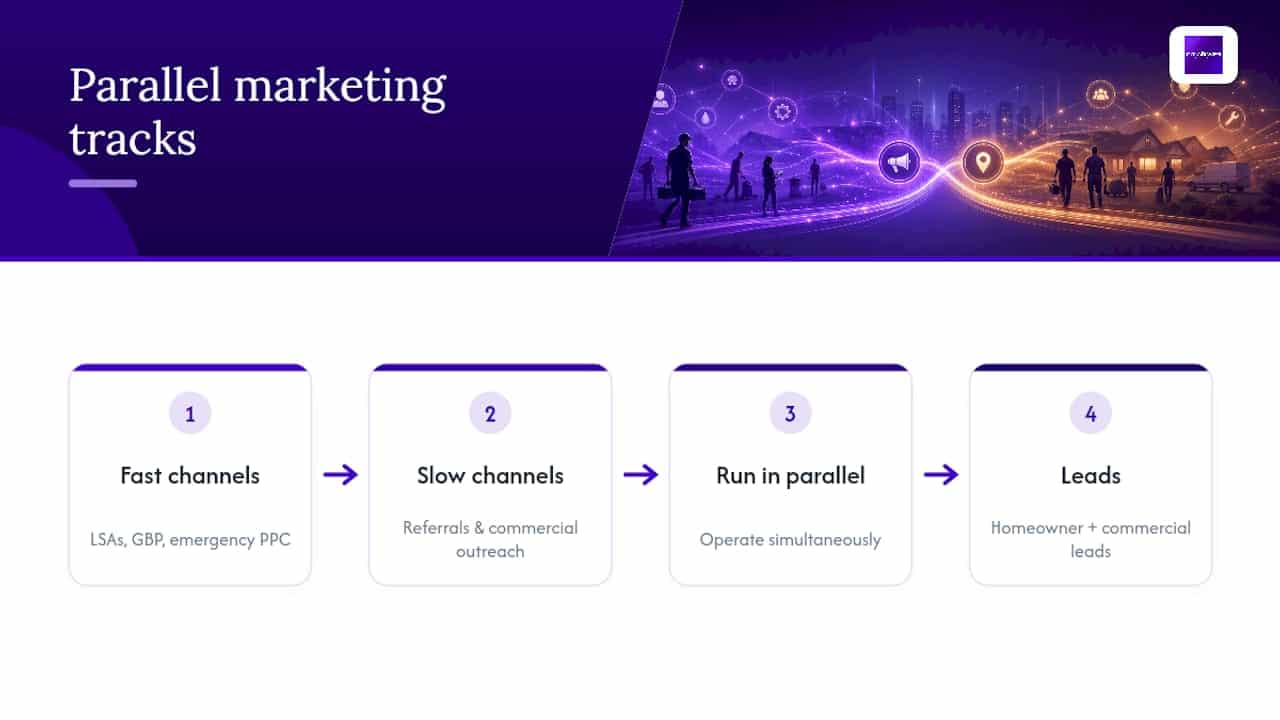
Restoration company marketing works differently than most local service categories because two buyer types show up at once: a homeowner with a burst pipe who needs help in the next hour, and an insurance adjuster or property manager who needs a vetted vendor on retainer. Winning both means running two campaigns in parallel instead of one generic local marketing plan.
The homeowner path is almost entirely search driven. People turn to online search for local businesses at a very high rate, which is exactly why Google Business Profile and the map pack carry so much weight for a plumber, a roofer, or a water damage restoration company fielding a 2 a.m. call. The commercial path runs on relationships built over months, not on clicks.
That split explains why the recommended mix leans hard into three fast-response channels (LSAs, GBP, emergency PPC) while running referral and commercial outreach as a parallel, slower-burn track. A multi-channel approach that blends referrals, local SEO, PPC, and reviews is the foundation most restoration marketers eventually land on, whether they start there or arrive after wasting a year on one channel.
Prioritized Channel Roadmap: What to Start First and Why
Start with the channels that generate revenue inside 30 days, then layer in the ones that compound over a year. Here is the order that tends to produce the fastest payback for restoration companies specifically:
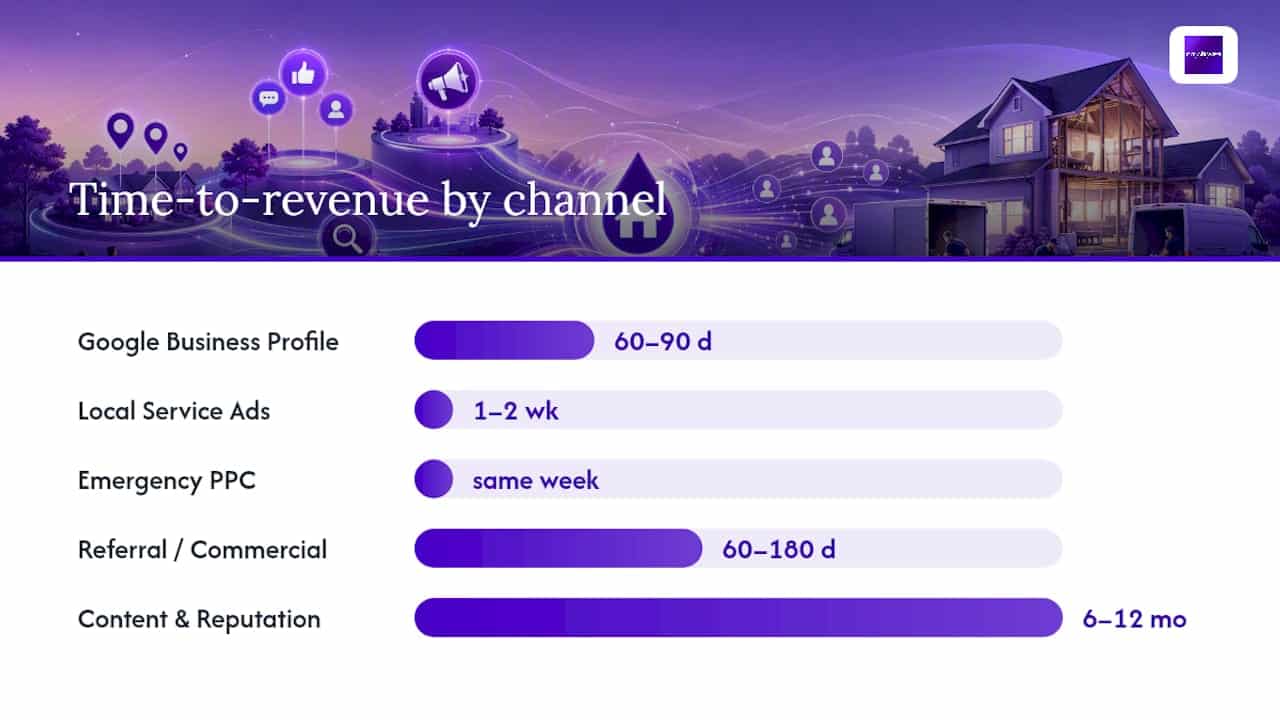
- Google Business Profile and map-pack optimization (weeks 1 to 4 to launch, 60 to 90 days to see ranking movement): the cheapest channel to start and the one that touches every other channel’s conversion rate.
- Local Service Ads (1 to 2 weeks for verification, immediate lead flow once live): the single best fit for emergency-intent searches because it charges per lead, not per click.
- Emergency PPC on Google Search (live same week, optimization ongoing): fills the gaps LSAs don’t cover and lets you target specific damage types and zip codes.
- Referral and commercial pipeline (60 to 180 days to first signed account): slower to build, but it produces the steadiest revenue once it’s running.
- Website conversion fixes and call tracking (2 to 4 weeks): a force multiplier for every dollar spent on the four channels above.
- Content and reputation management (ongoing, compounding over 6 to 12 months): builds the trust layer that lowers cost per lead across every paid channel.
Budget allocation should track revenue stage. A company above $5 million usually flips that ratio, putting more into referral programs, commercial outreach, and brand content since the emergency channels are already near capacity.
Statistic to plan around: Local Service Ads and disciplined emergency PPC setups typically deliver the lowest cost per acquired customer for restoration work in most U.S. markets, which is why they sit at the top of this roadmap rather than commercial outreach or content.
Storm season changes the math. When a hurricane, hailstorm, or major flood event hits a region, LSA and PPC bids spike along with demand, and GBP visibility becomes even more valuable because searches surge faster than paid budgets can scale. Building a standing storm-response budget, even a small one held in reserve, lets a company flip on extra spend within hours instead of days.

Optimize Google Business Profile, Map-Pack Signals, and City Landing Pages
Google Business Profile is the single highest-leverage asset a restoration company owns, and most companies leave half its features unused. Optimizing categories, services, photos, and posts is the baseline; the companies that actually rank consistently in the map pack go further.
- Verify and lock down the primary category as “Water Damage Restoration Service” or the closest match, then add every relevant secondary category (mold remediation, fire damage restoration, biohazard cleanup).
- List every service explicitly inside the Services tab rather than relying on the business description alone. Google’s own guidance on Google Business Profile confirms services listed here feed directly into how the profile matches search queries.
- Upload fresh photos monthly, including crew photos, equipment, and before/after job shots, not just a logo and storefront.
- Post weekly, even something as simple as a completed job or a seasonal reminder about frozen pipes or basement flooding risk.
- Turn on messaging and respond within minutes, since response time on GBP messaging is a ranking and conversion factor most competitors ignore.
- Complete verification through official channels, following the GBP verification and category support documentation closely, since a stalled verification can freeze a profile out of the map pack entirely.
Service-area landing pages matter almost as much as the profile itself. A restoration company serving eight cities in a metro area needs eight distinct landing pages, each with unique content covering that city’s common damage causes, response time claims, and local landmarks or neighborhoods, wrapped in LocalBusiness schema markup. A single generic “service area” page listing eight city names in a paragraph will not rank for any of them.
Pro Tip: Set a review velocity target of at least 4 to 6 new Google reviews per month per location, and respond to every single one, positive or negative, within 24 hours. Map-pack ranking algorithms reward profiles with steady review velocity over profiles that got 40 reviews once and then went quiet.
GBP is a compounding asset. A profile that’s fully built out and consistently active in month one usually doesn’t outrank established competitors until month four or five, but once it does, that ranking holds with far less ongoing spend than paid channels require. It’s also worth setting up Bing Places alongside GBP, since it broadens visibility on Microsoft’s search and map surfaces at essentially zero incremental cost.
Paid Response Channels: Local Service Ads, Emergency PPC, and Paid Lead Sources
Local Service Ads should be the first paid channel a restoration company turns on, not the last. LSAs typically run between $35 and $85 per lead in most U.S. markets, and because restoration jobs regularly run into the thousands of dollars, that cost per lead converts into strong ROI even at a modest close rate.
Getting an LSA account live requires clearing Google’s background check and licensing verification, known as the Google Guarantee. That process needs a valid business license, proof of insurance, and background checks on any employee who enters a customer’s home, so start the paperwork weeks before you expect to need the leads.
- Gather licensing, insurance certificates, and employee background-check consent forms before applying, since incomplete documentation is the most common reason approval stalls.
- Set service radius and job-type filters conservatively at first, then widen once you see which zip codes and damage types produce the best close rates.
- Respond to every LSA lead within five minutes if possible, since Google’s own lead-response tracking affects how often your listing gets shown.
Emergency PPC on Google Search fills in around LSAs. Use phrase and exact match types for high-intent terms like “emergency water extraction near me,” layer in zip-code level geo-targeting instead of a blanket metro radius, and add call extensions so mobile searchers can tap to call without ever landing on a webpage. Negative keywords matter more here than in almost any other category: exclude terms like “jobs,” “training,” “DIY,” and “certification course” aggressively, since restoration searches attract a surprising volume of job-seekers and hobbyists.
Statistic to weigh: Local Service Ads convert well specifically because they’re built for emergency, high-ticket categories where buyers want a vetted, insured provider fast rather than the cheapest bid, which is a different buying psychology than most PPC categories are optimized for.
Third-party pay-per-lead vendors are worth evaluating carefully. Shared leads, where the same job gets sold to three or four competitors simultaneously, tend to produce lower close rates than exclusive leads, even when the shared lead costs less upfront. Run the math on cost per job closed, not cost per lead, before committing budget to any vendor.
Programmatic Referrals and Building a Preferred-Vendor Commercial Pipeline
Referral revenue rarely happens by accident.
- Design a structured referral program with a clear incentive (a set dollar credit, a gift card, or a recurring discount) for plumbers, real estate agents, and property managers who send business, and put the terms in writing.
- Create co-branded referral collateral, business cards or one-page leave-behinds a plumber can hand a customer on the spot, since a verbal recommendation converts far better with something tangible attached.
- Build a target list of commercial accounts including property management companies, insurance agencies, and apartment complexes, and rank them by unit count or claim volume.
- Prepare a short capabilities deck and a facility audit offer, since property managers respond better to a free assessment of their buildings’ flood or fire risk than to a cold sales pitch.
- Follow up on a fixed schedule, not sporadically. Quarterly check-ins with signed commercial accounts and monthly touches with prospects tend to outperform ad-hoc outreach by a wide margin.
- Track every referral source in your CRM down to the individual contact, so you know which property manager or which plumbing partner is actually worth the lunch and the gift card.
A multi-channel strategy that includes referrals and networking alongside paid search consistently outperforms companies relying on a single lead source. Referral and commercial revenue also tends to be less price-sensitive than emergency search traffic, since a property manager choosing a preferred vendor cares more about reliability than about being the lowest bid.
Website and Phone-Flow Tactics to Convert Emergency and Referral Leads
A restoration website has one job during an emergency visit: get the visitor to call in under ten seconds. Everything else is secondary.
- Put a large, tap-to-call phone number in the header on every single page, styled so it’s unmistakable on mobile, where most emergency searches happen.
- Build a dedicated landing page for each core service (water, fire, mold, biohazard) with a clear CTA above the fold, not a single generic “services” page listing everything.
- Add a separate commercial page targeting property managers and insurance adjusters, with different copy and a different CTA (a consultation request, not an emergency call button).
- Set up call tracking with dynamic number insertion so every channel, LSA, PPC, organic, referral, gets its own trackable number feeding into one dashboard.
- Route emergency calls through a script that qualifies the situation in under 60 seconds: type of damage, property size, insurance status, and timeline, before dispatching.
- Display trust signals prominently: licensing and certification badges, insurance information, and two or three short before/after case examples with real photos.
Pro Tip: Test your own website’s mobile call button on a phone with one hand while distracted, the way a homeowner standing in an inch of water actually will. If it takes more than two taps to reach a real person, you’re losing jobs to a competitor with a cleaner mobile flow.
Call routing deserves as much attention as the ads driving the calls. A missed call after hours should trigger an immediate text-back with a callback promise, and any call that goes to voicemail during business hours should be treated as a lost job until proven otherwise.
Long-Form Content, Case Studies, and Reputation Management
Not every restoration lead comes in through an emergency search. Some property owners research before disaster strikes, or spend a day comparing vendors after the initial panic passes, and that research-stage traffic responds to different content than an emergency landing page.
- Publish pillar content on topics like “What to do in the first 24 hours after water damage” at 1,500 words or more, written for a homeowner making decisions under stress, not for search engines.
- Build individual before/after case studies for major jobs, with photos, a short project timeline, and the type of damage handled, since these pages do double duty as trust signals and as long-tail SEO content.
- Create dedicated commercial capability pages covering multi-unit and large-loss experience, aimed squarely at property managers and adjusters doing vendor research.
- Automate review requests through a text or email flow triggered the day a job closes, when satisfaction is highest and the request feels timely rather than random.
- Prepare a short, calm response template for negative reviews that acknowledges the issue, states a resolution step, and takes the conversation offline, since a well-handled bad review often reads better to prospects than a suspiciously perfect five-star record.
Review management deserves a real process, not occasional attention. A structured approach to online reputation management that includes monitoring, response templates, and solicitation timing consistently outperforms companies that only react when something goes wrong.
Core KPIs, Dashboard Metrics, and Budget Allocation Examples
Three numbers matter more than any others in restoration marketing: cost per qualified lead, lead-to-job conversion rate, and average ticket by source. Track them by channel, not just in aggregate, since a channel with a higher cost per lead but a much higher close rate can easily outperform a cheaper channel on a per-job basis.
- Cost per qualified lead: total channel spend divided by leads that meet basic job criteria (real damage, in service area, not a job-seeker or spam call).
- Lead-to-job conversion rate: qualified leads divided by signed jobs, tracked separately for emergency and commercial sources since they convert very differently.
- Average ticket by source: referral and commercial jobs often run larger than emergency search jobs, which changes how you should value a “cheap” lead source.
- Run a 90-day lead-source audit at least twice a year, pulling every lead by channel into one spreadsheet with cost, close outcome, and job value, then calculate true ROI per channel instead of relying on platform-reported conversions alone.
Statistic to anchor budgets against: the U.S. damage restoration services industry includes thousands of active businesses tracked by IBISWorld, which underscores why differentiated positioning and a real measurement discipline matter more than simply outspending local competitors.
Sample budget allocations by revenue stage:
- Under $1 million: a significant portion to LSAs, GBP, and emergency PPC combined; a smaller portion to website and call tracking; and another part to early referral outreach.
- $1 million to $5 million: a notable share to emergency paid channels; portions to referral and commercial development, content and reputation, and testing new channels.
- Over $5 million: roughly 30% to emergency paid channels, which are likely near capacity; 35% to commercial pipeline and referral programs; 25% to brand content and reputation; 10% to expansion testing in new service areas.
Publisher EEAT: Short Case Examples and Author Proof Points
Two anonymized examples illustrate how this roadmap plays out in practice. A regional water damage restoration company rebuilt its Google Business Profile from a half-completed listing into a fully optimized one, category-matched, service-tagged, and posting weekly, while simultaneously launching Local Service Ads. Within a few months, its map-pack visibility across its core service cities improved measurably, and its cost per qualified lead from paid channels dropped as GBP began carrying more of the organic load.
A second example involved a multi-location restoration company that layered a structured commercial outreach program on top of its existing emergency channels. By building a target list of property managers and insurance agencies and following up on a fixed quarterly schedule, the company added a steadier revenue stream that didn’t fluctuate with storm season the way its emergency leads did.
Restoration companies that treat emergency search and commercial referrals as two separate campaigns, each with its own budget, content, and follow-up cadence, consistently outperform companies running one blended strategy for both buyer types.
This article was written by Matt, drawing on hands-on restoration and home-services marketing work across Google Business Profile optimization, Local Service Ads management, and website conversion strategy for local service businesses.
30/60/90-Day Execution Checklist
Use this sequence as a working plan, not a rigid script. Adjust timing to your market’s storm season and current marketing maturity.
- Days 1 to 30: fully optimize Google Business Profile (categories, services, photos, posts), install call tracking on every marketing channel, and start the Local Service Ads application and document-gathering process.
- Days 31 to 60: fine-tune PPC campaigns based on early conversion data, launch structured referral outreach to a first batch of commercial targets, and publish one pillar content piece.
- Days 61 to 90: run a full 90-day lead-source audit, reallocate budget toward the channels showing the strongest cost per qualified lead, and deepen commercial outreach with a second wave of target accounts.
| Timeframe | Primary focus | Success signal |
|---|---|---|
| Days 1 to 30 | GBP optimization, call tracking, LSA application | LSA account approved and live |
| Days 31 to 60 | PPC refinement, referral launch, first pillar content | First referral leads and improved PPC conversion rate |
| Days 61 to 90 | Lead audit, budget reallocation, expanded commercial outreach | Clear cost-per-qualified-lead figure by channel |
Agency Perspective: Trade-Offs, Common Mistakes, and Realistic Expectations
The biggest mistake restoration owners make is chasing one channel to the exclusion of the others, usually whichever one worked once. LSAs feel great until the market gets more competitive and cost per lead climbs, which is exactly why referral and commercial pipelines matter even when paid channels are performing well.
Build in-house once you have the volume to justify a dedicated marketing hire, roughly $2 million and up in most cases. Below that, an agency’s ability to run GBP, LSAs, and PPC simultaneously usually beats a generalist owner splitting attention across five channels. Expect real GBP and map-pack movement in three to five months, not three weeks. Paid channels move faster, but they also cost more per job until the organic layer catches up.
— Matt
How City Web Company Can Help You Execute This Plan
Some digital marketing agencies offer coordinated services including Google Business Profile optimization, paid media management, and conversion-focused website design under a single plan.

A typical engagement starts with a full audit of your current GBP profile, existing paid campaigns, and website conversion flow, then moves into the same 30/60/90 sequence outlined above: GBP and call tracking first, paid channel refinement next, referral and commercial support layered in as the foundation solidifies. Restoration companies working with City Web Company get Google Business Profile optimization built specifically around service-area landing pages and category structure, paired with paid media management tuned for emergency-intent keywords rather than generic local search terms.
If you’re weighing whether to invest in local SEO or keep spending purely on paid ads, this breakdown of local SEO versus traditional SEO walks through which approach grows a service business faster and why the two aren’t mutually exclusive. Start with a conversation about your current lead sources and where the gaps are at City Web Company’s get-started page.
Sources
- Marketing for Restoration Companies: Visibility Strategies — Docusketch
- Restoration Marketing Strategies for Your Company — NextGear Solutions
- Restoration Marketing: The Complete 2026 Strategy Guide — Tygart Media
FAQ
What Is Restoration Company Marketing?
Restoration company marketing is the set of channels and tactics, including Google Business Profile optimization, Local Service Ads, emergency PPC, referral programs, and commercial outreach, that restoration businesses use to capture both urgent homeowner demand and steady commercial contracts.
What Is the 70/20/10 Rule in Marketing?
The 70/20/10 rule allocates roughly 70% of marketing budget to proven channels that reliably generate leads, 20% to channels with a track record elsewhere that are new to your business, and 10% to experimental tactics.
How Do Restoration Companies Make Money?
Restoration companies earn revenue primarily from insurance-covered emergency jobs (water, fire, mold, and biohazard cleanup) billed at high average tickets, supplemented by commercial contracts with property managers and preferred-vendor agreements with insurance carriers.
What’s Working Best in Restoration Marketing Right Now?
Local Service Ads combined with a fully optimized Google Business Profile currently produce the strongest cost per qualified lead for emergency restoration work in most U.S. markets, while structured referral programs remain the most reliable way to build steady, less price-sensitive revenue.
Recommended
These articles were popular with other readers too: