

A conversion first playbook for movers: instant quotes, visible reviews, and instant lead routing. Get a booking ready site in 4–8 weeks.
Landscaper SEO: What to Do First (90 Day Plan + Templates)
The fastest path to more landscaping leads is a prioritized program: an optimized Google Business Profile, three to five focused service and location pages, steady review velocity, and seasonal content scheduled 60 to 90 days ahead of demand. Together these move map pack rankings faster than any other combination of tactics. Your task for the next 48 hours: claim or verify your Google Business Profile, confirm the primary category matches your core service, and upload one recent project photo.
TL;DR:
- Optimizing and verifying your Google Business Profile, requesting reviews, and uploading recent project photos can significantly improve map pack rankings within weeks.
- Building dedicated service and location pages with local proof, real project photos, and clear FAQs boosts organic visibility and conversion rates.
- Consistently publishing seasonal content early and targeting keywords based on search intent ensures your content ranks before peak demand periods.
- Maintaining steady review flow, fixing citation inconsistencies, and improving website speed are crucial for local authority and user experience.
- Outsourcing technical SEO and content tasks to specialists helps busy landscapers achieve faster results without diverting time from fieldwork.
Table of Contents
Table of Contents
- Quick-Action Checklist For Landscaper SEO
- How Do You Optimize A Google Business Profile For Landscaping?
- Structuring Service Pages And Location Pages That Convert
- What Keywords Should Landscapers Target, And When?
- Content That Ranks And Builds Trust
- Building Review Velocity And Fixing Citation Inconsistencies
- Technical SEO Fixes That Commonly Block Landscaper Sites
- Local Link Building And Partnerships That Actually Work
- Measuring What Actually Turns Into Booked Jobs
- Audit Checklist And Templates You Can Reuse
- The 90-Day Plan: Who Does What
- Why Most Landscapers Get The Order Wrong
- Get Landscaper SEO Help From City Web Company
- Sources
- FAQ
Quick-Action Checklist For Landscaper SEO
Work through these in order. Each one builds on the last, and skipping steps just means redoing them later.
- Day 1: Claim and complete your Google Business Profile (DIY, 1 hour).
- Week 1: Request reviews from your last 10 completed jobs (DIY, ongoing).
- Week 2: Publish 3 service pages for your top revenue services (DIY or hire a writer).
- Week 3: Audit citations for NAP consistency across directories (DIY or hire).
- Month 2: Fix technical issues: image compression, mobile speed, schema markup (hire a developer).
- Month 2-3: Build a 90-day content calendar tied to seasonal demand (DIY with a template, or hire an agency).
GBP and review tasks affect map pack visibility within weeks. Service pages and technical fixes build organic visibility over months.
Pro Tip: Keep review requests and GBP posting in-house. Outsource technical SEO and content calendars to a specialist unless someone on your team already codes and writes.
How Do You Optimize A Google Business Profile For Landscaping?
Google’s own local search documentation says rankings depend on relevance, distance, and prominence, and GBP completeness feeds directly into all three, according to Digiarun’s landscaper SEO guide. A half-filled profile with a vague category tells Google (and homeowners) nothing useful.
Fill out every field:
- Primary category (“Landscaper” or “Landscaping Company,” never “Contractor”)
- Full service list (mowing, hardscaping, irrigation, snow removal if applicable)
- Accurate hours and service area radius
- many photos, refreshed regularly with real job sites, not stock images
Post weekly. A finished patio photo with a two-sentence caption counts. Request reviews within 24 to 48 hours of job completion, while the work is still fresh in the customer’s mind. A simple text template works: “Thanks for choosing us for your [service] project! Would you mind leaving a quick review? Here’s the link: [URL].”
Pro Tip: Respond to every review, good or bad, within 48 hours. Google reads response rate as an activity signal, and customers read it as proof you’re paying attention.
Structuring Service Pages And Location Pages That Convert
A single “Landscaping Services” page trying to rank for mowing, hardscaping, irrigation, and tree trimming all at once will lose to competitors with dedicated pages for each. Google can’t tell what you specialize in in when everything’s crammed onto one page, and neither can a homeowner scanning search results.
Build one page per major service and one per service area, following this blueprint:
- Headline naming the service and location (“Paver Patio Installation in [City]”)
- Process overview: how the job typically runs, start to finish
- Realistic timeline (e.g., “most patio installs finish in 3 to 5 days”)
- Price band or starting range, even a rough one
- Photo gallery from actual local projects, ideally 8 to 12 images
- Local proof: neighborhood names, HOA-specific notes, climate considerations
- FAQ section with schema markup
- A quote request CTA above the fold and again at the bottom
Location pages with real project examples and neighborhood-specific detail consistently outperform generic, templated service-area pages, per Pixlel’s local ranking research. Aim for at least 600 to 800 words per page. Anything thinner reads as filler to both Google and prospective clients.
What Keywords Should Landscapers Target, And When?
Not every keyword deserves the same page or the same month. Match search intent to page type, then schedule publication around when people actually search.
- Transactional keywords (“landscaping company near me,” “hire landscaper [city]”) map to service and location pages, live year-round.
- Commercial keywords (“best mulch for shade gardens,” “cost of sod installation”) map to buying-guide blog content, published 4 to 6 weeks before decision season.
- Informational keywords (“when to aerate lawn,” “how to prep garden beds for winter”) map to seasonal guides, published 60 to 90 days ahead of peak search volume, a timing rule backed by Refact’s landscaping SEO research.
- Use Google’s autocomplete, the “People also ask” boxes, and your own CRM’s job history to spot which services actually generate revenue in your market, then prioritize keyword targets around those.
Spring cleanup content needs to publish by mid-January in most climate zones. Fall prep guides need to publish by late July. Waiting until the season starts means you’re competing for rankings that already went to whoever published early.
Content That Ranks And Builds Trust
Project case studies do double duty: they rank for high-intent, long-tail searches and they reassure a homeowner who’s never hired you before. Publishing project showcases with real cost breakdowns and timelines captures commercial-intent searches that generic service pages miss, according to RankPill’s landscaper SEO guide.
Structure each case study the same way:
- Project scope (what was requested, square footage, key challenges)
- Materials used and why
- Timeline from quote to completion
- Cost bracket (a range, not necessarily an exact figure)
- Before, during, and after photos
Publish seasonal guides ahead of demand spikes, spring lawn care in late winter, fall cleanup guides in midsummer, holiday lighting installs by early autumn. Repurpose every case study as a GBP post and a social media caption. One well documented project becomes three or four pieces of content instead of one.
Pro Tip: Keep a running folder of project photos organized by service type and neighborhood. When you need a case study or a GBP post, you’ll have material ready instead of scrambling for a phone with three blurry pictures.
Building Review Velocity And Fixing Citation Inconsistencies
Competitive local markets reward landscapers who maintain steady review velocity, with practitioners citing steady monthly new reviews as a benchmark for winning profiles, per Refact’s research. That pace beats a handful of five star reviews collected once and never revisited.
- Automate review requests through your invoicing or CRM tool, triggered the day after job completion.
- Audit your Name, Address, Phone (NAP) data across Google, Yelp, Angi, Houzz, and local chamber directories. Even a suite number mismatch can dilute trust signals.
- Prioritize fixing the top 10 to 15 citation sources first; long tail directories matter less.
- Respond to every review with a short, specific note mentioning the actual service performed.
- Attach photos to review responses when possible. It reinforces the same proximity and relevance signals Google already weighs for map pack placement.
Technical SEO Fixes That Commonly Block Landscaper Sites
Portfolio-heavy landscaping sites tend to run slow, and slow sites lose both rankings and impatient mobile visitors.
- Convert images to WebP format and compress everything before upload; a single uncompressed hero photo can add a full second to load time.
- Add lazy loading so image-heavy gallery pages don’t load 40 photos at once.
- Run your homepage and top service pages through a mobile speed test monthly. Most landscaper sites lose points to render-blocking scripts and oversized carousels.
- Add LocalBusiness schema sitewide, Service schema on each service page, Review schema where reviews display, and FAQ schema on pages with question-and-answer content.
- Check your XML sitemap is current, robots.txt isn’t blocking key pages, and canonical tags aren’t accidentally pointing service pages back to the homepage.
Unoptimized images are one of the most common technical drags on landscaping sites, largely because portfolio pages naturally accumulate large photo files over time, per RankPill’s technical audit findings.
Pro Tip: Run a free PageSpeed Insights check quarterly. Landscaper sites add new project photos constantly, and speed tends to degrade gradually until someone notices leads dropping.
Local Link Building And Partnerships That Actually Work
Backlinks matter less than GBP and citations for map pack visibility, but they still add prominence, particularly local ones from businesses your customers already trust.
- Partner with local nurseries or garden centers for cross-promotion. Offer a co-branded planting guide in exchange for a link from their site.
- Sponsor a local event (a garden tour, a Little League field, a community cleanup day) for a listing on the event’s sponsor page.
- Pitch regional plant or hardscape guides to local news outlets and Chamber of Commerce sites; offer a project spotlight or a short expert quote.
- Low risk sources: chambers, suppliers, local news. Higher risk: paid link networks or generic directory submissions that add no real value.
Expect three to six months before local partnership links show measurable ranking movement. It’s slower than GBP work, but it compounds.
Measuring What Actually Turns Into Booked Jobs
Rankings mean nothing if they don’t turn into calls. Every landscaper site needs a phone number that’s clickable on mobile, a quote form under five fields, project galleries organized by neighborhood, and ideally an instant estimate tool for common services like mowing or mulch delivery.
- Track calls, form submissions, and booked jobs separately, not lumped into one “lead” metric.
- Calculate cost per lead monthly, and cost per booked job quarterly. They tell different stories.
- Most landscapers see the first meaningful ranking lifts around 4 to 6 months into consistent SEO work; expecting faster results usually leads to abandoning a strategy right before it pays off.
- Set up call tracking numbers on your GBP and website separately, so you know which channel drove the call.
- Tag leads by quality (real project vs. tire kicker) in your CRM so cost per lead numbers don’t get skewed by unqualified traffic.
GBP activity and steady review generation remain the fastest, lowest-cost levers for increasing inbound calls, according to Refact’s analysis of local ranking factors.
Audit Checklist And Templates You Can Reuse
Run this checklist monthly. It takes about 20 minutes once your systems are in place.
- GBP: primary category correct, hours accurate, regular new photos this month
- Service pages: each major service has its own page, minimum 600 words
- Reviews: 10+ new reviews this month, all responded to within 48 hours
- Speed: homepage loads under 3 seconds on mobile
- Schema: LocalBusiness and Service schema present and validating
- Links: at least one new local partnership or mention pursued this quarter
| Metric | Healthy Benchmark |
|---|---|
| Monthly new reviews | a steady stream |
| Service page word count | 600 to 800 words |
| Mobile load time | Under 3 seconds |
| First ranking movement | 4 to 6 months |
The 90-Day Plan: Who Does What
- Days 1-30: Complete GBP, launch review requests, audit citations (owner or office manager, DIY).
- Days 31-60: Publish service and location pages, fix technical issues (hire a writer and developer if capacity is tight).
- Days 61-90: Launch seasonal content calendar, pursue two local partnerships, review KPI dashboard.
Expect early call volume lifts by month two, organic ranking gains by month four to six. If reviews stall under 5 per month or technical fixes keep getting deprioritized, that’s the signal to bring in outside help.
Why Most Landscapers Get The Order Wrong
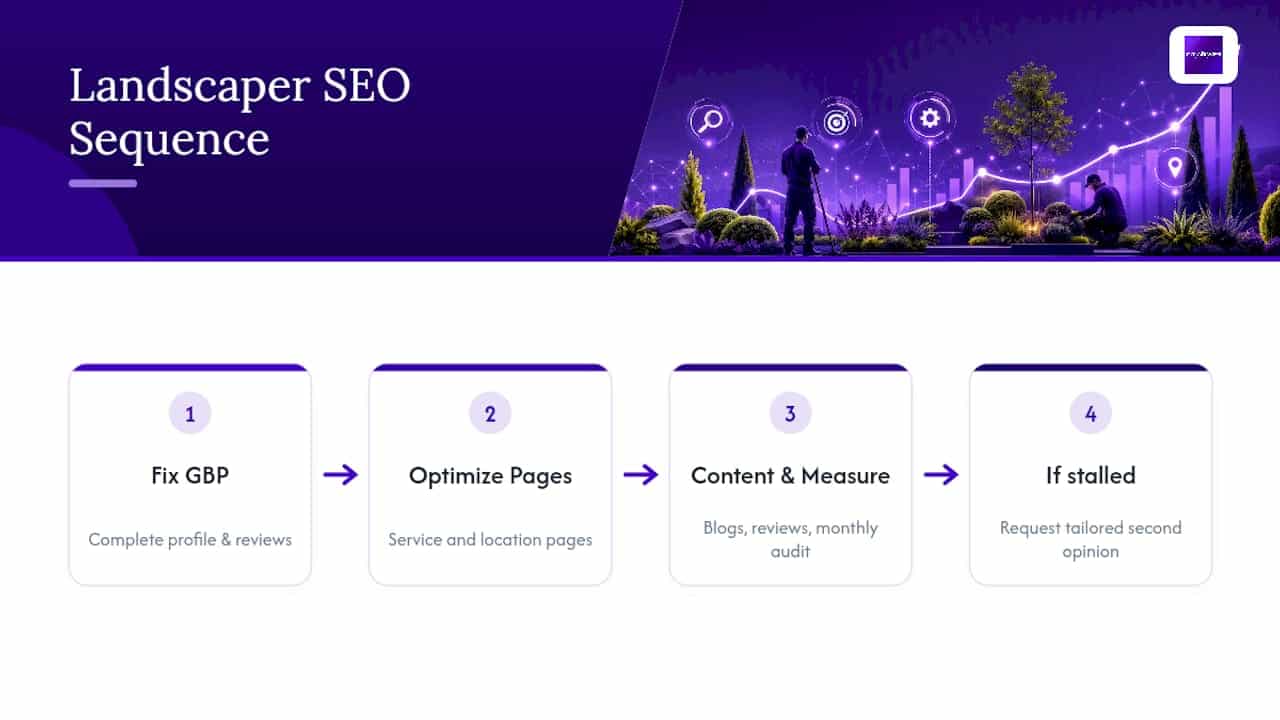
Most landscaping companies I’ve seen chase blog content or backlinks before their Google Business Profile is even complete. That’s backward. GBP and reviews move the map pack fastest because Google is optimizing for proof of a real, active, trusted local business, not keyword density. Fix your profile first, and everything else compounds from there.
Use the audit checklist above monthly, and if review velocity or technical fixes keep stalling, that’s worth a tailored second opinion.
— Matt
Get Landscaper SEO Help From City Web Company
Running the 90 day plan above while also running crews and quoting jobs is where most landscaping owners stall out, not from lack of strategy but from lack of hours in the day. City Web Company is the alternative to hiring an in-house marketer or juggling five different freelancers for landscapers who want the GBP optimization, location pages, review systems, content calendar, and measurement setup handled as one coordinated program instead of five disconnected tasks.


City Web Company’s core services for landscaping clients include Google Business Profile optimization, service and location page development, automated review request systems, seasonal content calendars, and call tracking setup tied to real booked-job reporting. This fits owners who’ve completed the DIY basics but hit a ceiling on time or technical capacity. Compare the local SEO approach against traditional SEO to see which fits your growth stage, then request a profile review to find out what’s actually holding your rankings back.
Sources
For deeper research on ranking factors, review Digiarun’s landscaper SEO guide on GBP relevance signals, Greenindustrypros on technical foundations, and Refact’s seasonal publishing research for content timing.
- SEO for Landscaping Companies That Books Jobs | Refact
- How to Rank Higher in Google for Local Landscaping Searches Without Paid Ads | Pixlel
FAQ
Is $100 An Hour Too Much For Landscape Work?
That depends entirely on your local market, labor costs, and service complexity; it’s a pricing question specific to your region, not something SEO data can answer, so check local competitor rates and your own overhead before setting it.
Can ChatGPT Do SEO For A Landscaping Business?
ChatGPT can help draft service page outlines, FAQ content, and review request templates, but it can’t claim your Google Business Profile, verify local citations, or judge whether your photos and pricing match what actually ranks in your specific market.
What Are The 3 C’s Of SEO?
Definitions vary across sources, but for local landscaping SEO the three factors that matter most are consistency (NAP data across directories), completeness (a fully filled GBP), and content (service and location pages with real local detail).
How Long Until Landscaper SEO Shows Results?
Most landscaping businesses see initial ranking movement around 4 to 6 months into consistent work, with GBP and review improvements often producing call volume increases faster than organic page rankings.
Recommended
These articles were popular with other readers too: