

Pass Google Business verification with a video-first checklist. Film one continuous 30 second take, fix flagged issues, and know when to hire help.
HVAC Local SEO for Contractors: A Prioritized Playbook
Five actions move the needle for HVAC local SEO more than anything else: a fully configured Google Business Profile, a steady flow of new reviews, dedicated service and city pages, clean technical fundamentals, and local citations and links that back up your address and phone number. Get those five right and you’ll typically see Map Pack movement inside 30 to 90 days, with organic and “near me” traffic compounding over the following two quarters.
Here’s the checklist, with realistic timelines attached:
- Google Business Profile optimization (categories, services, photos, posts) — impact starts in 0 to 30 days
- Review velocity (a steady cadence of new reviews, not a one-time push) — impact builds over 30 to 90 days
- Service and city page structure (dedicated pages per service, per service area) — impact in 60 to 120 days
- Technical fixes (site speed, mobile rendering, schema markup) — impact in 30 to 60 days
- Local citations and link building (directories, chamber listings, community links) — ongoing, compounding over 6 to 12 months
HubSpot’s local SEO research shows how much local search behavior skews toward immediate intent, which is exactly why HVAC companies that fix their Google Business Profile first tend to see the fastest gain in call volume. Layer in LocalBusiness schema and a reliable review pipeline, and you’ve covered the four ranking factors Google leans on hardest for service-area businesses: proximity, relevance, prominence, and trust.
Table of Contents
Key Takeaways
HVAC local SEO succeeds when Google Business Profile accuracy, steady review velocity, and dedicated service and city pages work together instead of in isolation.
| Point | Details |
|---|---|
| Fix GBP first | Complete categories, services, and service areas within 30 days for the fastest visible impact. |
| Build review velocity | Use a direct review link and request reviews after every completed job, not in occasional batches. |
| Avoid duplicate city pages | Write genuinely distinct content per location or fold thin areas into a broader service-area page. |
| Add structured data | LocalBusiness and Service schema help both search engines and AI Overviews understand your business. |
| Consider a documented agency process | City Web Company’s HVAC local SEO service bundles GBP remediation, page builds, and review workflows into one reporting cycle. |
Table of Contents
- Priority Roadmap for HVAC Local SEO: What to Do First, Next, and Ongoing
- How Do You Optimize a Google Business Profile for an HVAC Company?
- Building Service and City Pages That Actually Rank
- How Do You Get More Google Reviews for an HVAC Business?
- Fixing NAP Consistency and Local Citations
- Content Strategy: What HVAC Customers Actually Search For
- Local Link Building That Actually Moves HVAC Rankings
- What KPIs Should HVAC Owners Track for Local SEO?
- Quick Technical Fixes That Unblock HVAC Local Rankings
- City Web Company’s HVAC Local SEO Process, Step by Step
- What HVAC Contractors Get Wrong About Local SEO
- How City Web Company Implements This Playbook for Your HVAC Business
- Sources
- FAQ
Priority Roadmap for HVAC Local SEO: What to Do First, Next, and Ongoing
Treat this like a punch list, not a wish list. Contractors who try to do everything at once usually do nothing well. Sequence matters here because Google rewards consistency over time more than a single burst of activity.
Days 0 to 30: Fix the foundation
This is admin-heavy work, and most of it doesn’t require a developer.
- Claim, verify, and fully complete your Google Business Profile (categories, services, hours, service areas)
- Run a NAP audit across your website footer, GBP, and top ten directories
- Set up a direct review link and start asking every satisfied customer for one
- Fix obvious on-site issues: broken contact forms, missing phone number in the header, slow-loading images
Days 30 to 90: Build the pages that convert
Once the foundation is solid, build out the content that actually ranks for “[service] near me” and “[service] in [city]” searches.
- Publish dedicated service pages (AC repair, furnace installation, duct cleaning) and city or service-area pages
- Add LocalBusiness and Service schema markup sitewide
- Clean up remaining citation duplicates and inconsistencies
- Formalize a review request workflow tied to every completed job
90+ days: Compound the gains
This phase never really ends. It’s where most agencies earn their retainer.
- Build local links through sponsorships, chamber memberships, and manufacturer partner pages
- Publish seasonal content on a recurring calendar (furnace tune-ups in fall, AC checks in spring)
- Post to GBP weekly with photos, offers, or completed job updates
- Review your KPI dashboard monthly and adjust spend or focus accordingly
Costs vary widely depending on your market size and how much you outsource. A contractor doing everything in-house might spend almost nothing but time. A full agency retainer covering GBP management, content, and link building typically lands somewhere in that $800 to $2,500 monthly range once you’re past the initial setup phase. What you’re paying for in that ongoing spend is consistency: someone posting to GBP every week, someone requesting reviews after every job, someone watching for citation drift before it becomes a ranking problem.
One caution on timeline expectations: local SEO for contractors leans heavily on proximity, GBP signals, and review volume, and industry guidance on contractor local SEO suggests the businesses that fix core GBP and review gaps first tend to see the fastest Map Pack movement. Treat any specific ranking timeline as a directional estimate, not a guarantee, since competitive density varies enormously by metro area.
How Do You Optimize a Google Business Profile for an HVAC Company?
Your Google Business Profile carries more weight for HVAC local SEO than your website does, at least for Map Pack visibility. Most HVAC companies treat GBP like a business card. Google treats it like a live data feed, and it rewards profiles that get updated regularly.
Set up the profile correctly for a service-area business:
- Select “Service Area Business” during setup, not a storefront listing, unless customers actually visit your location.
- Hide your physical address if you don’t serve walk-in customers. This avoids confusing customers who show up at what might be a residential address.
- List every city or zip code you actually service, not just your home base. Google won’t rank you for areas you haven’t listed.
- Choose your primary category carefully. “HVAC Contractor” is usually the right primary category. Add secondary categories like “Air Conditioning Repair Service” or “Furnace Repair Service” only if you genuinely offer those as standalone services.
- Fill in the Services section with individual line items that mirror your website’s service pages exactly. A profile listing “AC Repair,” “Furnace Installation,” and “Duct Cleaning” as separate services with short descriptions gives Google more to match against local search queries than a vague “HVAC Services” catchall.
Photos and posts that actually move the needle:
- Upload at least four to six new photos monthly: completed jobs, your team on-site, trucks with visible branding, before-and-after shots of installs.
- Name image files descriptively before uploading (furnace-install-denver.jpg beats IMG_4821.jpg) and use that same specificity in any alt text on your website.
- Post to GBP weekly. A seasonal promo, a completed job photo, or a quick maintenance tip all count. Profiles that post regularly tend to show up more often in the “Updates” carousel that some searchers see before they even scroll to organic results.
- Seed your own Q&A section with the five questions customers ask most (“Do you offer emergency service?” “What areas do you cover?”) rather than waiting for strangers to ask first, since unanswered questions sit publicly and can hurt trust.
Pro Tip: Set up your direct review link now, even before you start actively asking for reviews. Half the battle is making the ask frictionless, and a saved link in your phone’s text message templates removes every excuse for delay.
Once your profile is live, check GBP Insights monthly for three numbers: search queries (what terms are triggering your profile), direct calls (a leading indicator of intent), and direction requests (a sign customers are cross-referencing your service area). If direction requests spike from a zip code you don’t actually serve well, that’s useful signal to adjust your service area list. City Web Company’s Google Business Profile optimization services handle this configuration work directly if you’d rather hand it off.
Building Service and City Pages That Actually Rank
Your website’s job is to convert the traffic your Google Business Profile earns. That means every core service needs its own page, and every service area worth targeting needs its own location page, built to be genuinely distinct rather than a copy-paste template with the city name swapped out.
Service page template
Each service page (AC repair, heat pump installation, ductless mini-split service, and so on) should include:
- A title tag structured as “[Service] in [City, State] | [Business Name]”
- An H1 that matches search intent closely, not a marketing tagline
- A URL structure like /services/ac-repair rather than a generic slug
- A meta description under 155 characters that states the service and location plainly
- Content that names specific neighborhoods or landmarks you serve, not just the city name repeated
Location pages without the duplicate content trap
This is where most HVAC sites get penalized without realizing it. If you serve fifteen suburbs and your “location pages” all say some version of “We provide top-quality HVAC service in [City]. Contact us today,” Google sees fifteen near-identical pages and ranks none of them well.
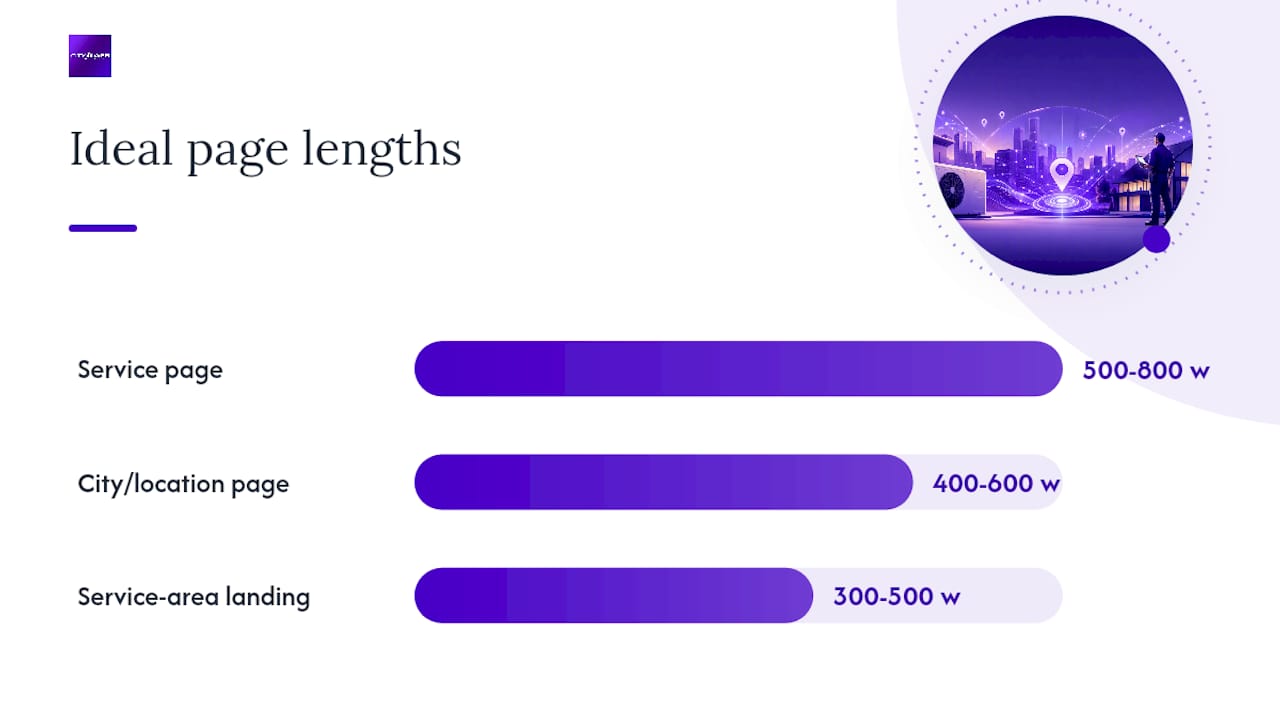
Instead, build genuinely unique content for each location: mention specific climate considerations, local permit requirements, response time from your nearest service hub, or even a completed job example from that area. If you can’t write 300 to 400 words of real, distinct content for a location, it’s better to fold that area into a broader service-area page than to publish a thin duplicate.
Data table: what belongs where
| Page type | When to use it | Ideal length |
|---|---|---|
| Service page | One per core service you offer | 500 to 800 words |
| City/location page | One per major service area with real local detail | 400 to 600 words |
| Service-area landing page | Groups of smaller towns without unique content angles | 300 to 500 words |
Schema and technical fundamentals
Add LocalBusiness schema to your homepage covering your business name, address (or service area), phone number, and hours. Add Service schema to each individual service page, and consider Review schema if you’re displaying testimonials on-site, and FAQ schema on pages where you answer common customer questions directly. Schema.org’s LocalBusiness documentation lays out the full property set, and structured data increasingly determines whether AI Overviews and rich results cite your business at all. If hand-coding JSON-LD isn’t practical, a JSON-LD schema generator can automate the markup for service and business schema without requiring a developer for every update.
Beyond schema, run through this technical checklist:
- Core Web Vitals scores in the “good” range on mobile, not just desktop
- HTTPS across every page, with no mixed-content warnings
- A clean canonicalization setup so Google doesn’t index duplicate URL variants
- An updated XML sitemap submitted through Search Console
- A robots.txt file that isn’t accidentally blocking service pages
Pro Tip: Internal links should flow from home to service to city pages to blog content, using anchor text that reinforces location and service together (“emergency furnace repair in [city]” rather than just “click here”). That link path tells Google exactly how your pages relate to each other geographically and topically.
Ahrefs is worth the subscription cost if you’re managing this yourself. It surfaces which keywords your competitors rank for that you don’t, and flags broken backlinks and crawl errors before they quietly tank your rankings.
How Do You Get More Google Reviews for an HVAC Business?
Review velocity, the steady drip of new reviews rather than a one-time push, matters more to Google’s local algorithm than your total review count. A business with 40 reviews spread evenly over two years signals ongoing customer satisfaction. A business with 200 reviews all from 2023 and nothing since looks stagnant, and Google’s local ranking system tends to reward recency and response rate over raw volume.


Yotpo’s research on reviews confirms what most HVAC owners already suspect from watching their own call volume: review content directly shapes both search visibility and purchase decisions, since prospective customers scan recent reviews before they scan your service list.
Set up your direct review link first. Every GBP listing has a unique place ID, and Google provides a short link format that takes customers straight to the “write a review” box, skipping the extra step of searching for your business first. Save this link in your phone, your invoicing software, and your team’s text templates.
Request templates that work:
- Text message, same day as service: “Thanks for choosing [Business Name] today! If you have 30 seconds, a review here really helps other homeowners find us: [link]”
- Email, 24 hours after service: A short note from the technician by name, thanking the customer and including the same direct link.
Response templates:
- Positive review: Thank the customer by name, mention the specific service performed, and invite them back for seasonal maintenance.
- Negative review: Acknowledge the issue without getting defensive, offer to resolve it offline, and leave a phone number or email in the public response so other readers see you took it seriously.
Pro Tip: Check for new reviews at least twice a week and respond within 48 hours. A fast, professional response to a negative review often does more for your reputation than ten five-star reviews sitting unanswered.
Fixing NAP Consistency and Local Citations
Inconsistent business information across the web actively erodes customer trust and search visibility. Research from Search Engine Watch found that consumers lose confidence in a business the moment they spot a mismatched address or phone number across different listings, and Google’s local algorithm treats that same inconsistency as a trust signal problem.
Run this audit first:
- Pull your business name, address, and phone number exactly as they appear on your website footer.
- Compare that against your Google Business Profile listing.
- Check the top ten directories where HVAC businesses commonly appear: Yelp, Angi, HomeAdvisor, Better Business Bureau, Nextdoor, and any state-specific contractor licensing directories.
- Flag any variation, even something as small as “Suite 200” versus “Ste. 200” or a missing area code.
Priority directories for HVAC citations:
- Google Business Profile (already covered, but confirm it matches everywhere else)
- Yelp and Angi, both of which HVAC customers actively cross-reference before calling
- Industry-specific directories tied to your manufacturer certifications (Carrier, Trane, or Lennox dealer locator pages, if applicable)
- Your local chamber of commerce directory
Fixing duplicates and formatting:
- Standardize address abbreviations (St. vs Street, Ste. vs Suite) across every listing
- Use the exact same phone number format everywhere, ideally with no variation in area code formatting
- Claim and merge duplicate listings rather than leaving old, outdated ones live alongside a corrected version
For businesses managing more than a handful of locations or service areas, a citation management tool saves real time over manually checking each directory. For a single-location HVAC contractor, a quarterly manual audit is usually enough to keep things clean.
Content Strategy: What HVAC Customers Actually Search For
Content only helps your local SEO when it matches what someone is actually typing into Google before they call a contractor. That means prioritizing service pages and location pages first, since those capture the highest-intent searches, and treating blog content as a supporting layer rather than the main event.
Content priority order:
- Service pages (AC repair, furnace installation, heat pump service)
- Location or service-area pages
- Seasonal maintenance guides tied to your local climate
- FAQ content that answers pre-call objections directly
Service pages should run 500 to 800 words, enough to cover the service in real depth without padding. City pages can run shorter, 400 to 600 words, since their job is more about local relevance signals than exhaustive detail.
Seasonal content calendar example:
- Late summer: “AC not cooling? Common causes before you call for repair”
- Early fall: “Furnace tune-up checklist before the first cold snap”
- Winter: “What to do when your heat goes out overnight”
- Spring: “Why your AC unit needs a spring inspection before summer”
Each of these hooks matches a real seasonal search spike, and publishing a week or two ahead of the seasonal shift gives Google time to index the content before demand peaks.
FAQ content deserves its own schema markup because it directly targets featured snippets and voice search queries, which HVAC customers use disproportionately often (“Hey Google, who fixes furnaces near me”). Structure FAQ pages with the exact question as the heading and a direct, two-to-three sentence answer immediately below it, since that format is what gets pulled into snippet results.
Local Link Building That Actually Moves HVAC Rankings
Not all backlinks carry equal weight for local SEO. A link from a national HVAC blog with no geographic relevance does less for your Map Pack rankings than a link from your local chamber of commerce, even if the chamber site has far less overall authority.
High-value link types for HVAC contractors:
- Local news coverage (a feature on a community project, a sponsorship, or a seasonal safety tip segment)
- Chamber of commerce membership listings
- Manufacturer partner or dealer locator pages if you’re a certified installer for a specific brand
- Sponsorships of local youth sports teams, community events, or charity drives, most of which include a website link in exchange
- Local business association directories
A simple outreach template:
“Hi [Name], we’re a local HVAC contractor and just sponsored [event/team]. Would you be open to including a link to our site on the sponsor page? Happy to provide our logo or a short blurb.” Short, specific, and easy to say yes to.
Your first ten outreach targets should include your chamber of commerce, any local business associations, your equipment manufacturer’s dealer page, one or two local news outlets, and any community organizations you’ve sponsored in the past year but never followed up with for a link.
Pro Tip: Track link impact by watching referral traffic in Analytics, not just domain rating changes. A single chamber of commerce link that sends five qualified visitors a month is doing more real work than a high-authority link that sends zero.
What KPIs Should HVAC Owners Track for Local SEO?
You can’t manage what you don’t measure, and most HVAC owners only find out their SEO is failing when the phone stops ringing, months after the underlying problem started. A basic dashboard checked monthly catches problems early.
Essential KPIs to track:
- Calls by source (organic, GBP, paid, referral)
- Booked jobs by channel, not just calls, since call volume alone can be misleading
- Cost per lead, if you’re running any paid channels alongside SEO
- Review velocity (new reviews per month, not just total count)
- Map Pack ranking movement for your top five to ten target keywords
Tracking setup checklist:
- Google Analytics goals configured for form submissions and click-to-call events
- A dedicated call-tracking number with source parameters, so you know which calls came from GBP versus your website
- Consistent UTM tagging on any links you share through social posts or GBP updates
- Search Console monitoring for impressions, clicks, and average position by query
| KPI | Check frequency | Who owns it |
|---|---|---|
| Calls and bookings by source | Weekly | Office manager or admin |
| Review velocity | Weekly | Owner or marketing lead |
| Map Pack rankings | Monthly | Marketing or agency |
| Cost per lead (if running ads) | Monthly | Owner or marketing lead |
A monthly report doesn’t need to be complicated. A single-page dashboard showing calls by source, new reviews, and ranking movement for your top keywords gives an owner everything needed to decide whether to keep investing or adjust course.
Quick Technical Fixes That Unblock HVAC Local Rankings
Technical problems quietly cap how well even a great GBP profile and strong reviews can perform. Most of these fixes take a developer an afternoon, not a month.
Quick fixes checklist:
- Run your site through a mobile usability checker and fix anything flagged as a tap-target or text-sizing issue.
- Fix mixed-content warnings by making sure every resource loads over HTTPS, not just the page itself.
- Compress images before upload rather than relying on the CMS to do it automatically.
- Disable or replace any plugin that’s visibly slowing page load, especially on older WordPress builds common in contractor sites.
- Enable caching at the server or CMS level if it isn’t already active.
Diagnostic tools worth using:
- Google PageSpeed Insights for Core Web Vitals scores
- Search Console for crawl errors and mobile usability issues
- Ahrefs or a similar crawler for broken links and duplicate title tags
When something breaks, check in this order: GBP first (is the listing itself showing correctly), then mobile rendering (does the site actually load fast on a phone), then server errors (any 404s or 500s Search Console has flagged), then structured data (does your schema still validate). Most ranking drops trace back to one of those four in that exact order.
City Web Company’s HVAC Local SEO Process, Step by Step
A typical HVAC local SEO engagement runs in four overlapping phases: an initial audit covering GBP, technical health, and citations; GBP remediation and category correction; service and city page development; and a review generation program layered on top, with link building running continuously in the background once the foundation is solid.
What a contractor should expect to receive:
- A documented audit identifying every NAP inconsistency, technical issue, and content gap
- A fully optimized GBP profile with correct categories, services, and a posting cadence
- Dedicated service and city pages built to avoid the thin-content trap
- A review request workflow with direct links and response templates
- Monthly reporting tied to the KPIs that actually matter: calls, bookings, and ranking movement
Anonymized results from HVAC clients who’ve gone through this process show meaningful percentage lifts in both call volume and Map Pack visibility within the first two reporting cycles, typically the 60 to 90 day mark, once GBP and review fundamentals are corrected. City Web Company’s GBP optimization service documents this remediation process in detail, and the HVAC marketing company overview breaks down the full deliverable list contractors receive during onboarding.
Pro Tip: Ask any agency you’re evaluating for a sample audit template before signing anything. If they can’t show you what a real audit looks like, they probably don’t have a documented process, they’re building it as they go.
What HVAC Contractors Get Wrong About Local SEO
The most common mistake isn’t a technical one. It’s choosing the wrong GBP primary category, then wondering why rankings never move even after months of content work. A close second: cloning city pages with the same three paragraphs and swapping the town name, which Google’s local algorithm treats as functionally duplicate content.
The third mistake is treating reviews as a one-time cleanup project instead of an ongoing workflow tied to every completed job. Fix these three and most of the remaining tactics in this playbook become easier to execute correctly.
On timelines: expect early signals (GBP impressions, a few new reviews) inside 30 days, but real Map Pack movement and lead volume increases usually take 60 to 90 days, and durable competitive advantage compounds over 6 to 12 months.
How City Web Company Implements This Playbook for Your HVAC Business
You could piece this together yourself with a weekend, a spreadsheet, and enough patience to manually audit citations across a dozen directories. Plenty of HVAC owners do exactly that. What City Web Company offers instead is the version where someone else does the weekly GBP posting, the ongoing review requests, and the monthly ranking checks, so you’re running calls instead of chasing algorithm updates.

A typical engagement starts with the same audit outlined above: GBP configuration, NAP consistency, technical health, and a content gap analysis. From there, deliverables usually include full GBP optimization, service and city page builds, a review generation workflow with direct links and response templates, citation cleanup across priority directories, and monthly reporting tied to calls and bookings rather than vanity metrics like impressions alone. Retainer pricing scales with how many service areas and services you cover, so ask any agency, including City Web Company, to walk through exactly what’s included before you sign.
Before hiring anyone, ask three questions: Can I see a sample audit? What does your reporting dashboard actually track? How do you handle review requests, manually or with a system? If those answers are vague, keep looking.
Ready to see what this looks like for your specific service area? Start with City Web Company’s local SEO services for HVAC and home service businesses to get a sense of scope and pricing before committing to anything.
Sources
FAQ
How Long Does HVAC Local SEO Take to Show Results?
Early signals like GBP impressions and new reviews typically appear within 30 days, while meaningful Map Pack ranking movement and lead increases usually take 60 to 90 days.
What’s the Single Biggest GBP Mistake HVAC Companies Make?
Choosing the wrong primary category or leaving service areas incomplete, both of which limit which local searches your profile can even appear for.
Do I Need a Separate Page for Every City I Serve?
Only if you can write genuinely distinct content for that location. Thin, duplicate-sounding city pages tend to hurt more than help.
How Many Reviews Do I Need to Rank Well?
Consistent review velocity, a steady trickle of new reviews over time, matters more than hitting a specific total count.
Can City Web Company Handle This Whole Process for My HVAC Business?
Yes, City Web Company builds and manages GBP optimization, service and city pages, review workflows, and citation cleanup as a bundled HVAC local SEO service.
Recommended
These articles were popular with other readers too: