Discover what click-through rate (CTR) is, how it’s calculated, and why it’s crucial for measuring the effectiveness of your ads.
What Is Promotional Merchandise, and How Do You Use It?
Promotional merchandise is any physical product imprinted with a company’s logo, slogan, or brand name and given away to build awareness, loyalty, or engagement. A branded coffee mug, a logoed tote bag, and a custom company T-shirt are three of the most common examples, and each does the same basic job: it puts your brand in front of someone repeatedly, at a cost per impression that beats almost every other marketing channel.
Marketers reach for these items constantly because the use cases are so flexible:
- Trade show handouts that put your name in a prospect’s hand before a competitor’s does
- Customer welcome gifts that turn a first purchase into a warmer relationship
- Employee swag that reinforces culture and turns staff into walking brand ambassadors
Table of Contents
Key Takeaways
Promotional merchandise works when the item’s utility matches the audience, the order is sized around a volume break, and every piece is tied to a measurable tracking method.
| Point | Details |
|---|---|
| Definition matters | Promotional merchandise means branded physical items given away to build awareness, loyalty, or event engagement. |
| Utility beats novelty | Useful, quality items get kept and reused far longer than cheap giveaways, driving more total impressions. |
| Order around quantity breaks | Per-unit pricing drops sharply at standard volume tiers like 250 or 1,000 units, so plan orders accordingly. |
| Track everything | Attach a QR code or promo code to every item so redemption and cost-per-lead are measurable, not guessed. |
| Agency support scales results | City Web Company connects merchandise orders to campaign landing pages and lead tracking for local service businesses. |
Table of Contents
- What Is Promotional Merchandise, Exactly?
- What Are the Real Marketing Benefits of Promotional Merchandise?
- What Types of Promotional Merchandise Should You Consider?
- How Do You Choose the Right Promotional Item?
- How Do You Source and Order Promotional Merchandise?
- What Do Promotional Products Cost, and How Long Do They Take?
- How Do You Measure Promotional Merchandise ROI?
- Where Did Promotional Merchandise Come From, and Where Is It Headed?
- What Should Local Service Businesses Know Before Ordering Swag?
- When Does It Make Sense to Bring In an Agency?
- Where Promotional Merchandise Fits Into City Web Company’s Services
- Sources
- FAQ
What Is Promotional Merchandise, Exactly?
The term covers a wider category than most people assume. Promotional merchandise, promotional products, swag, and freebies all describe roughly the same thing: branded items distributed at little or no cost to promote a company, a cause, or an event. Promotional merchandise is defined as products branded with a logo or slogan and handed out to build identity or drive recognition, typically through distributors who manage the sourcing and production side.
Where these items show up matters as much as what they are:
- Trade shows and conferences, where attendees expect a bag full of branded items by the end of day one
- Direct mail, where a physical item breaks through inbox fatigue in a way an email never will
- E-commerce inserts, where a small branded gift inside a shipped order turns a transaction into a memory
- Employee gifting, from onboarding kits to holiday boxes
Pro Tip: If the item is primarily useful and lightly branded, call it a “corporate gift.” If the branding is prominent and the goal is exposure over utility, it is a promotional product. That distinction changes how you budget and how you brief your supplier.
What Are the Real Marketing Benefits of Promotional Merchandise?
The case for promotional merchandise rests on one core mechanic: repeated, low-cost impressions that outlast a single ad view. A branded item sits on a desk, rides in a car, or gets worn to the gym for months, sometimes years, generating exposure long after the initial handout.
The measurable benefits break down into a few categories:
- Brand awareness through repeated exposure, since a kept item is seen dozens or hundreds of times
- Customer retention, because a useful gift creates a small sense of reciprocity
- Perceived value, where a quality item signals that the business itself is not cutting corners
- Lead capture, when items are tied to a sign-up, survey, or booth scan
The evidence backs this up directly. Industry research from Custom Ink found that 78% of U.S. consumers keep branded merchandise only when it is genuinely useful, which means the item’s function matters more than its price tag. American Marketing Association guidance echoes this: higher-quality, more useful items like tech accessories or durable drinkware get kept longer and deepen brand connection more than cheap giveaways that end up in a junk drawer within a week.
Two quick examples show this in action. A regional HVAC company handing out branded bottle openers at a home show often sees them tossed in a drawer. The same budget spent on a decent insulated tumbler tends to result in prolonged use, such as staying on a work truck’s dashboard for months, generating impressions every time a neighbor asks where it came from. A law firm gifting new clients a quality portfolio folder signals competence before the first meeting even starts, which pairs naturally with a broader brand promotion strategy.

What Types of Promotional Merchandise Should You Consider?
Promotional items generally fall into a handful of categories, and each one performs differently depending on the goal.
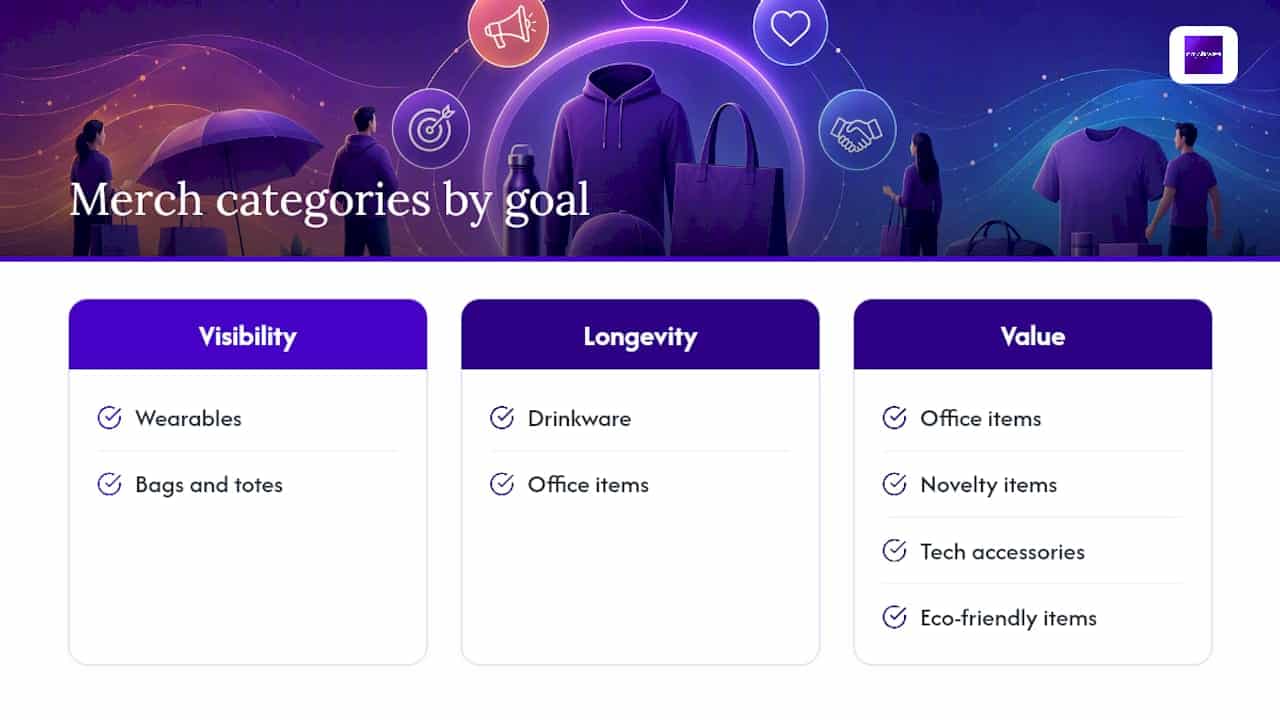
Wearables dominate the space. Wikipedia’s overview of the category notes apparel often accounts for more than 30% of the total product mix in the industry, and it makes sense: a T-shirt or embroidered cap turns a recipient into a mobile billboard, especially at events where matching staff shirts double as a booth identifier.
Drinkware (mugs, tumblers, water bottles) tends to win on longevity. These items live on desks and in cars, and a well-made tumbler can outlast a marketing campaign by years.
Office items (pens, notebooks, sticky notes) are cheap and effective for high-volume handouts, though pens in particular deliver an unusually low cost-per-impression relative to almost any other item, since a single pen gets used dozens of times before it’s lost or discarded.
Tech accessories (phone chargers, USB drives, wireless earbuds) carry higher perceived value and work well for VIP gifts or client retention, not mass giveaways.
Bags and totes perform well at conferences, since attendees need something to carry the rest of their swag in, which means your logo travels around the venue all day.
Eco-friendly items (recycled-material notebooks, bamboo utensils, organic cotton apparel) are a growing segment as buyers respond to sustainability expectations, and they carry a credibility bonus that plastic novelty items simply don’t.
Novelty items (stress balls, fidget toys) are the cheapest option but also the least likely to survive past a week. Reserve them for high-volume, low-budget events where sheer quantity matters more than retention.
How Do You Choose the Right Promotional Item?
Picking the wrong item wastes budget on something that ends up in a landfill within a month. Work through this checklist before you commit to an order:
- Define the audience. A construction crew and a med spa clientele have almost nothing in common, and the item should reflect that.
- Prioritize utility over novelty. An item someone actually uses gets far more exposure than one that just looks clever on a shelf.
- Estimate frequency of use. Daily-use items (pens, mugs, bags) beat occasional-use items (keychains, magnets) for total impressions.
- Set a budget per unit, including the decoration cost, not just the base product price.
- Check the imprint area and color limits. Small logos with fine detail often don’t reproduce well on curved or textured surfaces.
- Confirm brand fit. A cheap plastic item under a premium brand’s logo can undercut the very image you’re trying to build.
Before placing an order, ask any vendor these questions directly:
- What’s the minimum order quantity, and does it match your budget?
- Are there setup fees for first-time artwork, and are they waived on reorders?
- Can they guarantee PMS color matching for your exact brand colors?
- What’s their proof policy, and how many rounds are included before production?
- What happens if the finished order doesn’t match the approved proof?
Watch for a few red flags before you commit: vague material specifications, a supplier unwilling to send a physical proof (not just a digital mockup), and lead times that seem unusually long for a standard item. Any of those usually points to a supplier working through several layers of subcontractors, which adds risk to your timeline. If a current order has already gone sideways, these troubleshooting steps for common promotional product problems walk through how to fix it without starting over.
How Do You Source and Order Promotional Merchandise?
Most buyers don’t order directly from a factory. They work through distributors, who act as intermediaries handling artwork, proofing, and production logistics on the buyer’s behalf, or through an agency-managed process where a marketing partner handles sourcing as part of a wider campaign. Wikipedia’s breakdown of the industry describes this distributor layer as standard practice, since it insulates buyers from the technical complexity of manufacturing.
The ordering process usually follows a predictable sequence:
- Submit artwork in a vector format (typically .AI or .EPS) with exact PMS color codes specified.
- Review a digital or physical proof before anything goes into production.
- Approve a sample if you’re ordering a bespoke or non-catalog item.
- Confirm production timeline and get it in writing.
- Track shipping, especially for multi-location deliveries tied to an event date.
Vendors will typically request:
- A vector logo file (not a JPEG or screenshot)
- Your brand’s PMS color numbers
- Confirmed ship-to addresses and any in-hands deadline
- Purchase order or payment authorization
Skipping the proof step is the single most common mistake first-time buyers make, and it’s the one most likely to cause a costly reprint. For a walkthrough of the full process from a small-business angle, see how to create promotional swag.
What Do Promotional Products Cost, and How Long Do They Take?
Pricing on promotional merchandise follows a predictable shape: a one-time setup fee for artwork and imprint prep, a per-unit price, and a steep discount curve as quantity increases. Volume pricing in this industry is aggressive. Orders typically run from small quantities to very large distributions, and the per-unit cost at 50 units can run several times higher than the same item ordered at 1,000.
Rough ranges to plan around: basic items like pens or notepads often land under $2 per unit at moderate volume, mid-tier items like tumblers or tote bags commonly fall in the $5 to $15 range, and premium items like tech accessories or apparel can run $15 to $40 or more depending on the decoration method. Lead times scale with order size too. A small run of a simple item might ship in one to two weeks, while a large or custom order can take four to six weeks once you factor in proofing rounds.
Budgeting tip: order at or just above a standard quantity break (50, 100, 250, 500, 1,000) rather than a number in between, since pricing tiers reward hitting the break rather than falling just short of it. Build in a cushion for shipping and at least one proof revision.
How Do You Measure Promotional Merchandise ROI?
Tracking impact starts with picking the right KPIs before the order ships, not after.
- Estimate impressions. Industry rule-of-thumb models estimate wear-life and visibility to approximate total exposure over an item’s usable life.
- Track retention rate. Post-event surveys or informal follow-ups tell you whether people actually kept the item.
- Measure redemption. Unique promo codes or QR codes printed on the item show exactly how many recipients converted.
- Watch incremental sales tied to a gated landing page linked from the item.
- Gauge satisfaction lift through NPS surveys sent to recipients who received a gift versus those who didn’t.
A simple sample calculation: if 500 tumblers cost $4,500 total (including decoration and shipping) and each is estimated to generate 400 impressions over its lifespan, that’s a cost-per-impression of roughly $0.0225, far below most digital ad benchmarks. If the same batch generates 40 tracked leads through a printed QR code, that works out to a cost-per-lead of $112.50, a number you can then weigh against your other channels directly.
Where Did Promotional Merchandise Come From, and Where Is It Headed?
Branded giveaways have been a marketing staple for well over a century, evolving from simple printed calendars and matchbooks into a sprawling global industry. Today it spans thousands of product categories and is valued at more than $25 billion annually, with more recent industry estimates putting the figure closer to $27.7 billion.
A few things worth knowing if you’re new to the space:
- PPAI (Promotional Products Association International) offers supplier directories and standards resources that help buyers vet vendors before a first order.
- ASI (Advertising Specialty Institute) runs the retention research many marketers cite when justifying quality over quantity.
- Sustainability is reshaping product mix, with recycled-material and eco-conscious items growing steadily as a share of total orders.
What Should Local Service Businesses Know Before Ordering Swag?
A regional plumbing company City Web Company worked with added branded, insulated water bottles to its spring home-show booth instead of the disposable pens it had used for years. Booth traffic didn’t change, but the number of people who mentioned “I still have your water bottle” months later did, and that anecdotal recall translated into a noticeably warmer response on follow-up calls.
Industry-specific notes worth applying directly:
- Home services (HVAC, plumbing, landscaping): durable, outdoor-friendly items like tumblers, tool bags, or branded work gloves outperform novelty items by a wide margin.
- Law firms: understated, premium items (leather portfolios, quality pens) reinforce credibility better than anything flashy. See promotional merchandise ideas built specifically for law firms.
- Med spas: items tied to self-care (branded skincare bags, quality water bottles) align naturally with the client experience.
Pro Tip: Tie every merch order to a trackable landing page or promo code before you distribute a single item. Without that link, you’re guessing at ROI instead of measuring it.
A compact checklist for setup: define the audience and goal, choose one or two item categories that match daily use, confirm proofs before production, and attach a QR code or promo code to every distributed item so results are trackable from day one.
When Does It Make Sense to Bring In an Agency?
Promotional merchandise works best when it’s one piece of a coordinated campaign, not a standalone purchase. In our experience helping local service businesses plan campaigns, the items that perform tie back to a specific offer, a trackable code, and a follow-up sequence, not just a logo on a mug. One client in the pest control space paired a branded doorhanger kit with a QR-coded discount, and the tracked redemption rate gave them a concrete number to compare against their paid ad spend for the first time.
Handle it yourself if you’re ordering a single small batch for one event. Bring in a partner once merchandise needs to connect to landing pages, ad campaigns, or ongoing measurement.
Where Promotional Merchandise Fits Into City Web Company’s Services
If you’ve been buying swag as a one-off purchase disconnected from your ads, your website, and your lead tracking, you’re leaving the measurement half of the equation on the table. City Web Company builds promotional merchandise into full campaign plans, not standalone orders, which means every item you distribute gets tied to a trackable landing page, a promo code, or a QR scan from the start instead of becoming an untracked guess.
Our promotional products service handles sourcing, proofing, and production, while our broader digital marketing services connect that merchandise to the ads, SEO, and landing pages that actually convert a branded giveaway into a tracked lead. If you’re a local service business planning a trade show, a client gifting program, or a referral push, get a quote on your next order and we’ll show you exactly how to measure it before the first item ships.
Sources
- Promotional merchandise – Wikipedia
- What Is Promotional Products? W2P Glossary | Web to Print Guide
- Promotional Products 101: A Guide to Using Them Effectively | American Marketing Association
- 22 Best Promotional Items of 2026 (Ranked by ROI) – Custom Ink Blog
- Frequently asked questions | PPAI
FAQ
What Is Merchandising Promotion?
Merchandising promotion refers to tactics used to display, present, or highlight products at the point of sale, while promotional merchandise refers specifically to branded giveaway items distributed to build brand awareness or reward customers. The two terms overlap in marketing conversations but describe different activities.
What’s the Difference Between Promotional Products and Corporate Gifts?
Promotional products emphasize visible branding and mass distribution at low cost per unit, while corporate gifts emphasize higher quality and utility with lighter branding, usually given to a smaller, more targeted group.
How Much Does Custom Branded Merchandise Typically Cost?
Costs vary widely by item and volume, but basic items often run under $2 per unit at moderate volume, mid-tier items commonly fall between $5 and $15, and premium items can run $15 to $40 or more, with setup fees added on first orders.
What’s the Best Type of Promotional Item for a Trade Show?
Bags and wearables tend to perform best at trade shows since attendees need something to carry other items and often wear apparel throughout the event, extending your brand’s visibility across the venue.
Can an Agency Like City Web Company Help With Promotional Merchandise?
Yes. City Web Company sources, proofs, and produces branded merchandise while tying it directly into trackable landing pages and ad campaigns, which helps local service businesses measure actual ROI instead of guessing at impressions.
Recommended
- Struggling with Custom Promotional Products? Here’s the Quick Fix – City Web Company | Digital Marketing Agency
- What Is Promotional Swag: Definition, Examples, and How to Choose
- Promotional Merchandise Ideas for Law Firms: 2026 Guide
- Promotional Products – City Web Company | Digital Marketing Agency
These articles were popular with other readers too: