

Learn what a website conversion rate is and how it drives your marketing success. Discover key insights to boost your online performance.
Click-Through Rate Explained: The Formula and What It Means
Click-through rate (CTR) is the percentage of people who click a link after seeing it. The formula is simple: CTR = (clicks ÷ impressions) × 100. If 100 people see your ad and 5 click it, your CTR is 5%.
CTR matters because it’s the fastest signal you have for whether an ad, email, or search listing is actually relevant to the people seeing it. Low CTR usually means the headline, targeting, or offer isn’t landing. High CTR tells you the message resonates, and on platforms like Google Ads, it directly feeds into expected CTR, a factor in Ad Rank that can lower your cost per click.
A few reference points worth knowing before you go further:
- Google defines CTR as clicks divided by impressions, full stop. No adjustments, no weighting.
- Investopedia’s definition notes that average paid-ad CTRs have declined over the years as people have grown better at tuning out ads.
- Coursera’s walkthrough uses examples illustrating calculation of CTR from clicks and views but does not specify exact numeric benchmarks.
CTR is not a vanity number. It’s the cheapest, fastest diagnostic you have for message-market fit, and it’s the first thing to check when a campaign underperforms.
Table of Contents
Key Takeaways
CTR measures how often people click after seeing your ad, email, or listing, and it only means something when compared against the right channel-specific benchmark.
| Point | Details |
|---|---|
| CTR is a simple ratio | Divide clicks by impressions and multiply by 100 to get the percentage. |
| Channel context is everything | Never compare a display ad’s CTR directly against a search ad’s CTR. |
| Small samples mislead | Wait for at least a few hundred impressions before judging a headline or creative. |
| Headlines drive the biggest gains | Rewriting the headline or subject line is the highest-leverage CTR fix available. |
| City Web Company pairs CTR with conversions | Their campaign audits track CTR alongside call and lead data, not clicks alone. |
Table of Contents
- What Is Click-Through Rate and How Do You Calculate It?
- Where Is CTR Used, and Why Does It Mean Something Different on Each Channel?
- What Counts as a Good Click-Through Rate?
- How Do You Improve Click-Through Rate?
- What Are the Common Pitfalls in Reading CTR Data?
- Three Worked Examples: Search, Display, and Email
- How City Web Company Uses CTR to Optimize Local Campaigns
- Where the CTR Obsession Goes Wrong
- Get a Free CTR Audit for Your Ad Campaigns
- Sources
- FAQ
What Is Click-Through Rate and How Do You Calculate It?
The math behind CTR never changes, no matter the channel. What changes is what counts as an “impression” and a “click.”
Step 1: Count total impressions (how many times the ad, email, or listing was shown).
Step 2: Count total clicks (how many times someone clicked it).
Step 3: Divide clicks by impressions.
Step 4: Multiply by 100 to get a percentage.
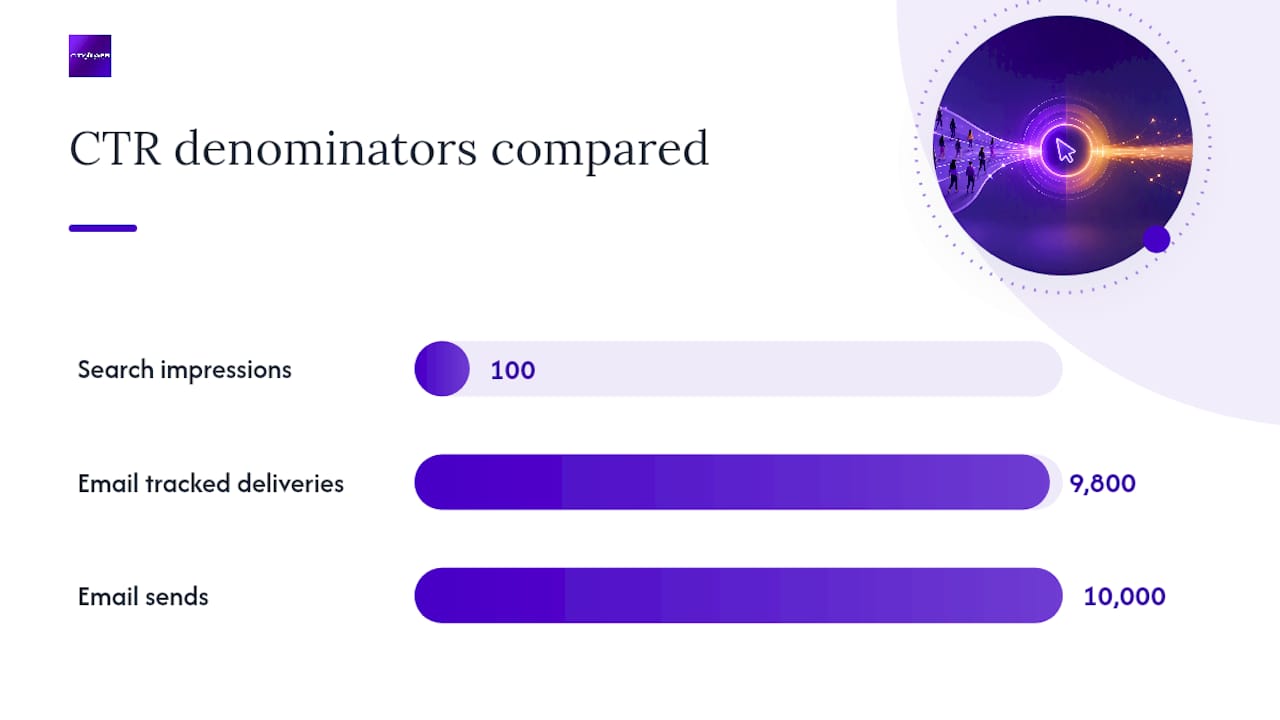
Here’s a plain search ad example. Your ad shows up 100 times in a day, and 5 people click it:
5 ÷ 100 = 0.05 → 5% CTR
Now here’s an email version, which works a little differently. Email platforms typically calculate CTR using tracked deliveries (emails that actually landed in an inbox) rather than raw sends, since some emails bounce. Say you send a campaign to 10,000 addresses, 9,800 are successfully delivered, and 294 unique people click a link inside:
294 ÷ 9,800 = 0.03 → 3% CTR
That distinction between raw sends and tracked deliveries is where a lot of people get their math wrong. Wikipedia’s entry on click-through rate confirms this: email CTR is calculated against tracked deliveries, not the number of people you hit “send” to.
There’s also a difference between raw clicks and unique clicks. Raw clicks count every click, including someone who clicks the same link three times. Unique clicks count each person once, no matter how many times they click. Most reputable email and ad platforms report unique clicks by default because it gives a truer read of audience engagement.
| Metric | What It Counts | Common Use |
|---|---|---|
| Raw clicks | Every click event, including repeats | Rarely used alone; can inflate CTR |
| Unique clicks | One click per person, regardless of repeats | Standard for email and most ad platforms |
| Tracked deliveries | Emails successfully delivered (excludes bounces) | Denominator for email CTR |
| Impressions | Times an ad or listing was displayed | Denominator for ad and search CTR |
You rarely have to calculate CTR by hand once a campaign is live. Google Ads displays CTR as a column in every campaign, ad group, and keyword report. Email platforms like Mailchimp, Klaviyo, and Constant Contact show it on the campaign summary page immediately after a send. The formula matters mostly so you can sanity-check what the dashboard is telling you, and catch it when something looks off.
Where Is CTR Used, and Why Does It Mean Something Different on Each Channel?
CTR shows up across five main channels, and the number that counts as “good” shifts dramatically depending on where you’re looking.
- Paid search ads (Google Ads, Microsoft Ads): High intent. People are actively searching for a solution, so CTR tends to run highest here.
- Paid display ads (banner ads on websites): Low intent. People are browsing content, not shopping, so CTR runs much lower.
- Social ads (Facebook, Instagram, TikTok): Mixed intent. Users are scrolling for entertainment, so ads need to interrupt that pattern to earn a click.
- Organic search listings: High intent, but competing against other organic results and paid ads on the same page.
- Email: Depends heavily on list quality and subject line strength, since the “impression” already assumes someone opened the message.
The core rule here is simple: never compare CTR across channels without adjusting for context. Practitioner guidance from Semrush makes this point directly: CTR is platform-dependent, and marketers who benchmark a display campaign against a search campaign are comparing two different behaviors, not two versions of the same metric.
Pro Tip: Pair CTR with a downstream metric like conversion rate or cost per lead before you judge a campaign. A high CTR that produces zero calls or sales tells you the ad copy is misleading, not that the campaign is working.
What Counts as a Good Click-Through Rate?
“Good” CTR depends on channel, ad format, placement, and industry, and treating any single number as a universal target will mislead you.
A few grounding rules of thumb:
- Search ads generally post higher CTRs than display ads because search users have already expressed intent by typing a query.
- Display ad CTRs have fallen substantially over time. Investopedia cites historical averages as low for some display formats, a reflection of “banner blindness” after two decades of internet advertising.
- Email CTR benchmarks vary by list quality and industry. Campaign Monitor’s benchmark data shows meaningful spread between industries, so a legal firm and an e-commerce brand shouldn’t expect the same click-through numbers from a newsletter.
Small sample sizes will also lie to you. Wait until you’ve accumulated a few hundred impressions at minimum before drawing conclusions about a headline or creative.
For the most current numbers, check platform-native benchmark tools (Google Ads shows industry benchmarks inside the interface) rather than relying on a blog post from a few years back. Averages shift, sometimes significantly, as ad formats and user behavior change.
How Do You Improve Click-Through Rate?
Raising CTR comes down to testing specific, isolated changes and measuring what moves the number. Here’s the order that tends to produce results fastest:
- Rewrite the headline first. It’s the single highest-leverage element on a search ad, a display banner, or an email subject line.
- Sharpen the call to action. “Learn More” underperforms specific action language like “Get a Free Quote” or “Book Your Inspection.”
- Tighten your targeting. An ad shown to the wrong audience will always underperform, regardless of creative quality.
- Add ad extensions or preheader text. Search ad extensions (sitelinks, callouts, structured snippets) increase the visual footprint of your ad and give people more reasons to click. In email, preheader text is free real estate that most senders waste.
- Run controlled A/B tests. Change one variable at a time, split traffic evenly, and run the test until you hit a meaningful sample size, generally a few hundred clicks per variant at minimum.
A few things practitioners learn the hard way:
- Match ad copy to the actual search intent behind the keyword. An ad promising “Same-Day Service” for a keyword search where people are just researching options will get clicks that never convert.
- Use urgency sparingly. “Limited Time” works when it’s true and wears out fast when it isn’t.
- Test landing pages alongside your ad copy. A strong call-to-action design on the destination page matters just as much as the ad that got the click.
Pro Tip: Always measure CTR next to conversion rate. If a new headline doubles your CTR but conversions stay flat, you’ve attracted the wrong clicks, not better ones. For a deeper look at turning that traffic into results, see this guide on improving website conversion rate.
What Are the Common Pitfalls in Reading CTR Data?
CTR looks like a clean, simple number, but a handful of tracking issues can quietly distort it.
- Viewability problems. A display ad loaded at the bottom of a page that nobody scrolls to still counts as an “impression” on many platforms, deflating your real CTR.
- Accidental and fraudulent clicks. Mobile ads placed near navigation buttons get accidental taps. Click fraud, whether from bots or bad actors, inflates click counts without producing real interest.
- Bot traffic. Automated crawlers and scrapers can register as impressions or even clicks on poorly filtered ad networks.
- Platform counting differences. Google Ads, Facebook Ads, and email platforms each define “impression” slightly differently, which is another reason cross-platform comparisons get messy.
- Attribution windows and redirects. A click that passes through a redirect or a shortened URL can sometimes fail to register correctly, especially across different tracking systems.
When a CTR number suddenly jumps or drops with no obvious campaign change behind it, treat that as a data quality flag before you treat it as a performance signal. Cross-check the spike against server logs, apply click filters where your platform allows it, and confirm the traffic source before you change strategy based on the number alone.
If your numbers look too good or too strange to be true, they usually are. Learn more about validating advertising data before making decisions off a single dashboard metric.
Three Worked Examples: Search, Display, and Email
Numbers make more sense side by side. Here are three real-world scenarios showing the same formula applied to three different situations.
Example 1: Search ad with high intent. A plumbing company runs a Google Ads campaign targeting “emergency plumber near me.” The ad gets a few thousand impressions and a few hundred clicks over a week, yielding a strong CTR reflecting high intent.
Example 2: Display ad with broad reach. The same company runs a banner ad across a home-improvement content network to build awareness. This ad gets many thousands of impressions but relatively few clicks, consistent with typical display benchmarks where CTR tends to be low.


Example 3: Email campaign. The company sends a seasonal maintenance reminder to its customer list. Of several thousand emails delivered, a modest number of unique recipients click a link, resulting in a modest CTR typical for email campaigns.
The pattern holds across nearly every industry: search beats email, and email beats display, because each channel captures a different level of buyer intent.
How City Web Company Uses CTR to Optimize Local Campaigns
Agencies don’t treat CTR as a standalone scoreboard. It’s one input in a workflow that ends with phone calls and booked jobs, not just clicks.
A typical process for a home services client looks like this: build two or three ad variations targeting the same keyword group, split the budget evenly, and let the campaign run until each variant has a statistically usable number of impressions. From there, the winning headline and creative get scaled, while the underperformers get cut. But the team doesn’t stop at CTR. Every ad gets tracked through to call and lead conversion, because a headline that generates clicks without generating calls isn’t actually winning.
- Test headline variations against the same audience and keyword set before scaling spend.
- Refine audience targeting using geographic and demographic data specific to the service area.
- Track CTR alongside call-through rate to confirm the clicks are converting into real business, not just traffic.
Pro Tip: Segment CTR data by device before drawing conclusions. A landscaping ad might post a strong CTR on desktop and a mediocre one on mobile simply because the landing page loads slower on phones, not because the ad itself is weak.
For a broader look at how these metrics fit into a full campaign strategy, see five essential paid advertising metrics to track alongside CTR.
Where the CTR Obsession Goes Wrong
I’ve watched plenty of campaigns get “optimized” into a corner because someone chased CTR as the finish line instead of a checkpoint. A headline that promises something the landing page doesn’t deliver will absolutely raise your CTR. It will also waste ad spend on visitors who bounce the second they land, which helps nobody.
The actual priorities, in order, are matching ad copy to real search intent, testing headlines against each other with enough volume to trust the result, and then following every click downstream to see if it turned into a call, a form fill, or a sale. CTR tells you whether people found the message compelling enough to act on the first impulse. It says nothing about whether they found what they expected once they got there. Treat it as a diagnostic tool you check early in the funnel, not a target you chase for its own sake.
Get a Free CTR Audit for Your Ad Campaigns
If your ads are getting impressions but not clicks, or clicks but not calls, City Web Company can find out why faster than trial-and-error testing on your own. Unlike running blind experiments on your ad account for months, an outside audit spots the specific headline, targeting, or landing page issue holding your numbers back within days.

City Web Company’s paid ads management, local SEO, and landing page testing work together because a strong CTR that leads to a slow, confusing landing page still loses the sale. The team reviews your current ad account, benchmarks your CTR against your specific industry and channel, and prioritizes the two or three changes most likely to move the needle, whether that’s a headline rewrite, an audience refinement, or a landing page fix.
A free campaign review from City Web Company includes:
- A full ad account review across your active campaigns
- A CTR baseline compared against your specific industry and channel
- A prioritized list of optimizations ranked by expected impact
Request your free Google Ads audit and find out exactly where your campaigns are leaving clicks, and leads, on the table.
Sources
- Understanding Click-Through Rate (CTR): Definition, Formula, and Importance
- What Is CTR (Clickthrough Rate)? | Coursera
- What Is Click-Through Rate (CTR)? + How to Improve It – Semrush
FAQ
What is considered a good click-through rate?
There’s no single good CTR since it depends heavily on channel and industry. Search ads often see CTRs in the mid-single digits or higher, while display ads average much lower, sometimes around 0.2%, and email CTR ranges vary widely by list quality and industry per Campaign Monitor’s benchmark data.
Is a higher CTR always better?
Not necessarily. A high CTR from misleading ad copy can attract clicks that never convert, so CTR should always be measured alongside conversion rate or lead quality, not treated as a standalone win.
How is email CTR different from ad CTR?
Email CTR is typically calculated against tracked deliveries (emails that successfully landed) rather than impressions, since Wikipedia’s definition confirms the denominator shifts to delivered messages for email specifically.
Can I compare CTR between Google Ads and Facebook Ads?
Direct comparison is misleading because the platforms differ in user intent and impression counting methods. Semrush’s guidance recommends using platform-specific benchmarks instead of cross-channel comparisons.
How can City Web Company help improve my CTR?
City Web Company audits your ad account, benchmarks your CTR against your specific channel and industry, and tests headline and targeting changes while tracking downstream call and lead conversions, not just clicks.
Recommended
- From Website Clicks to Phone Calls – Turning Traffic Into Action – City Web Company | Digital Marketing Agency
- 5 Paid Advertising Metrics You Must Track (or Risk Wasting Money) – City Web Company | Digital Marketing Agency
- The True ROI of SEO – What the Numbers Don’t Always Show – City Web Company | Digital Marketing Agency
These articles were popular with other readers too: