

Pass Google Business verification with a video-first checklist. Film one continuous 30 second take, fix flagged issues, and know when to hire help.
Local Citations for Small Businesses: What They Are and What to Do Next
A local citation is any online mention of your business’s Name, Address, and Phone number (NAP) on a third-party site, directory, map app, or social platform. Two things to do right now: log into your Google Business Profile and confirm your NAP is accurate, then run your business name through a quick Google search to spot any listings with wrong addresses or old phone numbers. Expect new or corrected citations to influence your local rankings after some weeks as search engines re-crawl directories and aggregators push updated data.
- Check Google Business Profile first. It is the single most influential citation you control.
- Search your business name in quotes. Look for inconsistencies across the first two pages of results.
Table of Contents
Table of Contents
- What Does a Local Citation Actually Contain?
- Why Do Local Citations Matter for Your Search Visibility?
- Where Do Local Citations Actually Appear?
- How to Build and Claim Your Citations Step by Step
- How to Audit Your Citations and Keep Them Clean
- Citations vs. Backlinks: Which One Do You Actually Need?
- Key Takeaways
- The Citation Mistakes We See Most Often
- City Web Company Handles Citations So You Can Focus on Your Business
- Useful Sources
- FAQ
What Does a Local Citation Actually Contain?
The core of every citation is NAP: your business name, street address, and phone number. Beyond those three fields, most structured listings also accept a website URL, business hours, category tags, a short description, and sometimes a service area or photos.
Structured vs. unstructured citations
Citations come in two types: structured and unstructured.

Structured citations appear in formal directory listings with labeled fields. Think of a Yelp profile or a Google Business Profile entry. Every field has a slot, and the data sits in a predictable format.
| Field | Example |
|---|---|
| Business name | Apex Plumbing Services |
| Address | 412 Maple St, Denver, CO 80203 |
| Phone | (720) 555-0198 |
| Website | apexplumbingdenver.com |
| Hours | Mon–Fri 7 AM–6 PM |
| Category | Plumber, Emergency Plumbing |

Unstructured citations are mentions in editorial content where your NAP appears in running text. A local news article that reads “Apex Plumbing Services, located at 412 Maple St in Denver, was recognized by the Denver Business Journal” is an unstructured citation. No labeled fields, but Google still reads it.
Partial citations still count
Even a partial citation that omits one or more NAP fields can help with discovery and should be tracked. A mention that includes only your business name and city still signals relevance to Google. The goal is to find those partial records and complete them wherever the platform allows.
Why Do Local Citations Matter for Your Search Visibility?
Google cross-references your Google Business Profile with third-party citations to verify that your business exists where you say it does. Consistent NAP across multiple sources strengthens that verification signal, which directly influences whether you appear in the local pack (the map results at the top of a Google search).
The practical benefits go beyond rankings:
- Map-pack visibility. Consistent citations are one of the clearest signals that pushes a business into the three-pack of local results.
- Referral traffic. Yelp, Bing Places, and Apple Maps each send their own users to your listing. People who never use Google still find businesses through these platforms.
- Customer trust. A business with complete, consistent listings looks established. Mismatched addresses or disconnected phone numbers create doubt before a customer ever calls.
How citations differ from backlinks
Citations and backlinks are both off-page SEO signals, but they serve different purposes. Citations provide geographic and topical relevance; backlinks primarily pass authority from one site to another. A citation from the local chamber of commerce directory does not pass link equity the way an editorial mention with a hyperlink does. Both matter, but for different reasons at different stages.
Pro Tip: Focus on a handful of high-authority directories in your industry and city before chasing volume. A complete, verified listing on Yelp, Google Business Profile, and your local chamber site outperforms fifty thin submissions to obscure directories.
Where Do Local Citations Actually Appear?
Citations show up across a wide range of platforms. Knowing where to look helps you prioritize the ones that drive real traffic and ranking signals.
Structured platforms worth claiming first
- Google Business Profile / Google Maps — The most important citation you own. It feeds directly into Google’s local pack and Maps results.
Unstructured citations in the wild
A local news site covering your sponsorship of a charity 5K, a neighborhood blog recommending your HVAC company, an event listing that names your business as a vendor. None of these have labeled NAP fields, but they still register as relevance signals.
A concrete example: a local parenting blog publishes a post titled “Best Pest Control Companies in Tucson” and mentions your business by name with your phone number in the body text. That mention can drive direct calls and reinforces your relevance for Tucson-based searches, even without a hyperlink back to your site.
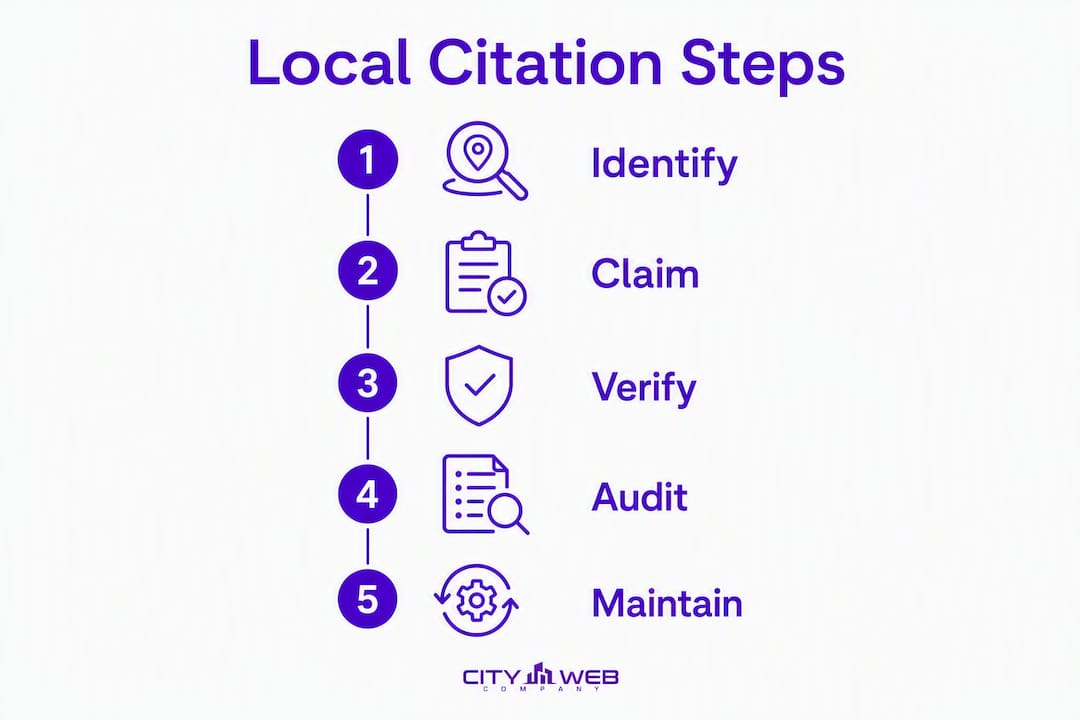
How to Build and Claim Your Citations Step by Step
Before you add a single new listing, establish a single source of truth. Write down your exact business name, address, phone number, website URL, hours, and primary categories. Copy every field character for character when you submit to any platform.
The citation-building checklist
- Create your source-of-truth document. Lock in the exact spelling, abbreviations, and formatting you will use everywhere (e.g., “St.” not “Street” if that is how your address appears on your lease).
- Claim and optimize Google Business Profile. Verify ownership, complete every field, add photos, and select the most specific categories available.
- Claim Apple Maps, Bing Places, and Facebook. Each has its own verification process, typically a phone call, postcard, or email confirmation.
- Claim your Yelp listing. Search for your business first; a listing may already exist from user submissions.
- Submit to data aggregators. Updating Data Axle and Foursquare pushes your corrected data downstream to hundreds of smaller directories automatically.
- Add industry-specific directories. Identify two or three directories specific to your trade or profession and claim those listings.
- Track your submissions. Log each platform, the date submitted, and the verification status.
Tools and platforms at a glance
| Platform / Tool | Best Used For | How to Claim |
|---|---|---|
| Google Business Profile | Primary citation, map-pack rankings | Google account verification via postcard or phone |
| Apple Maps | iPhone and Siri search visibility | Apple Maps Connect, email verification |
| Bing Places | Desktop search, Microsoft ecosystem | Microsoft account, phone or postcard |
| Yelp | Consumer reviews, referral traffic | Claim at biz.yelp.com, phone verification |
| Social citation, messaging leads | Facebook Business Manager, admin confirmation | |
| BrightLocal | Citation audit, tracking, and submissions | Paid subscription, dashboard-based |
| Moz Local | Automated distribution, duplicate suppression | Paid subscription, connects to aggregators |

Pro Tip: If you are managing citations for a business with multiple locations, BrightLocal’s location management tools and Moz Local’s automated distribution save significant time compared to manual submissions.
For most small businesses with a modest budget, claiming the top platforms manually can take several hours. Paid tools like BrightLocal or Moz Local reduce ongoing maintenance time considerably and are worth the cost once you have more than three locations or want automated monitoring.
How to Audit Your Citations and Keep Them Clean
Adding new citations without correcting legacy duplicates or errors often compounds inconsistency problems. Run an audit before you build anything new.
Audit methodology
- Inventory existing listings. Search your business name in quotes on Google, Bing, and Yelp. Log every listing you find.
- Identify mismatches. Compare each listing against your source-of-truth document. Flag name variations, old addresses, disconnected phone numbers.
- Find duplicates. Two Yelp listings for the same location confuse both customers and search engines. Claim and merge or suppress the duplicate.
- Prioritize fixes by authority. Fix Google Business Profile and Yelp before worrying about minor directories.
Why aggregators are the most efficient fix
Data aggregators propagate corrected business data downstream to many smaller directories. Fixing your record at Data Axle or Foursquare can update dozens of smaller sites automatically, which is far more efficient than hunting down each one individually.
Maintenance schedule and realistic timelines
| Task | Frequency | Who Should Own It |
|---|---|---|
| Review Google Business Profile | Monthly | Business owner or marketing manager |
| Check top 5 directories for accuracy | Quarterly | Marketing manager or agency |
| Full citation audit | Annually | Agency or dedicated tool |
| Update aggregator records after any change | Immediately | Business owner |
New citations usually show ranking impact after some weeks. Aggregator propagation can take multiple weeks. DIY citation work for a single-location business runs roughly four to eight hours upfront, then one to two hours per quarter for maintenance. Managed citation services through an agency typically run on a monthly retainer and include monitoring, duplicate suppression, and reporting.
For consistent NAP citations across all platforms, the payoff compounds over time. A listing that is accurate today and stays accurate for two years becomes a reliable trust signal that a newly claimed listing cannot match.
Citations vs. Backlinks: Which One Do You Actually Need?
Both are off-page SEO signals, but conflating them leads to wasted effort. Here is the practical difference:
- Citations verify that your business exists at a specific location. They influence local pack and Google Maps rankings. They do not pass link authority.
- Backlinks pass authority from one domain to another. They influence organic rankings across all search types, not just local.
- Where they appear: Citations live in directories, map apps, and social profiles. Backlinks appear as hyperlinks in editorial content.
- What data they include: Citations carry NAP and extended business data. Backlinks carry anchor text and link equity.
- Typical SEO effect: Citations lift local pack visibility. Backlinks lift domain authority and competitive organic rankings.
The practical recommendation: prioritize citations if your goal is to appear in the map pack for “[service] near me” searches. Shift focus to backlinks once your citations are clean and consistent, especially if you are competing for broader organic rankings in a crowded market. For a deeper look at how these factors interact, the local SEO ranking guide covers both signals in context.
Key Takeaways
Local citations are NAP-based verification signals that influence local pack rankings, and the single most important place to start is an accurate, complete Google Business Profile.
| Point | Details |
|---|---|
| Start with Google Business Profile | Claim, verify, and complete every field before touching any other directory. |
| Audit before you build | Find and fix existing duplicates and mismatches before adding new listings. |
| Quality beats quantity | A few accurate, high-authority listings outperform dozens of inconsistent ones. |
| Expect a 60 to 90 day timeline | New and corrected citations typically show ranking impact after some weeks. |
| City Web Company manages it for you | City Web Company handles citation audits, GBP optimization, and ongoing monitoring for local service businesses. |
The Citation Mistakes We See Most Often
The most common problem is not a missing listing. It is a business that has been operating for five or more years with three or four different name variations scattered across the web. “ABC Plumbing,” “ABC Plumbing & Drain,” “A.B.C. Plumbing Services LLC” — all pointing to the same business, all sending conflicting signals to Google.
A close second is the PO Box problem. Some businesses list a PO Box as their address on directories because they work out of a home or a vehicle. Google’s guidelines prohibit PO Boxes for service-area businesses, and using one can get a listing suspended or buried. The fix is to set the listing as a service-area business with no street address displayed, which is exactly what Google’s own documentation recommends.
Duplicate listings are the third pattern. A business moves locations, claims a new listing, and the old one sits unclaimed with the wrong address. Customers call the old number, get no answer, and move on. The fix is to claim the old listing and either merge it or mark it as permanently closed.
The consequence of all three mistakes is the same: Google cannot confidently verify your business, so it ranks you lower in the local pack than a competitor with cleaner data. Resolving these issues starts with a documented source of truth. Write down the exact legal name, address, and phone number you want everywhere, and use that document every time you touch a listing.
Pro Tip: Store your source-of-truth document somewhere your whole team can access it, such as a shared Google Doc. When a staff member updates your website footer or a vendor asks for your address, they pull from the same record every time.
City Web Company Handles Citations So You Can Focus on Your Business
Getting citations right is straightforward in theory and tedious in practice. Most small business owners start strong, claim Google Business Profile and Yelp, then let the rest slide. Six months later, an old listing with a disconnected phone number is quietly costing them calls.

City Web Company’s local SEO services include a full citation audit, duplicate suppression, aggregator submissions, and Google Business Profile optimization. You get a prioritized fix list in the first week, a clear work plan with realistic timelines, and ongoing monitoring so nothing slips. No guessing which directories matter and no hours spent chasing down old listings. For businesses ready to move past the basics, the Google Business Profile optimization service covers the single most important citation in depth. Contact City Web Company to get a citation audit started.
Useful Sources
These are the primary references used throughout this article. Each covers a distinct area of local citation strategy.
- Moz: What Are Local Citations? — Authoritative reference on verification signals, aggregators, and map-pack rankings.
- Moz Whiteboard Friday: How to Build AI Citations — For businesses interested in how AI-driven discovery differs from directory submissions; requires editorial outreach rather than form fills.
- Ahrefs SEO Glossary: Local Citation — Concise reference on partial citations and their value.
- City Web Company: Consistent NAP Citations and Local SEO — Internal resource on why exact NAP consistency drives local visibility.
- City Web Company: How Local SEO Works — Broader guide to local ranking mechanics for service businesses.
FAQ
What is a local citation in SEO?
A local citation is any online mention of your business’s name, address, and phone number on a third-party site, directory, or map platform. Search engines use these mentions to verify your business’s location and legitimacy.
How many citations does a small business need?
There is no fixed number. Quality and consistency matter more than volume; a smaller set of accurate, high-authority listings outperforms a large number of mismatched entries.
How long does it take for citations to improve rankings?
New and corrected citations typically show ranking impact after some weeks. Aggregator updates can take up to eight weeks to propagate across smaller directories.
What is the difference between a citation and a backlink?
A citation verifies your business’s location and influences local pack rankings; a backlink passes authority between domains and influences broader organic rankings. They serve different SEO functions and should not be treated as interchangeable.
Can City Web Company manage my citations for me?
Yes. City Web Company provides citation audits, duplicate suppression, aggregator submissions, and ongoing Google Business Profile optimization as part of its local SEO services for small and local service businesses.
Recommended
These articles were popular with other readers too: