
Master the paid media management process to optimize your campaigns. Drive leads and boost ROI for your local service business today!
What Is Local Search Intent? A Guide for Local Businesses
Local search intent is the goal a searcher has to find a product, service, or resource tied to a specific geographic location, usually to meet an immediate need. It shapes how Google displays results, what content ranks, and whether your business shows up when a nearby customer is ready to act. For local business owners and marketers, understanding local search intent is not optional. It is the foundation of every effective local SEO strategy, from your Google Business Profile to the keywords on your service pages. Miss it, and you hand customers to competitors who got it right.
Table of Contents
What is local search intent and how do you recognize it?
Local search intent is the goal a searcher has to find a resource related to a specific geographic location for timely decisions. That definition sounds simple, but the signals behind it are layered. Some queries are obvious. Others require Google to read between the lines.
Explicit vs. implicit location signals
Explicit local intent shows up when a searcher types a location directly into the query. “Plumber in Denver,” “best pizza Chicago,” or “HVAC repair Grand Junction” all tell Google exactly where the user wants results. These are the easy cases.

Implicit local intent is more common and more interesting. A user who types “emergency plumber 24 hours” or “pizza near me” does not always include a city name. Local search queries often include immediate action signals like “near me,” “open now,” and “24 hours” that trigger location-based results. Google reads those urgency phrases as local signals and pulls results based on the searcher’s physical location.
Google infers local intent without explicit location words, customizing results based on the searcher’s physical location. That means a user searching “roof repair” in Phoenix gets Phoenix roofers, not a national directory. The same query typed in Austin returns Austin results. Your business does not need to rank nationally. It needs to rank where your customers are standing.
Here are the most common local intent signals to recognize in queries:
- Location modifiers: city name, neighborhood, zip code, or state
- Proximity phrases: “near me,” “close to me,” “nearby”
- Urgency phrases: “open now,” “24 hours,” “same day,” “emergency”
- Service plus location: “landscaper Austin TX,” “pest control near me”
- Brand plus location: “Starbucks downtown,” “Home Depot Grand Junction”
Pro Tip: Search your own top service keywords from a mobile device in your service area. If a local pack with map pins appears, Google has already classified that query as local intent. That is your signal to prioritize Google Business Profile optimization for those terms.
How local intent fits within the four search intent types
Local search queries reflect informational, commercial, transactional, and navigational intent types, and local SEO should cover content for each stage. The geography layer does not replace these intent categories. It sits on top of them.
Understanding where a searcher sits in the decision process tells you what content to serve them. Here is how the four intent types map to local search behavior:
-
Informational local intent. The user is researching, not buying yet. Query example: “how much does tree removal cost in Colorado.” The right content asset is a blog post or FAQ page that answers the question and mentions your service area. This stage builds trust before the transaction.
-
Commercial investigation local intent. The user is comparing options. Query example: “best HVAC companies in Grand Junction” or “top-rated pest control near me.” Review pages, comparison content, and case studies perform well here. Your Google Business Profile star rating becomes a ranking factor and a conversion tool at this stage.
-
Transactional local intent. The user is ready to act. Query example: “book HVAC tune-up Grand Junction” or “emergency plumber open now.” These queries need a fast-loading page with a clear phone number, a booking form, and a service area statement. Integrating clear “ready to act now” signals and easy contact methods in your digital presence directly improves conversions from these queries.
-
Navigational local intent. The user already knows the business they want. Query example: “City Web Company Grand Junction” or “Joe’s Plumbing phone number.” Your Google Business Profile and branded pages must be accurate and complete to capture this traffic.
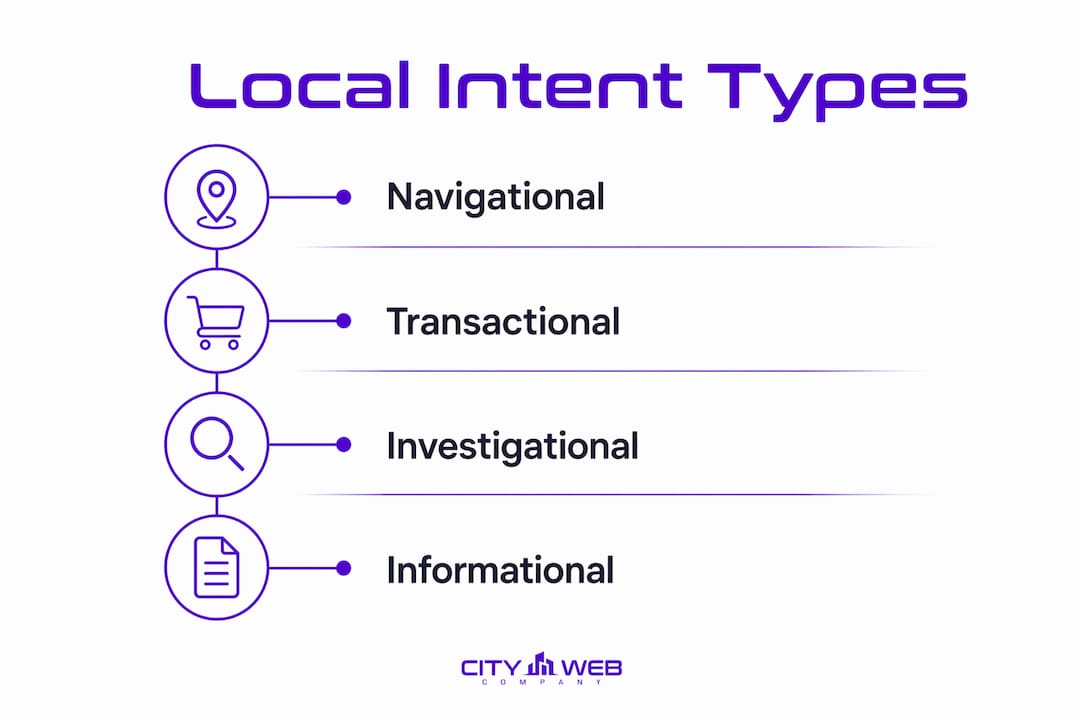
Local intent queries cover three refined buckets: navigational (known brand), transactional (ready to act), and investigational (comparing options). That framework overlaps with the classic four types but puts the emphasis on action readiness, which is exactly how local marketers should think.
| Intent type | Example query | Best content asset |
|---|---|---|
| Informational | “how much does AC repair cost” | Blog post, FAQ page |
| Commercial investigation | “best plumbers near me” | Reviews page, case studies |
| Transactional | “emergency plumber open now” | Service page with click-to-call |
| Navigational | “City Web Company Grand Junction” | Google Business Profile, homepage |

Why local search intent matters for your business visibility
Local search intent drives foot traffic, phone calls, and booked appointments. A business that ranks for the right local queries at the right intent stage captures customers at the exact moment they are ready to spend money. That is the core value of understanding local intent for any service business.
The three factors Google uses to rank local results are relevance, proximity, and prominence. Relevance measures how well your content matches the query. Proximity measures how close your business is to the searcher. Prominence measures how well-known and trusted your business appears online. Local search intent optimization touches all three.
Here is where most local businesses lose ground:
- They optimize for “near me” phrases but ignore city-specific and neighborhood-level keywords
- Their Google Business Profile has incomplete categories, missing hours, or no photos
- Their service pages do not mention specific cities or service areas in titles and headers
- They have no content targeting the informational or commercial investigation stages
- They never test how their rankings look from different parts of their service area
Location emphasis must be consistently reinforced across on-page assets like titles and headers to rank for local intent. A plumbing company in Denver that only mentions “plumber” without “Denver” or specific neighborhoods is invisible to the geographic filter Google applies.
Pro Tip: Check your search rankings from multiple zip codes in your service area, not just your office address. Google’s local results shift block by block, so what ranks at your front door may not rank five miles away where your customers live.
There is no singular global number one local search rank. Local results vary block by block based on user location, making multi-location testing necessary. That fact alone changes how you should measure your local SEO performance.
How to optimize for local intent across your digital presence
Aligning your digital presence with local search intent requires more than adding a city name to your homepage. It requires matching the right content to the right intent stage across every channel.
Build intent-aligned content for each stage
Successful local SEO aligns content type to user funnel stage: educational content for early research and conversion-oriented pages for transactional queries. A disaster restoration company, for example, should have a blog post answering “what to do after a basement flood” for informational searchers and a dedicated “emergency water damage restoration Denver” service page for transactional searchers. Both pages serve the same business, but they target different moments in the customer’s decision process.
Optimize your Google Business Profile
Your Google Business Profile is the single most visible local asset you control. Complete every field: business categories, service areas, hours, photos, and the Q&A section. Choose primary and secondary categories that match the exact services you offer. A pest control company that lists only “pest control service” misses searchers looking for “termite inspection” or “rodent removal,” both of which are separate category options.
Use local keywords beyond “near me”
Google interprets broad service queries as implicitly local based on user location and intent, so optimization must cover real service areas beyond just “near me” keyword phrases. Build service area pages for each city or neighborhood you serve. Use local keyword research to find the specific terms customers use in your market. “Landscaper near me” and “lawn care service Colorado Springs” are both local intent queries, but only one of them tells Google exactly where you work.
Align paid advertising with local intent signals
Paid search campaigns on Google Ads can target by zip code, city, and radius. Ads aligned with transactional local intent queries, like “HVAC installation quote Grand Junction,” convert at a higher rate than broad national campaigns. Local PPC strategies that match ad copy to the specific intent stage of the query reduce wasted spend and improve lead quality.
Here is a quick reference for matching tactics to intent stages:
| Intent stage | Tactic | Platform |
|---|---|---|
| Informational | Blog posts, FAQ pages | Website, Google Search |
| Commercial investigation | Review generation, case studies | Google Business Profile, website |
| Transactional | Service pages, Google Ads | Website, Google Ads |
| Navigational | Brand accuracy, GBP completeness | Google Business Profile |
Testing local search visibility requires checks from multiple geographic points and mobile devices to capture the dynamic nature of local search results. Build that testing habit into your monthly marketing review.
Key Takeaways
Local search intent is the geographic and action-focused purpose behind a query, and matching your digital assets to each intent stage is the most direct path to more local leads.
| Point | Details |
|---|---|
| Define local intent correctly | Local search intent combines geographic relevance with action readiness, not just “near me” phrases. |
| Cover all four intent stages | Create content for informational, commercial, transactional, and navigational local queries. |
| Reinforce location everywhere | Add city names and service areas to page titles, headers, and your Google Business Profile. |
| Test rankings across your service area | Local results shift block by block, so check visibility from multiple locations and devices. |
| Align paid ads with intent stage | Match Google Ads copy and targeting to transactional queries for the highest conversion rate. |
Local intent is a moving target, and most businesses are standing still
I have worked with local service businesses long enough to see the same mistake repeat itself. A business invests in a website, adds “near me” to a few pages, and calls it local SEO. Then they wonder why a competitor three miles away is getting all the calls.
The uncomfortable truth is that local search intent is not a static keyword problem. It is a dynamic, location-specific signal that Google refines down to the block level. What ranks for a searcher at one intersection may not rank for someone six blocks away. I have seen businesses with strong overall SEO scores get outranked in their own zip code because they never tested their visibility from where their customers actually search.
The businesses that win local search in 2026 are not the ones with the most backlinks. They are the ones with complete Google Business Profiles, service area pages that name actual neighborhoods, and content that speaks to each stage of the buying process. They also run Google Ads that match transactional intent queries precisely, not broad campaigns that burn budget on irrelevant clicks.
One more thing most articles skip: local SEO versus traditional SEO is not a competition. They work together. But local intent requires a different content architecture, a different keyword strategy, and a different measurement approach. Treating them as the same thing is where most businesses fall short.
The fix is not complicated. It requires consistency, geographic specificity, and the discipline to test your visibility from the customer’s perspective, not your own office chair.
— Matt
How City Web Company helps you capture local search traffic
Local search intent only generates revenue when your digital presence is built to match it. City Web Company works with local service businesses across industries like HVAC, pest control, landscaping, and disaster restoration to build exactly that kind of presence.
City Web Company’s local SEO services cover Google Business Profile optimization, service area page creation, local keyword targeting, and paid search campaigns aligned with transactional intent. The agency also provides Google Business Profile optimization as a standalone service for businesses that need to improve their local pack visibility fast. If you want a full picture of how local digital marketing drives leads for service businesses, City Web Company’s team is ready to show you what that looks like for your specific market.
FAQ
What is local search intent in simple terms?
Local search intent is the reason behind a search query when the user wants to find a product, service, or location in a specific geographic area. It signals to Google that the searcher needs nearby, relevant results rather than general information.
How does Google detect local intent without a city name in the query?
Google uses the searcher’s physical location, device type, and query context to infer local intent even when no city name appears. A search for “emergency plumber” from a mobile device in Denver will return Denver plumbers, not a national directory.
What is the difference between local SEO search intent and regular SEO intent?
Local SEO search intent adds a geographic filter to the standard intent categories. Regular SEO targets informational or transactional queries broadly, while local SEO targets those same intent types within a defined service area or city.
Why do my local search rankings change depending on where I check them?
Local results vary block by block based on the searcher’s proximity to your business. There is no single number one local rank. Rankings shift based on distance, so checking from multiple locations in your service area gives a more accurate picture of your actual visibility.
What content works best for transactional local intent queries?
Service pages with a clear phone number, a booking form, and a specific city or neighborhood in the page title perform best for transactional local intent. Adding schema markup and keeping page load times fast on mobile further improves conversion rates from these high-intent queries.
Recommended
These articles were popular with other readers too: