

Pass Google Business verification with a video-first checklist. Film one continuous 30 second take, fix flagged issues, and know when to hire help.
Paid Media Management Process: A Guide for Local Service Businesses
The paid media management process is the systematic, ongoing control of digital advertising campaigns to acquire attention, drive conversions, and improve ROI through continuous optimization. For local service businesses, whether you run an HVAC company, a pest control operation, or a landscaping crew, this process is the difference between ad spend that generates real leads and money that quietly disappears. Platforms like Google Ads and Meta Ads reward disciplined management with lower costs and better placement. This guide walks you through every stage of the advertising campaign process, from initial setup to sustained performance, so you can run paid media like a system, not a gamble.
Table of Contents
What are the essential steps in the paid media management process?
The paid media management process is a continuous cycle of planning, execution, optimization, and measurement. It is not a one-time setup. Treating it as “set and forget” is the fastest way to burn through a budget with nothing to show for it.
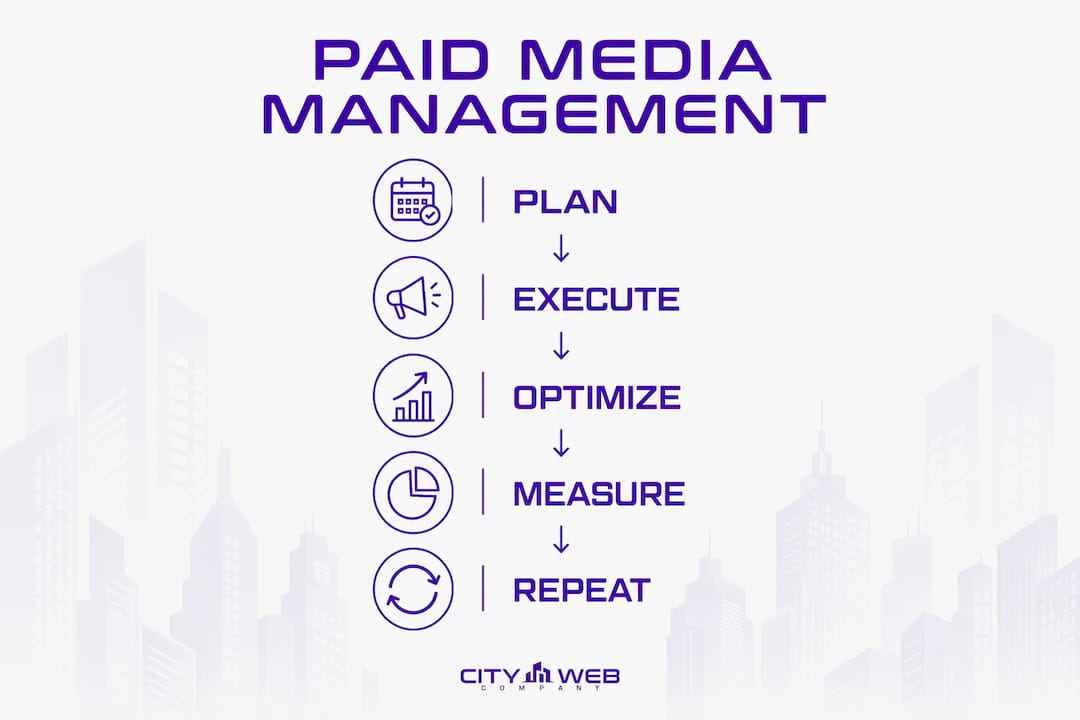
Paid search management breaks into six recurring disciplines: research, account structure, creative, bidding, budget pacing, and measurement. Each discipline runs on a regular cadence, and skipping any one of them creates gaps that compound over time. A plumber running Google Ads without a structured keyword research cycle, for example, will eventually pay for irrelevant clicks from users searching for DIY repairs.
The full sequence looks like this:
- Audience and keyword research — Identify who you are targeting, what they search for, and what problems they need solved.
- Campaign and account structure setup — Organize campaigns, ad groups, and targeting so the platform can read your intent clearly.
- Ad creative development — Write headlines, descriptions, and visuals that match the searcher’s intent and your offer.
- Bidding strategy selection — Choose a bid strategy aligned with your KPI, whether that is cost per acquisition (CPA) or return on ad spend (ROAS).
- Budget pacing — Distribute your daily and monthly budget so spend is consistent, not front-loaded or exhausted by midmonth.
- Performance tracking and reporting — Measure results against your KPIs and feed that data back into the next planning cycle.
Pro Tip: Set a fixed weekly review time on your calendar rather than checking campaigns only when something looks wrong. Reactive management creates inconsistent results. Scheduled reviews create compounding improvements.
How to ensure accurate conversion tracking and why it matters
Conversion tracking quality is the foundation of every paid media decision you make. Inaccurate or duplicated tracking data degrades smart bidding and automation effectiveness directly. Google Ads and Meta Ads both use machine learning to optimize delivery, and that machine learning is only as good as the data you feed it.
Google Ads conversion tracking works by installing two code components on your website: the Google tag and an event snippet. The Google tag fires on every page. The event snippet fires only on the page that confirms a conversion, such as a “thank you” page after a form submission or a phone call trigger. When these are misconfigured or duplicated, the platform counts false conversions and misallocates your budget toward traffic that never actually converted.
Enhanced Conversions are now the baseline requirement for privacy-compliant tracking. They work by hashing first-party customer data, such as email addresses submitted through your contact form, and matching it back to Google’s signed-in user data. This improves match quality in environments where cookies are blocked or restricted. For a local HVAC company running lead generation campaigns, Enhanced Conversions can recover attribution data that would otherwise be lost.
Key steps to verify your tracking setup:
- Install the Google tag site-wide and confirm it fires on every page using Google Tag Assistant.
- Place the event snippet only on the conversion confirmation page, not site-wide.
- Check the Conversions diagnostics panel in Google Ads to confirm tracking status shows “Recording.”
- Audit for duplicate conversion actions, which inflate reported conversions and mislead bidding algorithms.
- Test a live conversion yourself by submitting a form and confirming the event appears in real-time reporting.
Pro Tip: If you use Shopify, the native Google Ads channel integration handles tag installation automatically and reduces the risk of misconfiguration. For WordPress sites, Google’s Site Kit plugin offers a guided setup that non-technical business owners can complete without a developer.
Google Ads vs. Meta Ads: platform management best practices
Google Ads and Meta Ads share the same core management disciplines, but their operational rules differ in ways that catch local business owners off guard. Understanding those differences protects your budget and prevents avoidable performance drops.
Google Ads management cadence
Google Ads rewards a structured review rhythm. Weekly tasks include reviewing search term reports to add negative keywords, checking Quality Scores, and adjusting bids on high-performing keywords. Monthly tasks include reviewing ad copy performance, updating audience lists, and analyzing conversion data by device and location. The account structure itself, meaning campaigns, ad groups, and keyword match types, should be audited quarterly to remove waste and reflect any changes in your service offerings.


Meta Ads and the learning phase
Meta Ads introduces a concept that trips up many local business owners: the learning phase. Every new ad set enters a learning phase when it launches. Meta requires roughly 50 optimization events within a 7-day window for an ad set to exit this phase and stabilize performance. Until that threshold is met, delivery is inconsistent and cost per result is unreliable.
The critical mistake is editing an ad set while it is still in the learning phase. Changing the budget, audience, creative, or bid resets the learning counter entirely. That means the ad set starts over, and you lose whatever data the platform had already gathered. For a disaster restoration company spending $50 per day on Meta Ads, a single impatient edit can cost a week of progress.
Underfunded ad sets stay in a “learning limited” state indefinitely. If your daily budget is too low to generate 50 optimization events per week, the ad set never stabilizes. The fix is to consolidate ad sets rather than running many small-budget variations simultaneously.
Comparing Google Ads and Meta Ads management
| Management area | Google Ads | Meta Ads |
|---|---|---|
| Learning phase trigger | Quality Score and bid adjustments | 50 optimization events per 7 days |
| Editing risk | Low; edits rarely reset performance | High; structural edits reset learning |
| Budget approach | Daily budget caps per campaign | CBO above $300/day; ABO below that threshold |
| Primary review task | Search term and negative keyword audit | Creative fatigue and audience overlap check |
| Key performance signal | Click-through rate and conversion rate | Cost per result and frequency |
Pro Tip: For Meta Ads, Campaign Budget Optimization (CBO) generally outperforms Ad Set Budget Optimization (ABO) once you exceed $300 per day in total campaign spend. Below that threshold, ABO gives you more control during the learning phase and prevents the platform from starving newer ad sets.
How to optimize budget and bidding to maximize ROI
Budget management in paid media is an active strategy, not a spending cap. Systematic budget control means actively reallocating spend from underperforming campaigns to those generating the highest return. A landscaping company running three campaigns simultaneously should review performance weekly and shift dollars toward whichever campaign is producing the lowest cost per booked estimate.
Bidding strategy selection starts with a clear KPI. If your goal is lead volume at a controlled cost, Target CPA bidding tells Google’s algorithm the maximum you are willing to pay per conversion. If your goal is revenue efficiency, Target ROAS bidding instructs the platform to prioritize conversions with the highest expected value. Choosing the wrong strategy for your goal wastes budget even when the campaign appears to be performing.
Budget pacing is the discipline of monitoring how quickly your daily budget is being spent and adjusting delivery settings to prevent exhaustion before the day ends. A moving company that exhausts its daily Google Ads budget by noon loses every afternoon search, which is often when customers are ready to book. Checking pacing daily during the first two weeks of a new campaign prevents this pattern from becoming a habit.
Common budget and bid optimization practices that protect ROI:
- Review cost per conversion weekly and pause keywords or ad sets exceeding your CPA target by more than 30%.
- Increase budgets on campaigns that have hit their daily cap consistently for five or more days.
- Use bid adjustments by device, location, and time of day to concentrate spend where conversions are most likely.
- Avoid making bid changes and creative changes in the same week. Isolating variables makes it clear which change drove the result.
- Set a monthly budget ceiling at the account level to prevent overspend during high-traffic periods.
The most common pitfall is firefighting. Business owners check their campaigns only when a bill arrives or a lead volume drops, then make multiple changes at once. That approach makes it impossible to know what worked. A disciplined review cadence is what separates accounts that improve over time from accounts that stay stuck.
How to build a sustainable monitoring and testing routine
A sustainable paid media routine runs on four time horizons: daily, weekly, monthly, and quarterly. Each horizon has distinct tasks, and mixing them creates confusion. Checking quarterly strategy decisions daily is as wasteful as ignoring daily pacing issues for a month.
A/B testing is the engine of continuous improvement in paid media. The rule is simple: change one variable at a time. Test a new headline against the control. Once you have a winner, test a new call to action. Testing multiple variables simultaneously makes it impossible to attribute the result to any single change. For a pest control company testing ad copy, this means running two ads that are identical except for the headline, letting them run until one reaches statistical significance, then declaring a winner.
Creative fatigue is a specific risk on Meta Ads. When the same audience sees the same ad too many times, frequency rises and click-through rate falls. Proactive creative refresh based on performance signals, not a fixed calendar schedule, prevents campaign stalls. The signal to watch is a rising cost per result combined with a rising frequency. When both move up together, the creative needs to change.
| Review frequency | Key tasks |
|---|---|
| Daily | Check budget pacing, flag anomalies in spend or conversion volume |
| Weekly | Search term audit, negative keyword additions, bid adjustments, creative performance check |
| Monthly | Ad copy refresh, audience list updates, conversion data review by device and location |
| Quarterly | Account structure audit, campaign strategy review, KPI recalibration |
Pro Tip: Track your advertising effectiveness metrics in a shared dashboard so every review session starts with the same data view. Consistency in reporting format makes it easier to spot trends and harder to miss problems.
Key Takeaways
A disciplined paid media management process requires six recurring functions, accurate conversion tracking, platform-specific rules, and a fixed review cadence to produce consistent ROI for local service businesses.
| Point | Details |
|---|---|
| Six core disciplines | Research, structure, creative, bidding, budget pacing, and measurement must all run on a regular schedule. |
| Conversion tracking accuracy | Misconfigured or duplicated tracking corrupts smart bidding data and wastes budget on false signals. |
| Meta Ads learning phase | Ad sets need 50 optimization events per week to stabilize; editing during this phase resets progress. |
| Budget as active strategy | Reallocate spend weekly from underperforming campaigns to those with the lowest cost per conversion. |
| Fixed review cadence | Daily, weekly, monthly, and quarterly reviews prevent account stalls better than reactive adjustments. |
What I’ve learned from watching local businesses run paid media
Most local service businesses that struggle with paid ads share one problem: they treat their campaigns like a light switch. They turn them on, check the bill, and turn them off when the numbers look bad. That is not management. That is guessing with a credit card.
The businesses I have seen get real results from Google Ads and Meta Ads share a different habit. They show up on a schedule. They review the same metrics every week. They make one change at a time and wait to see what happens. It sounds boring, and it is. That is exactly why it works.
The other thing I keep coming back to is conversion tracking. Business owners often skip the setup or assume it is working because the platform says it is. But a duplicated conversion action or a misfired tag can make a losing campaign look like a winner. You cannot manage what you are not measuring accurately. Spending two hours getting tracking right before you spend a dollar on ads is the highest-return investment in the entire process.
Paid media is not a shortcut to leads. It is a system. The businesses that treat it like one, with a real social media advertising workflow and a commitment to the process, are the ones that build a reliable pipeline. The ones that treat it like a vending machine keep wondering why nothing comes out.
— Matt
How City Web Company helps local businesses run better paid media
Running a paid media program while managing a service business is a real operational challenge. Most business owners do not have time to audit search terms weekly, monitor Meta Ads learning phases, and recalibrate bidding strategies every month.
City Web Company works with local service businesses, from HVAC contractors to pest control operators to moving companies, to build and manage paid media campaigns that follow the exact process outlined here. That means proper conversion tracking setup, platform-specific management for Google Ads and Meta Ads, and a fixed review cadence that keeps campaigns improving over time. If you want a paid media program that runs like a system and generates consistent local leads, explore City Web Company’s digital marketing services for local businesses to see how the process works in practice.
FAQ
What is paid media management?
Paid media management is the ongoing process of planning, running, optimizing, and measuring digital ad campaigns on platforms like Google Ads and Meta Ads. It is a continuous cycle, not a one-time setup.
How often should I review my paid media campaigns?
Daily checks cover budget pacing, weekly reviews handle search terms and bids, monthly sessions address creative and audience updates, and quarterly audits cover overall account structure and strategy.
Why does the Meta Ads learning phase matter for local businesses?
Meta Ads requires roughly 50 optimization events per ad set within 7 days to stabilize performance. Editing an ad set during this phase resets the learning counter and causes inconsistent delivery and unreliable costs.
What is the biggest mistake in managing paid ads?
The most common mistake is making multiple changes at once in reaction to poor performance. This makes it impossible to identify what caused the problem or what fixed it. One change at a time, on a fixed schedule, produces measurable results.
How does conversion tracking affect my ad performance?
Inaccurate or duplicated conversion tracking feeds bad data to Google Ads and Meta Ads smart bidding algorithms. The platform then optimizes for the wrong signals, which drives up cost per real lead and misallocates your budget.
Recommended
These articles were popular with other readers too: