

Pass Google Business verification with a video-first checklist. Film one continuous 30 second take, fix flagged issues, and know when to hire help.
Why Reviews Impact SEO for Local Service Businesses
Customer reviews are a direct ranking signal that Google uses to evaluate your business’s relevance, trustworthiness, and local authority. For local service businesses, understanding why reviews impact SEO is not optional. It is the difference between showing up on page one when someone searches “plumber near me” and being invisible while a competitor takes the call. Reviews influence rankings, visibility, and click-through rates all at once. This article breaks down exactly how that works and what you can do about it.
Table of Contents
Why do reviews impact SEO and local search rankings?
Reviews are the most powerful local SEO signal in 2026, outperforming any other single factor in hyperlocal competition. That is a strong claim, but the mechanics behind it are straightforward once you understand what search engines are actually measuring.
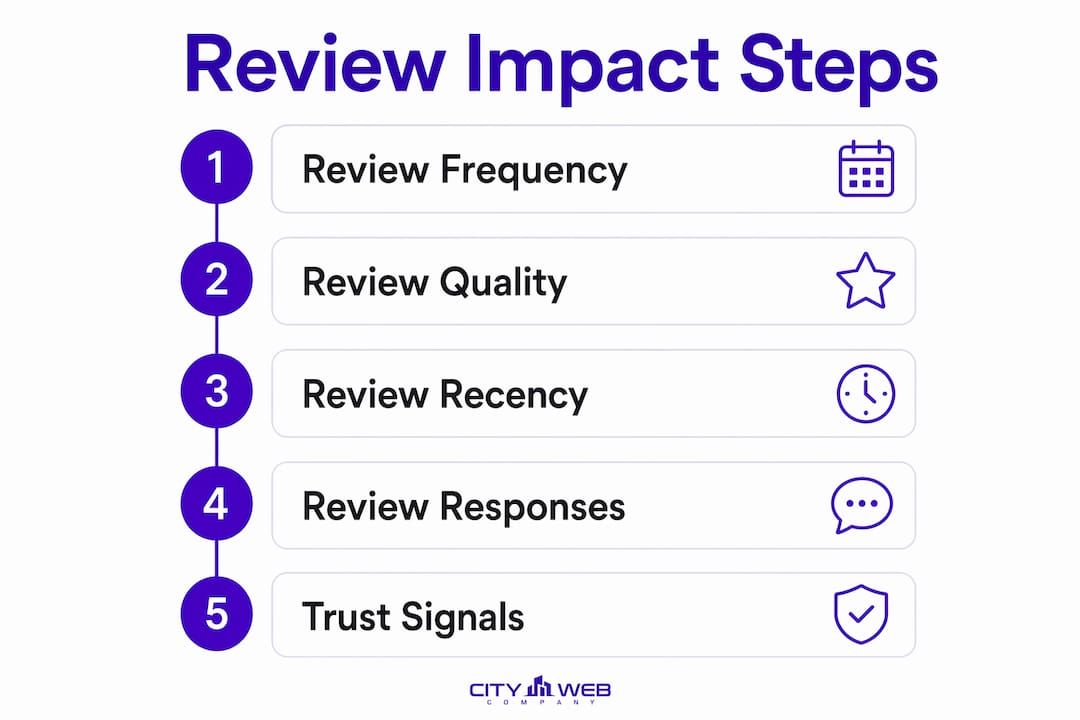
Reviews add fresh, keyword-rich content
Every new review posted to your Google Business Profile is indexed content. When a customer writes “The HVAC technician arrived on time and fixed our furnace the same day,” Google reads that as confirmation your business offers HVAC repair services. That is user-generated content reinforcing your service categories without you writing a single word. Review text helps search engines confirm service relevance beyond star ratings, boosting topical signals and page freshness. A steady stream of reviews keeps your profile active and current in Google’s eyes.


Star ratings trigger rich snippets and boost CTR
When your reviews meet Google’s threshold for structured data display, your listing earns star ratings in search results. Those gold stars are not just cosmetic. Listings with review stars can see click-through rate increases of 20–30%, which drives more traffic and improves rankings indirectly. More clicks tell Google your listing is relevant to the search query, which feeds back into your ranking position. For a local HVAC company or landscaper competing against five other businesses in the same zip code, that CTR advantage is significant.
Reviews build trust signals that satisfy google’s e-e-a-t
Google’s quality evaluation framework, known as E-E-A-T (Experience, Expertise, Authoritativeness, Trustworthiness), relies heavily on authentic user review content to assess businesses. Detailed reviews provide experience signals that no marketing copy can replicate. A pest control company with 200 detailed reviews describing specific treatments, technician names, and outcomes signals far more credibility than one with a polished website and 12 generic reviews. Google’s algorithm treats that depth of real-world feedback as proof that the business delivers what it claims.
Here is a summary of the core SEO mechanisms reviews activate:
- Content freshness: New reviews continuously update your profile with indexed, keyword-relevant text.
- Topical relevance: Service-specific language in reviews confirms your business categories to search engines.
- Rich snippet eligibility: Sufficient review volume and ratings unlock star displays in search results.
- E-E-A-T signals: Authentic, detailed reviews satisfy Google’s trust and experience criteria.
- Behavioral signals: High CTR from star-rated listings reinforces ranking position over time.
How does review velocity influence your search rankings?
Review velocity is defined as the rate and consistency at which your business receives new reviews over time. Steady accrual of reviews is preferred by Google’s algorithm over one-time spikes, because consistent growth signals an active, relevant business rather than a manufactured burst of feedback.
Why consistency beats volume spikes
Imagine two landscaping companies. Company A gets 50 reviews in one week after sending a mass email blast, then nothing for six months. Company B gets 4 to 6 reviews every month, every month, for a year. Google’s AI-powered ranking systems interpret Company B as more active and trustworthy. The algorithm treats review consistency as evidence that the business is continuously serving customers, which aligns with what Google wants to show searchers. A spike followed by silence looks unnatural and can actually trigger scrutiny from Google’s review quality filters.
Review velocity as a competitive differentiator
In competitive local markets, review velocity separates businesses that hold their rankings from those that slowly slide. A moving company that collects reviews after every job builds a compounding advantage. Each new review adds fresh content, reinforces service keywords, and signals ongoing business activity. Over 12 months, that business will have a profile that looks dramatically more active than a competitor who collected reviews in one push two years ago. Local prominence and competitive advantage are directly tied to this pattern of consistent, ongoing review growth.
The practical factors that support healthy review velocity include:
- Asking for reviews at the point of service completion, not days later.
- Using a simple, direct link to your Google Business Profile review page.
- Training every technician or service rep to make the ask part of their standard close.
- Tracking monthly review counts so you can spot and fix gaps quickly.
Pro Tip: Set a monthly review target based on your job volume. If you complete 40 jobs per month and convert 10% into reviews, that is 4 to 5 new reviews monthly. That pace alone will outperform most local competitors who have no system at all.
What role does responding to reviews play in SEO performance?
Responding to customer reviews is a behavioral engagement signal that improves your Google Business Profile ranking. Responding systematically to every review boosts perceived business activity and engagement in Google’s eyes. This is not just good customer service. It is a ranking tactic.
How responses signal activity to google
Google treats your response behavior as evidence that a real, attentive business operates behind the profile. A profile with 80 reviews and 80 responses looks far more active than one with 80 reviews and zero responses. Engagement with reviews is treated by search engines as part of the ranking signal, not just a customer service metric. That distinction matters because many business owners respond to negative reviews and ignore positive ones. Both types of responses contribute to your engagement score.
Best practices for review response cadence
Follow these steps to build a response system that supports your local SEO:
- Respond within 24 hours. Speed signals attentiveness. Google notices recency of activity on your profile.
- Personalize every response. Use the customer’s name and reference the specific service. Generic responses add less value than specific ones.
- Include a service keyword naturally. A response like “We’re glad the furnace repair went smoothly” reinforces your service categories without keyword stuffing.
- Address negative reviews professionally. A calm, solution-focused response to a 1-star review demonstrates credibility to both Google and future customers reading your profile.
- Never copy-paste the same response. Duplicate responses are easy for Google to detect and reduce the engagement signal value.
Pro Tip: Block 15 minutes each morning to respond to any new reviews from the previous day. Treating it as a daily habit rather than a monthly task keeps your profile consistently active and prevents the backlog that leads to ignored reviews.
Responding to reviews also improves conversion rates. A potential customer reading your profile sees not just the reviews but how you handle feedback. A disaster restoration company that responds thoughtfully to every review, including the critical ones, builds trust before the phone even rings. That trust converts searchers into callers, which is the ultimate goal of local SEO best practices.
How to optimize your review strategy to maximize SEO benefits
A review strategy built for SEO goes beyond simply asking customers to leave feedback. The quality, specificity, and technical integration of reviews all determine how much SEO value you extract.
Quality reviews vs. generic reviews
| Review Type | SEO Value | Example |
|---|---|---|
| Generic, short | Low | “Great service, would recommend!” |
| Service-specific, detailed | High | “The plumber fixed our burst pipe within 2 hours and explained the repair clearly.” |
| Service-specific with media | Highest | Detailed text review plus photos of completed work |
Quality reviews outperform generic feedback by providing richer content signals to search engines and better impressions to potential customers. A single detailed review mentioning your service type, location, and outcome is worth more than five one-line reviews. Train your team to coach customers on what to include, not by scripting their words, but by prompting them with questions like “What problem did we solve for you today?”
Coaching customers for better review content
Coaching customers to include service-specific context helps search systems verify that your business offers the services implied by its categories and website. This is one of the most underused tactics in local SEO. A landscaping company can prompt customers with “Feel free to mention the specific service we completed, like lawn care, irrigation, or tree trimming.” That guidance produces reviews that reinforce your service keywords without any manipulation.
Technical optimization: schema markup and structured data
Schema markup, specifically Review and AggregateRating schema, tells search engines to display your star ratings as rich snippets in search results. Adding this structured data to your website amplifies the SEO benefits of reviews you collect on third-party platforms. Many local service business websites lack this entirely, which means they miss the CTR boost that star ratings provide. If your website is built on WordPress, plugins like Yoast SEO or Schema Pro handle this without custom coding. For custom-built sites, a developer can add the JSON-LD markup directly.
Key steps to build a review strategy that maximizes SEO returns:
- Ask for reviews at the moment of highest customer satisfaction, typically right after job completion.
- Send a direct link to your Google Business Profile review page via text message, not email.
- Prompt customers with open-ended questions to encourage detailed, service-specific responses.
- Add Review schema markup to your website to enable rich snippets in search results.
- Monitor your review profile on Google, Yelp, and industry-specific platforms like Angi or HomeAdvisor for completeness.
- Respond to every review within 24 hours to maintain engagement signals.
For a deeper look at how online reviews drive revenue growth alongside SEO gains, the connection between reputation and revenue is well-documented for small and mid-sized businesses. Reviews are not just an SEO tool. They are a revenue driver.
What i’ve learned after years of watching reviews move rankings
I have watched the relationship between reviews and rankings evolve significantly, and the direction has been consistent: reviews matter more every year, not less. When I first started working with local service businesses, reviews were a nice-to-have. Now they are the single factor I look at first when diagnosing why a business is not ranking.
The businesses that win in local search are not always the ones with the best websites or the most backlinks. They are the ones with 150 detailed Google reviews, a 4.8-star rating, and a profile where the owner responds to every single comment. That pattern shows up across industries, from HVAC companies to pest control operators to moving companies.
What surprises most business owners is how much the quality of reviews matters, not just the count. I have seen a plumbing company with 40 detailed, service-specific reviews outrank a competitor with 200 generic ones. Google’s algorithm is sophisticated enough to distinguish between “Great job!” and a paragraph describing the specific repair, the technician’s professionalism, and the outcome. The latter is real content. The former is noise.
The other thing I tell every client: do not treat review management as a marketing task. Treat it as an operations task. The best review programs I have seen are built into the service delivery process itself. The technician asks at the door. The office follows up with a text link. The manager responds by morning. That system runs on its own and compounds over time. If you are looking at how search rankings matter for your business, reviews are the fastest-moving lever you have direct control over.
— Matt
How city web company can strengthen your review-driven SEO
If you run a local service business and reviews are not yet a structured part of your SEO strategy, you are leaving rankings and revenue on the table. City Web Company works with home service companies, HVAC contractors, landscapers, pest control operators, and other local businesses to build review programs that produce real ranking results.
City Web Company’s local SEO services include Google Business Profile optimization, review strategy development, and structured data implementation. The team handles the technical side so you can focus on delivering the service that earns the reviews. If you want a customized plan for your market, explore City Web Company’s digital marketing services or reach out directly to get started.
Key takeaways
Customer reviews are the most direct and controllable SEO signal available to local service businesses, affecting rankings, click-through rates, and conversion all at once.
| Point | Details |
|---|---|
| Reviews are a ranking signal | Google uses review frequency, quality, and recency to evaluate local business relevance and trustworthiness. |
| Review velocity matters | Consistent monthly reviews outperform one-time spikes and signal ongoing business activity to Google’s algorithm. |
| Responses improve rankings | Responding to every review within 24 hours creates engagement signals that Google counts as ranking evidence. |
| Review quality beats quantity | Detailed, service-specific reviews provide stronger SEO signals than high volumes of generic one-line feedback. |
| Schema markup amplifies impact | Adding Review structured data to your website unlocks rich snippet star ratings that increase click-through rates by 20–30%. |
FAQ
Do google reviews directly affect search rankings?
Yes. Businesses with frequent, positive Google reviews rank higher in local search results and earn more clicks. Google treats review signals as evidence of relevance and trustworthiness.
How many reviews does a local business need to rank well?
There is no fixed number, but consistency matters more than total count. A business collecting 4 to 6 detailed reviews per month will outperform a competitor with a larger but stagnant review profile over time.
Does responding to reviews help SEO?
Responding to reviews contributes to behavioral engagement signals that improve your Google Business Profile ranking. Google treats response activity as evidence of an active, attentive business, which feeds into local ranking algorithms.
What makes a review valuable for SEO?
A review that mentions the specific service performed, the location, and the outcome provides far more SEO value than a generic comment. Detailed, specific reviews give search engines richer content signals and give potential customers more reason to call.
Can negative reviews hurt my SEO?
A small number of negative reviews does not destroy rankings, especially if you respond professionally. What matters is your overall rating trend and review volume. A business with 150 reviews averaging 4.6 stars will outrank one with 20 reviews averaging 5.0 stars in most competitive local markets.
Recommended
These articles were popular with other readers too: