Unlock local leads with our social media ads walkthrough! Learn to create effective ads that minimize spend and maximize results for your business.
What Is Google Ads and Why It Drives Local Leads
Struggling to get your service business noticed in a crowded market can feel like an uphill battle. With more customers turning to Google when they need answers fast, standing out in local search results has never been more important. Using targeted online advertising, Google Ads gives American business owners new ways to reach customers actively seeking their specific services, connect directly with qualified leads, and showcase trusted credentials that build confidence from the very first search.
Table of Contents
Table of Contents
- Google Ads Defined for Local Services
- Main Ad Types and How They Work
- Bidding, Budgets, and Placement Explained
- Benefits and Drawbacks for Service Providers
- Common Pitfalls and Ways to Avoid Wasting Budget
Key Takeaways
| Point | Details |
|---|---|
| Targeted Advertising | Google Ads allows local service businesses to reach potential customers precisely when they search for specific services in targeted geographic areas. |
| Cost-Effective Model | Businesses only pay for actual customer interactions, ensuring a more budget-friendly approach to lead generation. |
| Ad Format Variety | Multiple ad types, including Search Network Ads and Local Services Ads, cater to different marketing needs and improve visibility. |
| Continuous Optimization | Regular performance tracking and adjustments are essential to maximize return on investment and refine advertising strategies. |
Google Ads Defined for Local Services
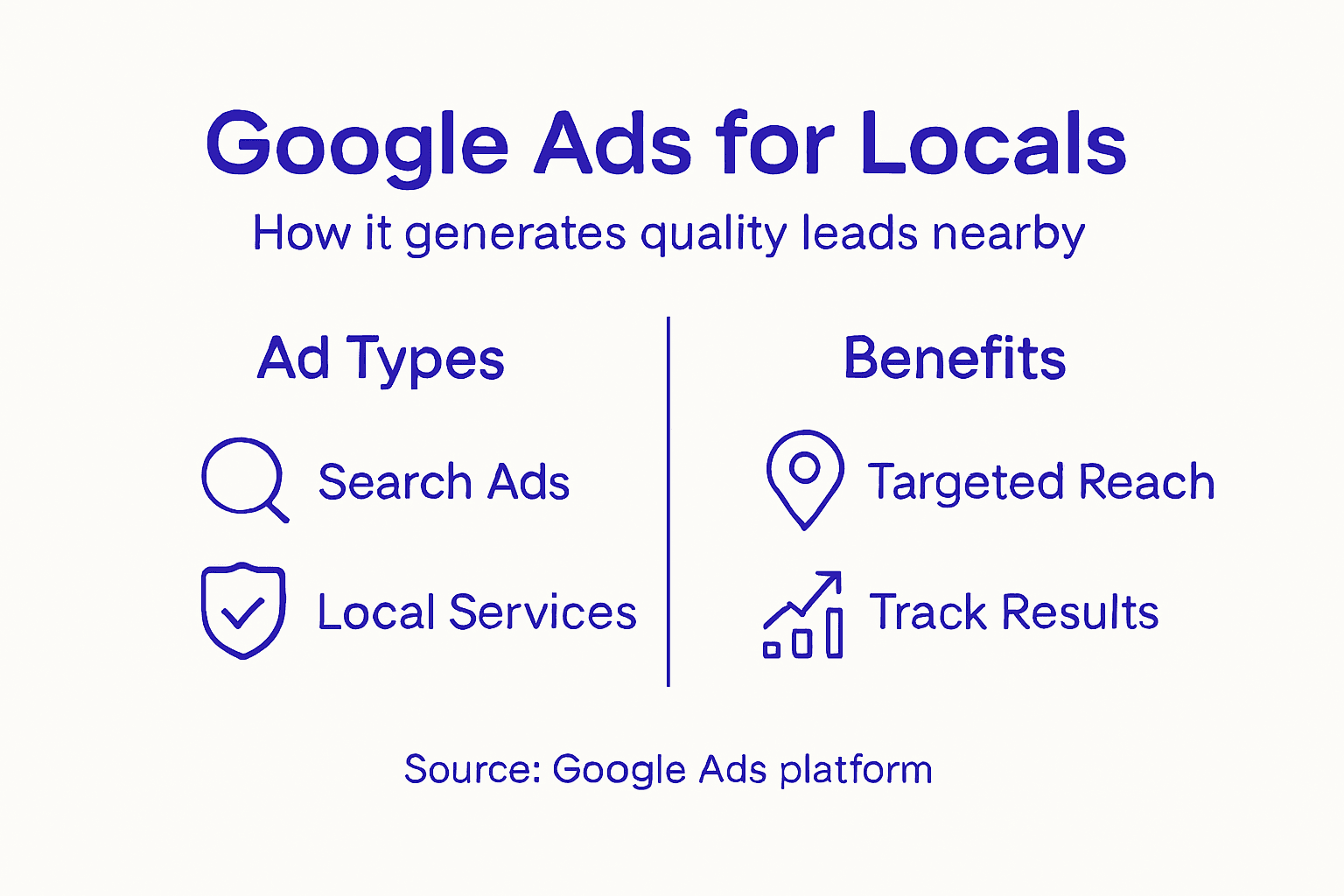
Google Ads represents a powerful digital marketing platform designed specifically to help local service businesses connect with potential customers through targeted online advertising. These ads enable service providers to appear prominently in search results, allowing businesses to reach customers precisely when they are searching for specific services in their local area.
At its core, Google Ads operates on a pay-per-click (PPC) model, which means businesses only pay when potential customers interact with their advertisements. For local service providers, this translates into a cost-effective approach to generating high-quality leads. Local service advertising platforms provide unique opportunities for businesses to showcase their services directly to interested customers.
Key features of Google Ads for local services include:
- Targeted geographic advertising that reaches customers in specific service areas
- Flexible budget controls allowing businesses to set daily spending limits
- Performance tracking with detailed metrics on ad interactions
- Options for displaying business credentials like Google Guaranteed badges
- Immediate visibility in search results above traditional organic listings
The platform works by matching business services with user search intent, displaying ads to potential customers based on relevance, location, and search queries. Local Services Ads take this a step further by only charging businesses when direct customer contact occurs, creating a performance-driven advertising model.
Pro tip: Start with a modest budget and gradually increase spending as you understand which keywords and targeting strategies generate the most qualified leads for your specific service business.
Main Ad Types and How They Work
Google Ads offers multiple advertising formats designed to meet the specific needs of local service businesses. Local service advertising campaigns represent a specialized approach that differs significantly from traditional digital marketing strategies, focusing on generating high-quality leads through targeted search placement.
The primary ad types for local services include:
- Search Network Ads: Appear directly in Google search results when users look for specific services
- Local Services Ads: Prominently displayed at the top of search results with verified business credentials
- Display Network Ads: Showcase visual advertisements across websites and apps related to local services
- Remarketing Ads: Target previous website visitors to re-engage potential customers
- Performance Max Campaigns: Utilize machine learning to optimize ad placement across multiple Google platforms
Search Network Ads work by matching business keywords with user search queries, allowing local service providers to appear precisely when potential customers are seeking their specific services. These ads operate on a pay-per-click (PPC) model, meaning businesses are charged only when someone clicks on their advertisement.
Local Services Ads take a more specialized approach by focusing on lead generation rather than simple clicks. These ads include unique features like Google Guaranteed or Google Screened badges, which help build immediate trust with potential customers by verifying the business’s credentials and professional standing.
Local service businesses can significantly improve their visibility and credibility by leveraging these targeted advertising strategies.
Pro tip: Experiment with different ad types and track performance metrics closely to identify which format generates the most qualified leads for your specific service business.
Here’s a concise comparison of the main Google Ads types for local services:
| Ad Type | How It Reaches Customers | Best Use Case | Cost Model |
|---|---|---|---|
| Search Network Ads | Matches user queries in search results | Service demand fulfillment | Pay-per-click (PPC) |
| Local Services Ads | Prominent position with verified badge | Lead generation and trust | Pay-per-lead |
| Display Network Ads | Visual banners on related sites and apps | Local brand awareness | Pay-per-click (PPC) |
| Remarketing Ads | Targets previous website visitors | Re-engage undecided users | Pay-per-click (PPC) |
| Performance Max | Automated placement across Google platforms | Broad reach and automation | Pay-per-lead/click |
Bidding, Budgets, and Placement Explained
Understanding the intricacies of Google Ads bidding and budgeting is crucial for local service businesses looking to maximize their advertising investment. Local service advertising strategies provide a unique approach to managing advertising spend, focusing on lead generation rather than traditional click-based models.
The key components of Google Ads budgeting and placement include:
- Weekly Budget Setting: Businesses can control total advertising spend by establishing weekly budget limits
- Geographic Targeting: Ads are restricted to specific service areas to ensure relevant local exposure
- Lead-Based Pricing: Payment occurs only when genuine customer leads are generated
- Bid Optimization: Automatic adjustments to maximize visibility and lead potential
- Performance-Driven Placement: Top search result positions based on multiple factors
Bidding in Google Ads operates differently for local service businesses compared to traditional advertising models. Instead of paying for every click, businesses set maximum bid amounts for specific types of leads. This performance-based approach ensures that companies only invest in high-quality, relevant customer interactions.
Successful local service advertising requires a strategic approach to budget allocation and continuous performance monitoring.
Search result placement is determined by a complex algorithm that considers multiple factors beyond simple monetary bidding. Google evaluates business credentials, ad relevance, customer reviews, and historical performance to determine ad positioning. This means that verified and well-performing businesses can achieve top placements even with more conservative budgets.


Pro tip: Start with a conservative weekly budget and gradually increase spending as you gain insights into which lead types and keywords generate the most valuable customer interactions.
Benefits and Drawbacks for Service Providers
Local service businesses face a complex landscape of opportunities and challenges when utilizing Google Ads. Online advertising strategies offer significant potential for growth, but require careful navigation of their unique ecosystem.
Key benefits for service providers include:
- Targeted Lead Generation: Direct connection with potential customers actively seeking services
- Cost-Effective Marketing: Pay only for actual leads, not just clicks
- Enhanced Credibility: Google Verified badges increase customer trust
- Precise Geographic Targeting: Ads appear only to customers in your service area
- Performance Tracking: Detailed metrics to optimize advertising strategy
The verification process plays a crucial role in determining a business’s advertising potential. Google thoroughly screens service providers, which means businesses must maintain high professional standards to participate. This screening helps eliminate unqualified providers and protects consumers, but can also create barriers for newer or smaller businesses.
Not all service providers will qualify for Google’s advertising platforms, making initial entry a competitive process.
Drawbacks of Google Ads for local services are equally important to understand. These include potential high costs for competitive industries, limited control over lead quality, and the ongoing need to maintain excellent customer reviews and ratings. Some businesses may find the platform’s requirements and constant algorithm changes challenging to navigate consistently.
Pro tip: Invest time in understanding Google’s verification requirements and maintaining a stellar online reputation to maximize your advertising potential.
Common Pitfalls and Ways to Avoid Wasting Budget
Managing Google Ads effectively requires strategic planning and continuous optimization to prevent unnecessary spending. Online advertising strategies emphasize the importance of careful budget management and targeted approach.
Common budget-wasting pitfalls for local service providers include:
- Overly Broad Geographic Targeting: Displaying ads outside primary service regions
- Inadequate Keyword Selection: Using generic terms that attract unqualified leads
- Neglecting Performance Tracking: Failing to analyze and adjust campaign metrics
- Inconsistent Business Credentials: Outdated licensing or insurance documentation
- Ignoring Lead Quality Metrics: Not screening or evaluating incoming contact requests
The budget optimization process requires continuous monitoring and strategic adjustments. Businesses must develop a systematic approach to evaluating lead sources, understanding conversion rates, and refining their targeting parameters. This means regularly reviewing which geographic areas, keywords, and times of day generate the most valuable customer interactions.
Successful Google Ads campaigns demand constant attention and willingness to make data-driven adjustments.
Implementing robust tracking mechanisms is crucial for preventing budget waste. This involves setting up detailed conversion tracking, creating specific lead qualification criteria, and developing a systematic method for assessing the true value of each generated lead. Businesses should be prepared to quickly eliminate underperforming ad strategies and reallocate resources to more effective channels.
The table below summarizes common pitfalls and countermeasures in Google Ads for service providers:
| Pitfall | Resulting Problem | Practical Solution |
|---|---|---|
| Broad geographic targeting | Wasted budget on far leads | Refine service area targeting |
| Generic keyword selection | Attracts unqualified inquiries | Use service-specific keywords |
| Neglecting campaign metrics | Inefficient ad spend | Monitor and adjust weekly |
| Outdated credentials | Reduced ad eligibility | Regularly update documentation |
| Ignoring lead quality | Low ROI from campaigns | Review and qualify leads |
Pro tip: Create a weekly review process to analyze lead quality, conversion rates, and spending efficiency, allowing you to make rapid, informed adjustments to your advertising strategy.
Unlock Your Local Lead Potential with Expert Google Ads Management
Struggling to generate quality local leads through Google Ads can be frustrating and costly. This article highlights common challenges like optimizing your budget, targeting the right geographic area, and leveraging features such as Google Guaranteed badges. Understanding how to navigate these complexities is crucial for service providers aiming to maximize their return on investment and build trust with potential customers.
At City Web Company, we specialize in tailored PPC & Paid Ad Strategies that focus on local service businesses. Our approach helps you avoid common pitfalls like broad targeting or under-optimized bidding while improving lead quality through precise campaign management and continuous analytics & conversion tracking. Whether you need help refining your Google Ads setup or want to integrate smarter digital advertising tactics, our experts are ready to guide you.
Ready to transform your Google Ads into a powerful lead generation tool that drives real growth for your business? Contact us today at City Web Company to start building a customized plan designed to increase your visibility, credibility, and customer base now.
Frequently Asked Questions
What is Google Ads?
Google Ads is an online advertising platform that helps businesses reach potential customers through targeted advertising, allowing them to appear prominently in search results.
How does Google Ads generate local leads for service providers?
Google Ads connects local service businesses with customers actively searching for those services in their area, making it an effective lead generation tool.
What are the key advertising formats available in Google Ads for local services?
Key ad formats include Search Network Ads, Local Services Ads, Display Network Ads, Remarketing Ads, and Performance Max Campaigns, each catering to different advertising goals.
What is the cost model used in Google Ads?
Google Ads operates primarily on a pay-per-click (PPC) model, charging businesses only when potential customers interact with their ads, or in the case of Local Services Ads, when genuine leads are generated.
Recommended
- Google Ads for Local Businesses: The Ultimate Guide to Getting More Customers – City Web Company | Digital Marketing Agency
- Why Invest in Google Ads for Local Services
- Google Local Service Ads: Get More Leads, Not Just Clicks – City Web Company | Digital Marketing Agency
- How to Advertise Locally on Google: A Complete Guide for Businesses – City Web Company | Digital Marketing Agency
These articles were popular with other readers too: