Discover essential law firm website strategies that attract clients through optimized design, local SEO, compelling content, and conversion-focused features that drive results.
A Strategic Guide to Web Design for Small Businesses
Most business owners view their website as a digital brochure, a static page with a phone number and a list of services. This perception is the single most expensive misconception in digital marketing, and it is why so many websites become a sunk cost instead of a revenue-generating asset.
Effective web design for small businesses is not about creating an online placeholder. It is about building a strategic tool engineered from the ground up to drive measurable growth.
Table of Contents
Why Your Website Is More Than a Digital Brochure

Thinking of your website as a brochure leads to critical failures. It results in a site that might look pleasant but does nothing to generate phone calls, book appointments, or secure new projects. This passive approach is a relic of an older internet, and it is actively costing you money.
The true cost of a "brochure" site is not what you paid for it. It is measured in the revenue lost every time a potential customer searches for local services and finds your competitors instead of you.
The Hidden Costs of a Passive Website
A website without a clear strategy is more than a missed opportunity; it is an active drain on your resources. The core problem is that it operates as a pure expense, not an investment that delivers a measurable return.
This is how that cost manifests:
- Wasted Marketing Spend: Any money invested in advertising has no effective destination. You are sending potential customers to a digital dead end, a page not built to guide them toward a purchase.
- Inability to Track ROI: A simple brochure site provides zero data. You cannot determine which marketing efforts are working or how customers are finding you, leaving you to make critical business decisions without visibility.
- Damaged Credibility: An outdated or poorly functioning website erodes trust. Today, 75% of consumers admit to judging a business’s credibility based on its website design. A static site signals you may not be professional or current.
A website's job is not to simply exist. Its job is to work for your business 24/7, engaging potential customers and guiding them to take a specific, valuable action. This is the fundamental disconnect in most small business marketing. The goal is not just to be online; it is to have an online presence that functions as a predictable engine for growth.
Consider a local plumber with a brochure site listing "Plumbing Services." A competitor with a strategic website will have dedicated pages for "Emergency Drain Cleaning in [City]" and "Water Heater Installation," directly matching what real customers are searching for. This is what turns a website from a cost center into a lead generation tool.
The difference comes down to a shift in mindset. A strategic website is designed with a clear business goal, built to be found by motivated customers, and structured to turn traffic into measurable revenue. It provides the clarity needed to grow your business with confidence.
If your website feels more like a forgotten flyer than an active member of your sales team, it is time to rethink its role. At City Web Company, we help businesses transform their digital presence from a passive expense into a strategic growth asset.
Defining Your Website’s Primary Business Goal
Before considering colors, fonts, or layouts, we must define the single most important part of your website: its job. Many business owners jump straight into design and end up with a beautiful, expensive website that does nothing for their bottom line.
A successful web design for small businesses does not start with an aesthetic. It starts with a mission.
Without a clear, singular purpose, a website becomes a confusing digital brochure. It presents a jumble of information, hoping visitors will figure out what to do next. They will not. They will become confused, frustrated, and click away, often directly to your competitor.
The first step is to define your website's primary function. This is not a list of wishes. It is the one primary directive that will shape every design and content decision.
Identifying Your Primary Conversion Goal
Think of your website as your most valuable employee, working 24/7. What is the one task you need it to perform perfectly every day to bring the most value to your business? That task is your primary conversion goal. It is a specific, measurable action you want every qualified visitor to take.
For a local service business, this goal almost always falls into one of three categories:
- Generate a Qualified Phone Call: The visitor needs to call you now. This is critical for emergency services like a 24/7 plumber or an HVAC repair company.
- Submit a Lead or Quote Form: The visitor provides their details in exchange for an estimate or consultation. This is ideal for contractors, landscapers, and law firms where the sales process is more involved.
- Book an Appointment: The visitor puts themselves directly on your calendar using an integrated scheduling tool. This is perfect for dentists, chiropractors, and med spas.
Why only one? Because choosing a single primary goal forces clarity. If your law firm’s main objective is to book consultations, every element, from the homepage headline to the service page layout, must funnel users toward your scheduling link. A secondary goal, like a newsletter sign-up, can exist, but it must never compete for attention.
A website with a clearly defined purpose is a finely tuned sales funnel. It anticipates what your customer needs and makes it simple for them to take the next step toward hiring you. This focus removes guesswork. You stop hoping visitors find your contact info and start building an intentional pathway that leads them directly to the one action that generates revenue.
Aligning Your Website to Your Business Goal
Once you have defined that primary goal, every part of the site must work to support it. This is what separates a high-performance website from a passive digital business card. A website built to generate phone calls for an electrician will look and function completely differently from one designed to book appointments for a veterinarian.
Consider the user’s mindset. Someone with a flooded basement does not care about your company history; they need a phone number, front and center, on every single page. On mobile, it needs to be a large "Click to Call" button.
Conversely, a homeowner considering a major kitchen remodel needs to see your portfolio, understand your process, and read reviews before they are guided to a detailed quote request form. The user journey is different, so the design must be different.
This strategic alignment ensures your website is an active, hardworking tool built to achieve a specific business outcome. It is the foundation of a site that works for you, turning online traffic into real-world revenue.
How Professional Design Builds Customer Trust
For any local business, trust is the ultimate currency. Since most customers now find you on Google first, your website is often the first handshake. That initial impression is formed in milliseconds, and it is in that split-second judgment of your site’s design that a potential customer decides if you are credible.
A cluttered, slow, or outdated website sends a powerful message that you do not care about details. If your digital storefront is a mess, a visitor will naturally wonder if that same lack of care extends to your actual services.
This is not a theory; it is a business reality. Research shows that 94% of first impressions are design-driven. For service businesses, 75% of consumers will judge your company's entire credibility based on your website's design alone.
This means professional web design for small businesses is not an expense. It is a direct investment in the trust required to earn a new customer.
The Anatomy of a Trustworthy Website
Trust does not happen by accident. It is the result of a strategic approach to design that prioritizes clarity, consistency, and user confidence. A professional website uses specific elements that work together to signal to visitors that they are in the right place.
These foundational trust signals include:
- Visual Consistency: A cohesive design using the same colors, fonts, and branding on every page creates a feeling of stability and professionalism. Inconsistent visuals feel chaotic and erode trust.
- High-Quality Imagery: Authentic photos of your team, your work, and your actual business are powerful. They prove you are a real company with real people, setting you apart from competitors who use generic stock photos.
- Simple, Intuitive Navigation: A visitor should be able to find what they need quickly. If your contact info or service details are buried, users get frustrated and assume you are disorganized or hiding something.
A clean, mobile-friendly design that loads quickly does not just look good; it communicates respect for the user's time and attention. This simple act of consideration is one of the most effective ways to build subconscious trust from the first click.
Essential Trust Signals for Service Businesses
Beyond visuals, your website must show concrete proof of your reliability. These are the non-negotiable elements that answer a potential customer’s unspoken questions: Are you legitimate? Are you good at what you do? Can I trust you?
For any service-based business, this means you need:
- Prominently Displayed Reviews and Testimonials: Social proof is critical. Featuring genuine customer reviews with names and locations builds immediate credibility.
- Industry Certifications and Affiliations: Displaying logos from the Better Business Bureau, trade associations, or licensing boards proves your expertise and accountability.
- Clear and Accessible Contact Information: A visible phone number, physical address, and contact form show you are an established, reachable business, not a temporary operation.
- A Secure Foundation: Professional design integrates critical security. Understanding essential website security best practices is paramount for protecting customer data and building confidence.
By weaving these elements into your site, you move from just having a website to owning a strategic asset that actively builds the trust needed to turn a visitor into a paying customer. We dive deeper into this topic in our article on building customer confidence with professional websites. This is how we shift from the why of strategy to the how of building a site that customers instinctively choose.
Designing for Conversions, Not Just Looks
Many business owners fall into a common trap. They invest in a beautiful website, only to find they have built a costly digital sculpture that produces zero leads. A stunning site that does not make your phone ring or fill your inbox with quote requests is a failed marketing investment.
This happens when aesthetics are prioritized over function. Effective web design for small businesses is not about how the site looks; it is about what it makes a visitor do. Every choice, from the layout to the color of a button, must be a calculated move to guide users toward your business goal. Your website should be a tool built for action, not just admiration.
It comes down to understanding the person on the other side of the screen. A potential customer arrives on your site with a problem. Your design’s job is to make it simple for them to see you as the solution and show them exactly what to do next.
The Anatomy of a High-Performing Service Page
Your service pages are where the real work gets done. This is the moment a visitor decides whether to call you or click back to Google and find your competitor. To win them over, you must build a conversion pathway, an intuitive journey that takes a user from interest to action.
It is a straightforward process: good design builds trust, and trust wins customers.
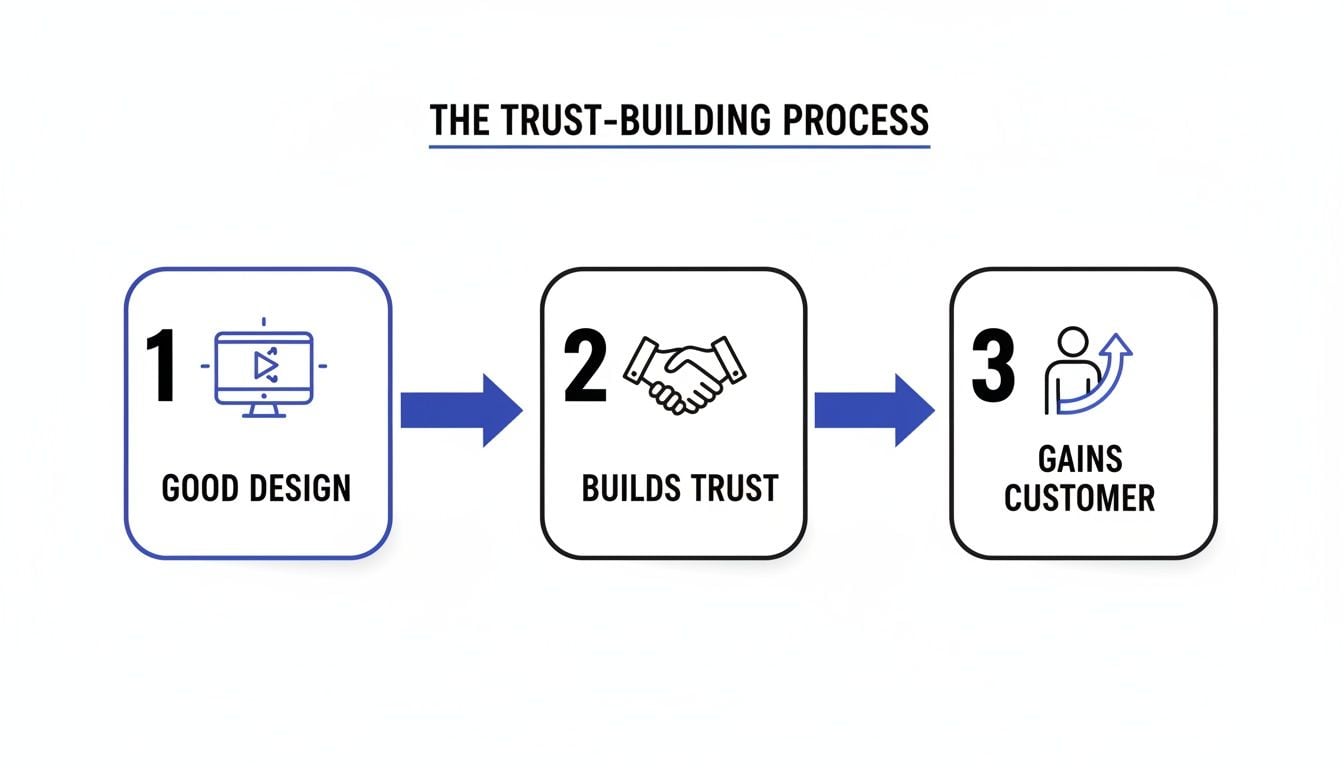

This visual makes it clear. A professional design is the foundation you need to earn a customer's business. Every element on the page must have a job. There is no room for decorative elements that get in the way of your goal.
Here are the key components of a page that converts:
- A Clear, Benefit-Driven Headline: Your headline must confirm the visitor is in the right place and state the value you offer. "Expert Furnace Repair in Denver" is effective. "Our Services" is not.
- Prominent Calls-to-Action (CTAs): Buttons like "Get a Free Estimate" or "Book an Appointment" must be impossible to miss. They should stand out visually and use strong, action-oriented language.
- Simple Lead Capture Forms: Only ask for what you absolutely need to start a conversation, typically name, phone, email, and a short message. A form with ten fields is a roadblock; a form with four feels effortless.
- Authentic Social Proof: Do not hide your best reviews on a separate page. Place genuine customer testimonials, case studies, and 5-star ratings directly on the service page to build confidence at the moment a visitor is evaluating you.
Mobile-First Design Is Non-Negotiable
A significant portion of your customers will find you on a smartphone. The person searching "emergency plumber near me" is not at a desktop computer. If your site is difficult to use on a phone, you are turning away paying customers.
A mobile-first design philosophy means your website is planned for the smallest screen first, then adapted for larger ones. This ensures the user experience is seamless on the devices your customers actually use to find and hire local services.
This is more than just having a site that "shrinks" to fit a screen. A true mobile-first design prioritizes critical actions.
It prioritizes:
- Click-to-Call Buttons: Your phone number should be a large, clickable button, often fixed to the top or bottom of the screen so it is always accessible.
- Thumb-Friendly Navigation: Menus and buttons must be easy for a thumb to tap without causing accidental clicks.
- Fast Load Times: Mobile users have little patience. A site taking longer than three seconds to load will see a significant drop-off in visitors.
- Readable Text: Your fonts need to be large and clear enough to read easily without pinching and zooming.
When you focus on these conversion-focused elements, you transform your website from a passive online brochure into an active, 24/7 lead-generating machine. The design stops being about personal taste and becomes a strategic framework for growing your business. Once a visitor's path to becoming a lead is clear and effortless, your website investment finally delivers a real, measurable return.
Integrating Your Website with Local SEO
Many business owners treat their website and local marketing as two separate jobs. This is a significant mistake. A stunning website is useless if no one in your service area can find it, and a local marketing campaign is a waste of money if it sends customers to a site that cannot convert them into leads.
Effective web design for small businesses and local SEO are two sides of the same coin. Your website is the foundation for getting seen in Google Search and, more importantly, in the Google Maps results where your customers are looking. SEO is not something you add on later; it must be integrated into the structure of your site from day one.
Building Your Digital Headquarters
Think of your Google Business Profile (GBP) as your digital storefront and your website as the headquarters that proves its legitimacy. Google constantly seeks signals that confirm your business is relevant and an authority in your field. A well-built website provides the exact proof Google needs to rank your GBP for valuable local searches.
This creates a powerful feedback loop. Your optimized GBP drives traffic to your website, and the expert content on your site proves to Google that you are an authority in your service area. In turn, Google rewards you by boosting your GBP’s ranking. Your website is not just a destination; it is the engine that powers your entire local search presence.
The shift to an online-first approach has reshaped the small business landscape. The data below shows not only the increase in website adoption but also the tangible financial cost of being left behind.
Website Adoption and Impact on Small Business Revenue
| Metric | 2020 | 2026 | Key Insight |
|---|---|---|---|
| Small Businesses with a Website | 64% | 78% | A strong online presence is quickly becoming a non-negotiable standard. |
| Average Annual Revenue Loss (Without Website) | – | $21,000 | Lacking a modern website directly translates to significant lost income. |
| Customer Acquisition Shift (rudys.ai analysis) | Offline | Online | The primary channel for finding local services has moved from offline to online. |
This table illustrates that having a professional website is no longer optional. It is a core component of a healthy business, and its absence has a measurable negative impact on your bottom line.
Essential On-Page SEO for Local Visibility
To make this work, your website needs to communicate effectively with search engines. This is done with specific on-page SEO tactics that tell Google what you do, where you do it, and why you are the best choice.
Here are the key elements your site must get right:
- Location-Specific Service Pages: Do not create a generic "Services" page. Build dedicated pages for each core service in each main city or neighborhood you cover. A page for "Emergency Plumbing in Bucktown, Chicago" will always outperform a vague page from a plumber who serves Chicago.
- Optimized Titles and Descriptions: These are the headlines and short descriptions people see in Google search results. They must include your service and location keywords to attract clicks from qualified local customers.
- Schema Markup: This code acts as a translator for search engines. It clearly tells Google your business name, address, phone number, and services, which removes guesswork and builds trust.
A website without local on-page optimization is like a ship without a rudder. It might look impressive, but it has no way to steer toward the customers who are actively searching for it.
For example, an electrician in Denver needs more than a homepage. They need a service page titled "EV Charger Installation in Highland, Denver" with content that addresses the specific needs of homeowners in that area. When that page is linked from their Google Business Profile, it creates a connection that tells Google this business is the most relevant expert for a user in that neighborhood.
Our guide on local search engine optimization provides a step-by-step process to get found. For businesses ready to take the next step, it is also important to choose the best SEO company to help you execute. This is how you stop competing in a crowded market and start dominating your specific service area.
Choosing the Right Web Design Partner for Growth
The success of your website depends on the quality of the team you hire. Many business owners, trying to manage costs, seek out the cheapest freelancer or a template solution, thinking a website is a commodity.
This mindset leads to failure. It results in a relationship with a vendor, someone who builds a website and then disappears. A vendor delivers a product. A strategic partner delivers a system designed for growth.
The Vendor vs. The Partner Mindset
Understanding the difference between these two approaches will determine whether your website becomes a valuable asset or a frustrating expense. A vendor takes your order. A partner asks probing questions, understands your business goals, and then builds a digital presence to achieve them.
To find a true partner, you must look past their portfolio and ask about their process. Their answers will reveal whether they think like a designer or a business strategist.
Here are the critical questions to ask any potential agency:
- Strategy and Goals: How will you translate our business goals into a concrete website strategy?
- Conversion Tracking: What is your process for tracking phone calls and form submissions so we can measure ROI?
- SEO Integration: How will you build the site to rank in local search for our most important services and service areas?
- Performance Measurement: How will we know if the website is working? What metrics will you track, and how often will we review them?
A vendor will talk about features, colors, and the number of pages. A partner will talk about conversion rates, cost per lead, and local search visibility.
A System for Growth, Not Just a Website
The right web design partner delivers more than a collection of files. They deliver a strategic asset and the data to prove its value. They know the launch of the site is not the finish line; it is the starting line.
A true partner does not just build you a website; they build a predictable engine for growth and provide you with the dashboard to see it working.
This is a fundamental shift from buying a product to entering a relationship focused on results. A partner is accountable for performance because they have built the systems to measure it. They can show you exactly how your investment is turning into tangible business opportunities.
This approach provides the strategic clarity most business owners lack. It ends the cycle of spending on marketing without knowing what works and gives you the confidence to invest in activities that generate a measurable return.
If you’re ready to have a conversation about your business goals, not just website features, let's talk. We can explore how a performance-focused web design for small businesses can become a reliable source of growth for your company.
Frequently Asked Questions About Small Business Web Design
When considering a new website, most business owners have the same practical questions about cost, timeline, and ongoing support. Here are direct answers to help you plan with clarity.
How Much Should a Small Business Website Cost?
Viewing website cost as a simple expense is a flawed approach. It is an investment in a critical business asset. A professional, conversion-focused website can start from a few thousand dollars and exceed $25,000 for larger projects with custom functionality.
The final price depends on key factors:
- Strategic Depth: The amount of research into your goals, customers, and competition.
- Custom Design vs. Template: A custom site is engineered for your specific business goals, while a template is an adapted pre-built design.
- Content and SEO: The work involved in creating expert, search-optimized content that attracts and converts customers.
- Functionality: The inclusion of features like online scheduling, e-commerce, or client portals.
The real question is not about the price, but the return. A cheap website that brings in zero leads is a liability. A strategic site that becomes your primary source of new business pays for itself many times over.
How Long Does It Take to Build a Website?
For a professional build that delivers results, you should plan for a timeline of 6 to 12 weeks. This is the time required to execute the process correctly.
A rushed project always involves cutting corners on important steps. A proper build includes a discovery phase to define business goals, a wireframing stage to map the user experience, and a content phase to write copy that converts. Skipping these steps is the fastest way to get a website that looks adequate but fails to perform.
What Is a Website Maintenance Plan?
A common myth is that a website is a "set it and forget it" asset. The opposite is true. A website maintenance plan is an ongoing service to keep your site secure, up-to-date, and running at peak performance after launch.
A solid maintenance plan covers the essentials:
- Software Updates: Keeping your platform and its plugins updated to patch security vulnerabilities.
- Security Scans: Actively scanning for malware and other threats.
- Backups: Creating regular, reliable copies of your site for instant restoration if needed.
- Performance Checks: Ensuring your site remains fast and functional for all visitors.
Ignoring maintenance is a significant risk. A hacked or broken site can damage your business reputation, harm your search rankings, and negate your initial investment.
At City Web Company, we do not just build websites; we build strategic growth systems. If you are ready to have a conversation about turning your online presence into a predictable engine for new business, we invite you to schedule a discovery call. Let's discuss your goals and map out a clear path to achieve them.
Learn more and connect with our team at https://citywebcompany.com.
These articles were popular with other readers too: