
Follow a proven website design process built for HVAC, plumbing, and landscaping businesses to generate more local leads and convert more visitors into customers.
Local SEO guide for attorneys: boost visibility & clients
Attracting local clients online remains one of the biggest challenges for attorneys competing in crowded search markets. When potential clients search for legal help in your area, appearing prominently in local search results can make the difference between a thriving practice and missed opportunities. This guide provides practical, step-by-step local SEO strategies designed specifically for attorneys who want to improve their search visibility, attract high-intent local clients, and grow their practice through targeted digital marketing.
Table of Contents
Table of Contents
- Key takeaways
- Understanding the local SEO landscape for attorneys
- Preparing your online presence for local SEO success
- Executing local SEO strategies: optimizing for visibility and client engagement
- Measuring results and refining your local SEO efforts
- Explore expert local SEO services for law firms
- FAQ
Key Takeaways
| Point | Details |
|---|---|
| Ranking factors | Google uses relevance, distance, and prominence to rank local law firms, so focus on these factors to improve visibility. |
| GBP optimization impact | Claiming and fully optimizing Google Business Profile for each location significantly improves local search visibility. |
| Localized content pages | Creating dedicated city and practice area pages with locally tailored content drives 48 percent more local traffic than generic pages. |
| Reviews and citations | Consistent management of reviews and a strong citation footprint boosts local prominence and authority. |
Understanding the local SEO landscape for attorneys
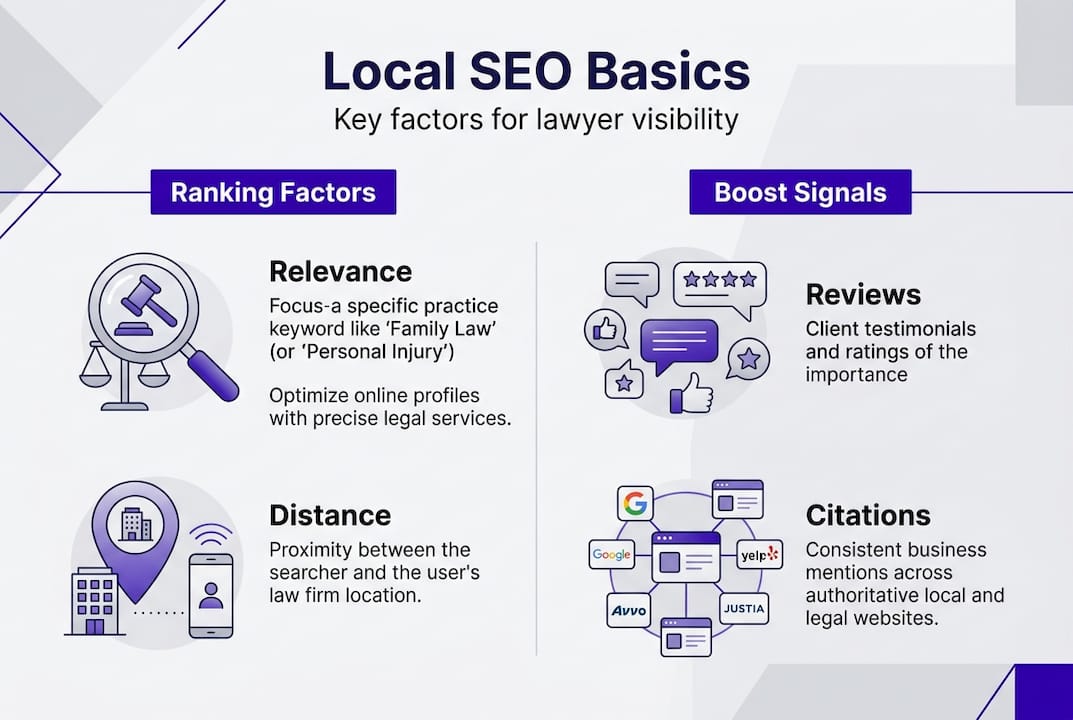
Google’s local search algorithm evaluates law firms based on three core factors: relevance, distance, and prominence. Relevance measures how well your Google Business Profile and website content match what someone is searching for. If a potential client searches for “personal injury attorney near me,” Google analyzes your business categories, descriptions, and website content to determine if you’re a relevant match.
Distance refers to proximity between the searcher’s location and your law firm’s physical address. Google prioritizes firms closer to the person conducting the search, which is why having accurate location information is critical. This factor becomes especially important for mobile searches, where users often need immediate legal assistance nearby.
Prominence encompasses your overall online authority, including reviews, citations, and general reputation across the web. GBP signals comprise approximately 32% of map pack ranking factors, making your Google Business Profile optimization essential. Reviews alone influence 18% of rankings, while citations contribute 37% to your local search authority.
Understanding these ranking factors helps you prioritize your SEO efforts effectively. Rather than spreading resources thin across countless tactics, you can focus on the elements that Google actually weighs when determining which attorneys to display in local search results.
Key ranking factors for attorney local SEO:
- Relevance of business profile and website content to search queries
- Physical proximity to the searcher’s location
- Quality and quantity of online reviews
- Consistency and breadth of local citations
- Overall online prominence and authority signals
“Local SEO isn’t about gaming the system. It’s about making it crystal clear to Google that you’re the right attorney for clients in your area searching for your specific legal services.”
Preparing your online presence for local SEO success
Before executing advanced local SEO tactics, you need a solid foundation. Start by claiming and fully completing your Google Business Profile for each physical office location. Multi-location firms should create independent listings for every office, as each location competes in its own local search market.
Your GBP setup requires accurate business categories that precisely describe your practice areas. Select your primary category carefully, as it significantly impacts which searches trigger your profile. Add secondary categories to cover additional practice areas, but avoid irrelevant categories that dilute your relevance signals.
Create dedicated city and practice area pages on your website with locally tailored content. Generic pages that simply swap city names won’t work. Each page should address location-specific legal issues, mention local courts, reference area-specific regulations, and demonstrate genuine knowledge of the community you serve. These dedicated pages drive 48% more local traffic compared to generic practice area pages.
Website technical performance directly impacts local rankings. Ensure your site is mobile-friendly, as most local searches happen on smartphones. Your website must meet Core Web Vitals standards for loading speed, interactivity, and visual stability. Slow, clunky websites frustrate users and send negative signals to Google about your ability to serve local clients effectively.

Build citations on reputable local and legal directories to establish prominence. Citations are online mentions of your firm’s name, address, and phone number. Focus on quality over quantity by prioritizing authoritative legal directories like Avvo, Justia, and FindLaw, plus local business directories and chamber of commerce listings.
Essential preparation checklist:
- Claim and verify Google Business Profile for each location
- Select accurate primary and secondary business categories
- Write compelling business descriptions with relevant keywords
- Create location-specific website pages with unique content
- Optimize website for mobile devices and Core Web Vitals
- Build citations on high-authority legal and local directories
Pro Tip: Regularly update your GBP with fresh photos of your office, team, and community involvement. Profiles with recent photos receive 42% more direction requests and significantly higher engagement, which signals activity and relevance to Google.
Executing local SEO strategies: optimizing for visibility and client engagement
Once your foundation is set, focus on execution. Client reviews represent one of the most powerful local SEO signals available. Reviews increase click-through rates by 71% and directly influence both rankings and client decision-making. Develop a systematic approach to requesting reviews from satisfied clients immediately after case resolution.
Respond to every review, positive or negative, to demonstrate engagement and build trust. Thank clients for positive feedback and address concerns professionally in negative reviews. This public interaction shows potential clients how you handle communication and builds confidence in your responsiveness.
Publish localized blog content that addresses legal issues specific to your service areas. Write about recent court decisions in your jurisdiction, changes to local laws affecting residents, and client success stories that highlight your community involvement. This content establishes topical authority and captures long-tail search queries from potential clients researching specific legal situations.

Build local backlinks through genuine community partnerships. Sponsor local events, join your chamber of commerce, participate in bar associations, and contribute to community organizations. These relationships naturally generate high-quality local links that boost your prominence and authority.
Optimize meta titles and descriptions for every page using local keywords that include both your city and practice areas. A well-crafted meta title like “Chicago Personal Injury Attorney | Free Consultation” clearly signals relevance for local searches while encouraging clicks.
Implement structured data markup using schema.org vocabulary to help search engines understand your content better. Legal service schema can enhance your search listings with rich snippets showing practice areas, ratings, and contact information directly in search results.
High-impact local SEO actions:
- Request reviews systematically after every successful case outcome
- Respond to all reviews within 24-48 hours to show engagement
- Publish 2-4 localized blog posts monthly on relevant legal topics
- Build 5-10 quality local backlinks quarterly through partnerships
- Optimize all website pages with location-specific meta data
- Add structured data markup to practice area and location pages
- Update GBP weekly with posts about legal tips or firm news
| Action | Expected Result | Timeline |
|---|---|---|
| Review acquisition campaign | 71% higher click-through rate | 1-3 months |
| Localized content publishing | 48% increase in local traffic | 2-4 months |
| Local link building | Improved domain authority and rankings | 3-6 months |
| GBP optimization and updates | 42% more direction requests | 1-2 months |
| Schema implementation | Enhanced search listings with rich snippets | Immediate |
Pro Tip: Automate review requests using email sequences triggered after case milestones, but personalize the message to maintain authenticity. Monitor your online reputation weekly using tools that alert you to new reviews across multiple platforms, allowing quick responses that demonstrate your commitment to client satisfaction.
Understanding why legal firms need SEO helps you appreciate the competitive advantage these tactics provide in crowded legal markets.
Measuring results and refining your local SEO efforts
Tracking performance separates successful local SEO campaigns from wasted effort. Monitor your Google Business Profile insights to track impressions, clicks, phone calls, direction requests, and website visits. These metrics reveal how many people find your profile and what actions they take, providing direct feedback on your local visibility.
Use Google Analytics to assess website traffic from local searches, paying attention to bounce rates and conversion goals. Set up location-based segments to isolate traffic from your target geographic areas. High bounce rates on local landing pages indicate content misalignment or poor user experience that needs immediate attention.
Track local rankings for relevant keywords combining your practice areas with city names. Monitor both map pack rankings and organic search positions. Rankings fluctuate, but consistent tracking reveals trends and helps you identify which optimization efforts drive improvements.
Regularly verify NAP consistency across all online directories and citations. Inconsistent information confuses Google and dilutes your local SEO signals. Audit your citations quarterly to catch and correct discrepancies before they impact rankings.
Troubleshoot ranking drops by reviewing recent changes to your Google Business Profile, website, or review profile. Sudden drops often correlate with GBP edits, website migrations, negative review surges, or competitor improvements. Identifying the timing helps you pinpoint the cause and implement corrections.
Local SEO can improve inquiries by 180% in six months and increase leads by 400% when executed properly, demonstrating clear ROI for attorneys willing to invest in systematic optimization.
Critical metrics to monitor:
- GBP impressions and click-through rates
- Direction requests and phone calls from GBP
- Website traffic from local organic searches
- Conversion rates for local landing pages
- Local keyword rankings in map pack and organic results
- Review velocity and average rating trends
- Citation accuracy across major directories
| Metric | Tool | Success Threshold |
|---|---|---|
| GBP impressions | Google Business Profile Insights | 20%+ monthly growth |
| Local website traffic | Google Analytics | 15%+ quarterly increase |
| Map pack rankings | Local rank tracking tools | Top 3 for primary keywords |
| Review rating | Reputation management platforms | 4.5+ stars average |
| Citation consistency | Citation audit tools | 95%+ accuracy |
| Conversion rate | Google Analytics goals | 3-5% for legal services |
Pro Tip: Set up monthly SEO reports that track these key metrics over time, allowing you to spot trends and make data-driven adjustments. Share these reports with your team to maintain accountability and celebrate wins, keeping everyone focused on online marketing strategies that actually move the needle for your practice.
Explore expert local SEO services for law firms
Implementing comprehensive local SEO requires expertise, consistent effort, and ongoing optimization. City Web Company provides specialized local SEO services designed specifically for law firms seeking to dominate local search results and attract more qualified clients.
Our team manages every aspect of your local search presence, from Google Business Profile optimization and review management to localized content creation and citation building. We understand the unique challenges attorneys face in competitive markets and develop customized strategies that deliver measurable results. Whether you need help establishing your local foundation or scaling an existing presence across multiple locations, our digital marketing services accelerate your ROI through proven local SEO tactics. Explore our comprehensive services to discover how expert support can transform your local visibility and client acquisition.
FAQ
What is the most important factor in local SEO for attorneys?
Google Business Profile optimization stands as the single most important factor, as GBP signals account for approximately 32% of local map pack rankings. Within GBP optimization, ensuring relevance through accurate categories and descriptions, maintaining proximity through correct location data, and building prominence through reviews and engagement all contribute significantly. High-quality reviews and accurate citations across the web reinforce your prominence and trustworthiness in Google’s eyes.
How long does it take to see results from local SEO for law firms?
Results typically begin showing between 3 to 6 months after implementing a comprehensive local SEO strategy. Initial improvements in GBP visibility and website traffic often appear within the first month, while significant ranking improvements and increased client inquiries usually manifest around the three to four month mark. Consistent optimization, regular content publishing, and active review management accelerate outcomes and compound results over time.
What are the best ways to get more client reviews locally?
Ask clients promptly after successful case resolution when satisfaction is highest, using personalized email or text messages with direct links to your review profiles. Implement automated review request systems that trigger at appropriate case milestones, but customize messages to maintain authenticity and comply with bar association advertising rules. Respond to every review you receive to encourage ongoing feedback and demonstrate your appreciation for client input, which motivates others to share their experiences.
Should a law firm have multiple Google Business Profiles for different locations?
Yes, every distinct physical office location must have its own independent Google Business Profile to maximize local search visibility. Each profile competes in its specific geographic market and captures location-specific search demand from potential clients in that area. Attempting to serve multiple locations with a single profile dilutes your local relevance signals and prevents you from ranking well in any particular market, significantly limiting your ability to attract clients across all your service areas.
Recommended
These articles were popular with other readers too: