

Discover the top 3 online branding tools for attorneys 2026. Compare agencies to enhance your digital presence and attract clients effectively.
Why Engage Local Audiences: Build Trust and Loyalty
Local audience engagement is defined as the practice of building authentic, two-way relationships between a business and the community it serves. Businesses that engage local audiences consistently outperform those relying on broad national campaigns because proximity creates trust, and trust drives repeat business. Research from the Joint Research Centre confirms that engagement improves policy quality and community trust across sectors, a principle that applies directly to local marketing. Understanding why engage local audiences matters is the first step toward building a customer base that stays loyal, refers neighbors, and actively advocates for your brand.
Table of Contents
What are the key benefits of engaging local audiences?
Local audience engagement delivers measurable advantages that broad marketing simply cannot replicate. The most significant benefit is trust. When your business speaks directly to the neighborhood, references local landmarks, and addresses community-specific concerns, customers recognize that you understand their world. That recognition converts faster than any generic ad.
The benefits of local engagement extend well beyond initial conversions:
- Higher trust and credibility. Customers are more likely to hire a business that feels like part of their community rather than a faceless national brand.
- Better message relevance. A plumber advertising in Denver can speak to altitude-related pipe issues. A landscaper in Phoenix can address desert-specific irrigation. Specificity earns attention.
- Stronger customer loyalty. Repeat business grows when customers feel a personal connection. Local engagement creates that connection consistently.
- Word-of-mouth amplification. Satisfied local customers refer neighbors, post reviews, and share content. That organic reach costs nothing and converts at a high rate.
- Competitive insulation. A locally trusted brand is far harder for a national competitor to displace than a business with no community ties.
The importance of local audience development shows up in public sector research too. 97% of surveyed public administrations plan to continue citizen engagement initiatives after experiencing improved outcomes and stronger community trust. That finding translates directly to business: when you engage your local audience, the results are good enough that you keep doing it.
Local engagement also increases willingness to participate in future programs. Community trust grows with participation, promoting cooperative relationships and long-term loyalty. For a local service business, that means customers who return, refer others, and give you the benefit of the doubt when something goes wrong.
How does community-centric messaging enhance engagement and loyalty?
Community-centric messaging is the practice of crafting marketing content that reflects the specific experiences, values, and needs of a defined local audience rather than a broad demographic. It is the opposite of a generic tagline applied across 50 markets. The difference in impact is significant.
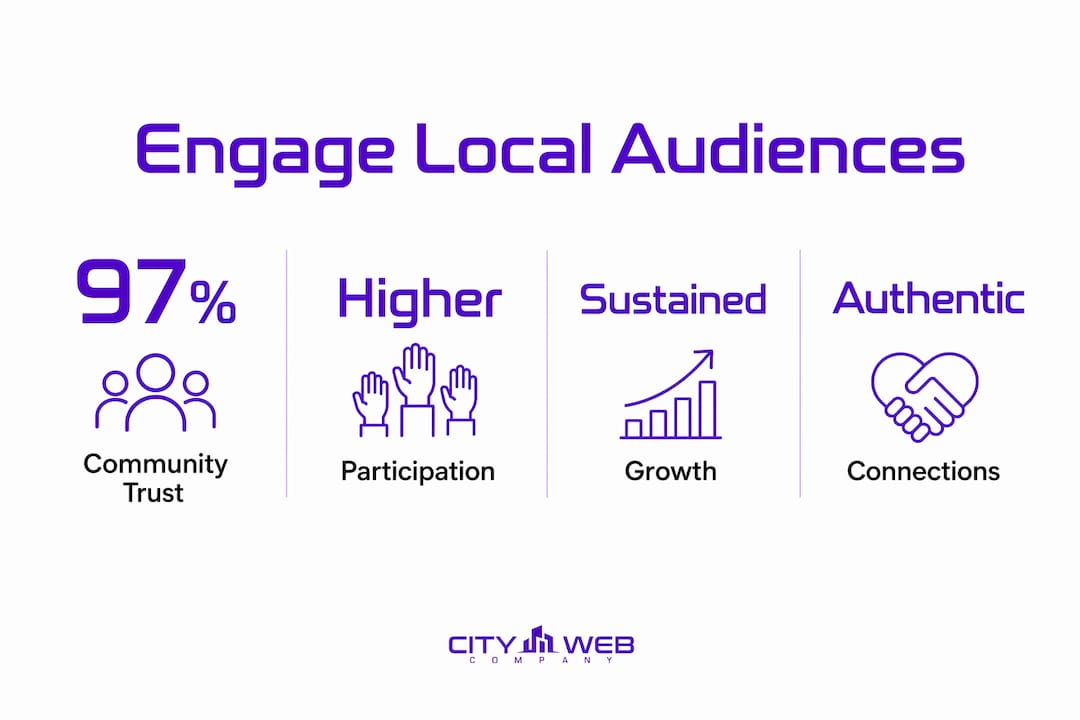
Localized messaging builds stronger trust than national campaigns because it demonstrates visible local impact. Customers who see their own neighborhood, hear their own concerns addressed, and recognize familiar faces in your content respond with higher participation rates and stronger advocacy. That is not a soft benefit. It shows up in repeat bookings, referrals, and online reviews.
Effective community-centric messages share several characteristics:
- Local voices. Feature real customers, employees, or community members rather than stock photography or generic testimonials.
- Specific local data. Reference your city’s growth rate, a local event you sponsored, or a neighborhood problem your service solved.
- Authentic imagery. Use photos of your actual team, your actual service area, and real job sites rather than polished national brand visuals.
- Neighborhood-level specificity. Name the zip codes, subdivisions, or towns you serve. Vague geography signals a lack of genuine local presence.
The paradox of local engagement is counterintuitive but well-documented: the more specific the message, the broader its influence. A story about one family’s flooded basement in a specific suburb resonates with every homeowner in that area. A generic story about water damage resonates with no one in particular.
Brands that shift from controlling their message to enabling local voices see the strongest results. Enabling local actors to shape messaging cultivates sustainable loyalty and better advocacy because it taps into trust that no external strategy can manufacture. For a local HVAC company or pest control business, that means letting your best customers tell your story in their own words.
Pro Tip: Ask your top three customers to record a 30-second video testimonial on their phone. Unpolished, authentic video from a real neighbor outperforms a professionally produced ad in local social media feeds every time.
Which strategies effectively reach and engage local customers?
Reaching local customers requires a combination of digital precision and genuine community presence. The most effective approach combines local SEO, targeted advertising, content marketing, and real-world community involvement. Each tactic reinforces the others.
-
Build a local SEO foundation. Local SEO and geo-targeted ads are among the most reliable tactics for connecting with nearby customers. Claim and fully optimize your Google Business Profile. Use city and neighborhood names in your page titles, service descriptions, and blog content. City Web Company’s geo-targeted SEO approach focuses specifically on getting service businesses found by customers searching within their city.
-
Run geo-targeted paid ads. Paid search and social ads let you set a radius around your service area and show ads only to people within it. A moving company in Austin has no reason to pay for clicks from Houston. Tight geographic targeting reduces wasted spend and increases relevance. The local PPC strategies that work best combine radius targeting with ad copy that names the specific city or neighborhood.
-
Partner with local influencers and community members. Local micro-influencers, neighborhood Facebook group admins, and community organization leaders carry more trust than national celebrities within their zip code. Partnering with trusted locals and amplifying user-generated content creates community ties that paid ads alone cannot build.
-
Create content that addresses local needs. Content tailored to a local market’s context outperforms generic articles with a city name dropped in. Write about local weather patterns that affect your service, local regulations your customers need to know, or community events you participated in. That specificity signals genuine local expertise.
-
Host or sponsor local events. Showing up in person at a neighborhood fair, sponsoring a youth sports team, or hosting a free workshop at the local library builds recognition that no digital ad can replicate. Physical presence confirms that your business is genuinely part of the community.
-
Collect and share local reviews. Ask every satisfied customer to leave a Google review that mentions their neighborhood or the specific service they received. Reviews that name local areas improve your local search rankings and serve as social proof for nearby prospects.
Pro Tip: Set up a Google Business Profile post every two weeks featuring a completed local job, a customer quote, and the neighborhood name. It takes 10 minutes and signals consistent local activity to both Google and potential customers.
The audience engagement strategies that drive the most sustainable growth combine digital visibility with authentic community presence. Neither works as well alone.


How local ownership and participation drive sustainable engagement
Local ownership in marketing means giving community members a genuine role in shaping how your business shows up in their neighborhood. It goes beyond asking for reviews. It means involving local customers, employees, and partners in decisions about messaging, events, and community initiatives.
Participatory local engagement leads to more accurate solutions and strengthens relationships with communities. Local knowledge improves the fit of any campaign or initiative because the people closest to a problem understand it best. A landscaping company that asks its best customers what they wish more businesses understood about local soil conditions will produce content that resonates far more than anything a marketing team in another city could write.
The table below shows how local ownership changes outcomes across common business activities:
| Activity | Without local ownership | With local ownership |
|---|---|---|
| Content creation | Generic service descriptions | Customer stories tied to specific neighborhoods |
| Ad messaging | Broad benefit claims | Local problem-solution narratives |
| Event planning | Company-centered promotions | Community-centered gatherings with local partners |
| Review generation | Occasional requests | Systematic, relationship-driven asks |
| Referral programs | Passive word of mouth | Active local advocates with a clear role |
Local ownership leads to better oversight and accountability compared to one-way external campaigns. When local customers feel invested in your success, they become your most effective marketing channel. They correct misinformation about your business, defend your reputation in community forums, and bring in referrals without being asked.
Sustainable loyalty arises when local actors are empowered to shape messaging and priorities. That empowerment provides a level of trust that no external strategy can replicate. For a local service business, the practical implication is clear: involve your best customers in your marketing, and they will do more for your growth than any ad campaign.
The benefits of local marketing compound over time precisely because community relationships deepen with each positive interaction. A customer who helped you name a new service package, appeared in your social media content, or co-hosted a neighborhood event is not switching to a competitor. That depth of connection is the real competitive advantage of local engagement.
Building trust online requires the same principles that work offline: consistency, authenticity, and genuine responsiveness to community needs.
Key Takeaways
Engaging local audiences builds the kind of trust and loyalty that broad national campaigns cannot buy, making it the most cost-effective long-term growth strategy for local service businesses.
| Point | Details |
|---|---|
| Local trust outperforms broad reach | Community-specific messaging generates higher loyalty and advocacy than generic national campaigns. |
| Specificity increases influence | The more precisely your message reflects local experience, the wider its authentic reach within that community. |
| Local SEO is the entry point | Geo-targeted search and paid ads connect your business to customers actively searching in your service area. |
| Local ownership deepens loyalty | Involving customers in your marketing creates advocates who defend and promote your brand without prompting. |
| Participation compounds over time | Each positive local engagement increases willingness to participate again, building a self-reinforcing growth cycle. |
What I’ve learned from watching local businesses win and lose their communities
The businesses I’ve seen struggle with local engagement almost always make the same mistake. They treat “local” as a targeting parameter rather than a relationship. They run geo-targeted ads with national-sounding copy, claim a Google Business Profile and never touch it again, and wonder why their cost per lead keeps climbing.
The businesses that win do something different. They show up. They sponsor the little league team even when no one is tracking the ROI. They post photos of their actual crew at actual job sites in actual neighborhoods. They respond to every Google review, including the bad ones, with a specific and human reply. That consistency builds a reputation that paid ads cannot manufacture.
The insight that surprised me most is how much local customers notice when a business is genuinely present versus performing presence. A plumber who mentions the specific subdivision where he worked last week in his social post gets more engagement than one who posts a stock photo of pipes. A pest control company that writes a blog post about the specific ant species common in their city’s older neighborhoods gets calls from homeowners who feel understood.
The other mistake I see constantly is over-relying on digital tactics while ignoring offline community involvement. Local SEO matters enormously. Geo-targeted ads work. But the businesses with the deepest community roots combine digital visibility with physical presence. They attend city council meetings, sponsor local charity events, and know the names of their best customers’ kids. That is not scalable in the traditional marketing sense. It is, however, the reason those businesses have waiting lists.
My honest advice: pick two or three neighborhoods where you want to be the obvious choice, and go deep rather than wide. Dominate those zip codes with content, reviews, partnerships, and presence before expanding. Thin coverage across a whole metro produces mediocre results everywhere. Deep engagement in a defined area produces referral networks that grow on their own.
— Matt
How City Web Company helps local businesses connect with their communities
Local businesses that want to grow need more than a website. They need a complete digital presence that puts them in front of the right customers at the right moment.
City Web Company builds local digital marketing strategies for service businesses across industries including HVAC, plumbing, landscaping, pest control, and home services. The approach combines local SEO services that improve search visibility, geo-targeted paid advertising that reaches customers in your service area, and content that reflects genuine local expertise. Every campaign is built around the specific community your business serves, not a generic template applied across markets. Contact City Web Company to get a marketing plan built for your neighborhood.
FAQ
What does local audience engagement mean for a business?
Local audience engagement means building authentic, two-way relationships between a business and the specific community it serves. It goes beyond advertising to include content, events, reviews, and direct customer involvement in brand activities.
Why is engaging local audiences more effective than national campaigns?
Local campaigns outperform national ones because specificity builds trust. Customers respond to messages that reflect their own neighborhood, problems, and experiences rather than generic benefit claims.
How does local SEO support community engagement?
Local SEO makes your business visible when nearby customers search for your services. Combined with community-specific content and a fully optimized Google Business Profile, it connects digital visibility to genuine local presence.
What role do local customers play in sustainable business growth?
Local customers who feel genuinely involved in a business become active advocates. They refer neighbors, defend your reputation online, and return for repeat business at higher rates than customers acquired through broad advertising.
How quickly can local engagement strategies produce results?
Local SEO and geo-targeted ads can produce measurable lead increases within weeks. Deeper community trust and referral networks build over months as consistent engagement compounds into a recognizable local reputation.
Recommended
These articles were popular with other readers too: