

A conversion first playbook for movers: instant quotes, visible reviews, and instant lead routing. Get a booking ready site in 4–8 weeks.
Lead Generation for Lawyers: A Law Firm Owner’s Guide
Lead generation for lawyers is the process of attracting potential clients, qualifying their cases, and converting them into signed retainers through a structured marketing and intake system. Most law firm owners track clicks and form fills, but the real metric is signed cases. A lead that never converts costs your firm money. Understanding the full legal lead generation workflow, from first impression to signed agreement, is what separates firms that grow from firms that stay flat. Tools like Clio, LexGro, and Pareto Legal have documented exactly how this process works, and the findings are clear: volume without conversion is just noise.
Table of Contents
What is lead generation for lawyers, and why does it matter?
Lead generation for lawyers is defined as a multi-step sales funnel that moves a prospective client from awareness to action. The four funnel stages are Awareness, Interest, Decision, and Action. “Action” means the prospect submits a contact form, calls your office, or books a consultation.
A lead is not a client. Marketing attribution must connect campaigns to signed cases, not just inquiry counts. A firm running Google Ads that generates 200 leads per month but signs only 4 clients has a conversion problem, not a traffic problem. Fixing the wrong stage wastes budget.
The distinction matters because legal leads are expensive. Pay-per-click costs in competitive practice areas like personal injury or family law can run well above $100 per click. When you measure only lead volume, you miss the true cost per signed case. That number is the one that determines whether your marketing is profitable.
Understanding what is lead generation for legal firms also means recognizing that lead generation is not a single tactic. It is a system. SEO, paid ads, referrals, landing pages, intake scripts, and follow-up sequences all work together. Weak performance at any stage drags down the entire system.
What are the key stages of a legal lead generation workflow?
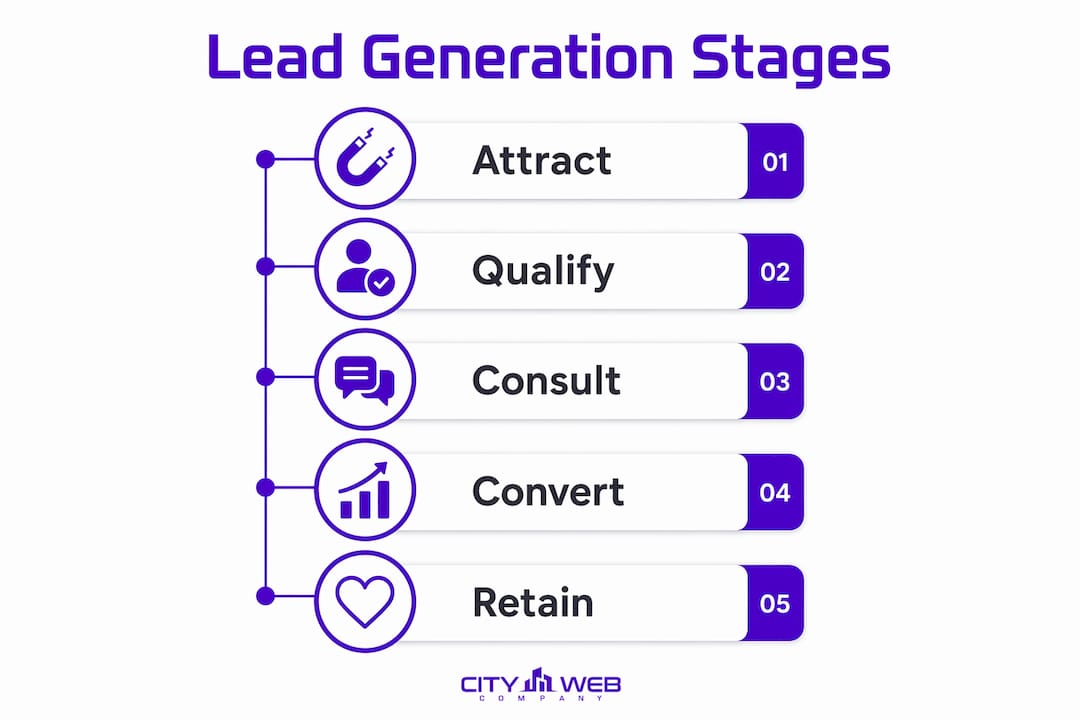
The legal lead generation workflow has four operational components: attracting contacts, qualifying leads, consulting, and converting. Each stage has its own inputs, outputs, and failure modes.
Attracting contacts
Attracting contacts means getting your firm in front of people who have a legal problem right now. This happens through organic search, paid ads, referrals, and directories. The goal is not broad awareness. The goal is reaching people with active intent, someone searching “car accident lawyer near me” at 9 p.m. on a Tuesday.
Qualifying leads
Qualifying leads means determining whether a prospect’s situation fits your practice area and case criteria before you invest time in a full consultation. Scripted intake questions work better than open-ended conversations here. The script captures the facts that drive your decision without making the caller feel interrogated. LexGro recommends scripted qualification that collects decision-driving facts quickly, which increases client comfort and speeds up the decision.


Consulting and converting
The consultation is where trust is built and the case is evaluated in depth. Conversion happens when you make an explicit ask: “Are you ready to move forward?” Firms that skip the explicit ask lose cases to competitors who ask directly. The conversion step also requires a clear next action, such as signing a retainer digitally or scheduling a follow-up within 24 hours.
Pro Tip: Build your intake script around three questions: What happened? When did it happen? Have you spoken with another attorney? Those three answers tell you 80% of what you need to qualify a case.
Speed is a conversion constraint on its own. Responding within 5 minutes gives your firm a dramatically higher chance of reaching a lead compared to waiting 30 minutes. Leads shop multiple firms simultaneously. The first attorney to respond with a clear, helpful answer usually wins the case.
Which marketing channels work best for attorney lead generation?
The most effective lead generation strategies for law firms combine organic search, paid advertising, and referral systems. No single channel dominates. The right mix depends on your practice area, geography, and budget.
Channel breakdown
- Local SEO: Optimizing your Google Business Profile and website for location-based searches drives high-intent traffic at a lower cost per lead than paid ads over time. A personal injury firm ranking in the top three local results for “[city] car accident lawyer” captures leads that are ready to call.
- Google Ads: Paid search delivers immediate visibility for high-intent queries. The tradeoff is cost. Competitive practice areas carry high cost-per-click rates, so conversion tracking to signed cases is non-negotiable.
- Content marketing: Blog posts, FAQs, and practice area pages build authority and capture prospects in the Interest stage. A family law firm publishing detailed guides on divorce proceedings in their state attracts prospects weeks before those prospects are ready to call.
- Referral networks: Attorney referrals and professional referrals from accountants, therapists, and financial advisors remain one of the highest-converting lead sources in legal marketing. These leads arrive pre-qualified and pre-sold on your credibility.
- Legal directories: Platforms like Avvo and Martindale-Hubbell drive leads in specific practice areas. Directory leads tend to be comparison shoppers, so your profile quality and reviews directly affect conversion.
- Lead generation companies: Third-party legal lead vendors sell shared or exclusive leads. The challenge is that measuring signed cases from vendor leads is harder, and lead quality varies widely.
Channel comparison
| Channel | Lead quality | Time to results | Cost level |
|---|---|---|---|
| Local SEO | High | 3–6 months | Low to medium |
| Google Ads | Medium to high | Immediate | High |
| Referrals | Very high | Ongoing | Low |
| Legal directories | Medium | Weeks | Medium |
| Content marketing | Medium | 6–12 months | Low |
| Lead vendors | Variable | Immediate | Medium to high |
Landing pages deserve special mention. A well-optimized law firm website converts more of the traffic you already have. Sending paid ad traffic to your homepage instead of a dedicated landing page is one of the most common and costly mistakes in legal marketing.
How does AI and automation improve legal client intake?
AI and automation improve legal lead generation by removing the manual steps that slow down intake and cause leads to go cold. AI-driven lead generation works best as an integrated process across ads, landing pages, and intake workflows rather than as a single tool bolted onto an existing process.
The practical applications break down into three areas:
- Ad optimization: AI tools run A/B tests on ad copy, adjust bids based on conversion data, and identify high-performing keywords faster than manual management. This reduces wasted ad spend and improves cost per lead.
- Landing page optimization: AI content tools generate and test headline variations, form layouts, and calls to action. A landing page that converts at 8% instead of 4% doubles your leads without increasing ad spend.
- Automated intake workflows: Automated intake systems create CRM entries, tag leads by practice area, run conflict checks, send acknowledgment texts or emails, and schedule consultations without any manual steps. A prospect who submits a form at 11 p.m. receives an immediate response and a booking link, not silence until Monday morning.
Pro Tip: Set a service-level agreement for your intake team: every new lead gets a phone call within 5 minutes during business hours and an automated text or email within 60 seconds outside of business hours. That single rule will increase your contact rate significantly.
Follow-up cadence is where most firms fail. Legal clients often require 5 to 12 touches before signing a retainer. Firms with automated follow-up programs convert a far higher percentage of qualified leads than the industry average. Manual follow-up breaks down because staff get busy, leads fall through the cracks, and no one remembers to call back the person who said “I need to think about it.”
The AI-driven approach also requires diagnosing funnel stage failures individually. If your ad click-through rate is strong but your landing page conversion rate is low, the problem is the page, not the ad. Assigning key performance indicators to each funnel stage tells you exactly where to focus.
What ethical rules govern lead generation for attorneys?
Attorney marketing is governed by ABA Model Rules 7.1 through 7.5, and violations carry real consequences including bar complaints, fines, and suspension. Every lead generation tactic your firm uses must comply with these rules and with your state bar’s specific regulations.
The core compliance requirements are:
- Rule 7.1 (Communications about services): All marketing must be truthful and not misleading. Testimonials that imply guaranteed outcomes violate this rule.
- Rule 7.2 (Advertising): Attorneys may advertise but must include required disclosures. Paying for leads from third-party vendors is permitted under specific conditions.
- Rule 7.3 (Solicitation): Direct solicitation of prospective clients is restricted, especially in person or by phone, when the prospect has not requested contact.
- Rule 7.4 (Communication of fields of practice): Claims of specialization require certification from an approved organization in most states.
- Rule 7.5 (Firm names and letterheads): Firm names must not be misleading about the nature or size of the practice.
State rules add another layer. Florida, for example, restricts direct contact with accident victims within 30 days of an incident. That rule directly affects how personal injury firms time their outreach and which channels they use. A direct mail campaign that goes out on day 29 in Florida is a bar complaint waiting to happen.
The practical fix is to build compliance checks into your lead workflow. Before any outreach goes out, a compliance review step should confirm that the timing, channel, and content meet both ABA and state bar requirements. This is not a one-time review. Rules change, and your workflow needs to change with them.
Key Takeaways
Effective legal lead generation requires a complete system from first contact to signed retainer, with conversion to signed cases as the only metric that matters.
| Point | Details |
|---|---|
| Leads are not clients | Measure marketing success by signed cases, not form submissions or call volume. |
| Speed determines conversion | Responding within 5 minutes dramatically increases the chance of reaching and signing a lead. |
| Automation closes the gap | Automated intake workflows handle follow-up consistently, converting more qualified leads than manual processes. |
| Compliance is non-negotiable | ABA Model Rules 7.1–7.5 and state-specific rules govern every marketing tactic your firm uses. |
| Channel mix matters | Combining local SEO, Google Ads, referrals, and optimized landing pages produces the most reliable lead flow. |
What I’ve learned about legal lead generation that most guides won’t tell you
Most articles about lead generation for attorneys focus on channels: run Google Ads, do SEO, get on Avvo. That advice is not wrong. It is just incomplete. After working with law firms on their digital marketing, the pattern I see most often is not a traffic problem. It is an intake problem.
Firms spend thousands of dollars driving traffic to a website and then let leads sit for hours before anyone calls back. By the time the intake coordinator picks up the phone, the prospect has already signed with the firm that called back in four minutes. The marketing worked. The operations failed.
The second thing most guides miss is the follow-up gap. A prospect who says “I need to think about it” is not a lost lead. That person is in the Decision stage of the funnel. They need one or two more touches, a follow-up call, a helpful email, a text reminder, before they are ready to commit. Without a system, those touches never happen. With automation, they happen automatically and consistently.
The third issue is attribution. I have seen firms cut their best-performing marketing channel because the office manager could not connect it to signed cases. If you cannot trace a signed retainer back to the campaign that generated the lead, you are flying blind. Set up proper tracking in your CRM before you spend another dollar on ads.
The firms that grow consistently are not the ones with the biggest ad budgets. They are the ones with the tightest intake processes, the fastest response times, and the clearest picture of what their marketing is actually producing. Build the system first. Then scale the spend.
— Matt
How City Web Company helps law firms generate qualified local leads
Law firms that want consistent, measurable lead flow need more than a website and a Google Ads account. They need a complete system built around local search visibility, conversion-focused web design, and paid media that tracks to signed cases.
City Web Company builds and manages digital marketing programs specifically for local service businesses, including law firms. The work covers local SEO, Google Ads management, landing page design, and intake workflow consulting. Every campaign is measured against the metric that matters: qualified leads that convert to clients. If your firm is ready to move from guessing at marketing to running a system that produces results, City Web Company is the right partner to build it with you. Reach out to start a conversation about what a results-focused legal marketing program looks like for your practice.
FAQ
What is lead generation for lawyers in simple terms?
Lead generation for lawyers is the process of attracting people with legal problems, qualifying their cases, and converting them into signed clients through a structured marketing and intake system.
How do law firms measure lead generation success?
The correct metric is signed cases, not lead volume. Tracking which campaigns produce signed retainers tells you where to invest and where to cut.
How fast should a law firm respond to a new lead?
Responding within 5 minutes gives your firm a dramatically higher contact rate compared to waiting 30 minutes or longer. Automated texts and emails can cover after-hours inquiries immediately.
What ABA rules apply to attorney lead generation?
ABA Model Rules 7.1 through 7.5 govern attorney advertising, solicitation, and communications. State bars add additional restrictions, such as Florida’s 30-day rule limiting direct contact with accident victims.
What is the biggest mistake law firms make in lead generation?
The most common mistake is focusing on lead volume while ignoring intake speed and follow-up consistency. Leads that do not receive a fast, structured response convert at a fraction of their potential rate.
Recommended
These articles were popular with other readers too: