Claim your Google Business Profile, publish focused service pages, and build steady review velocity with a 90 day SEO plan for landscapers and reusable...
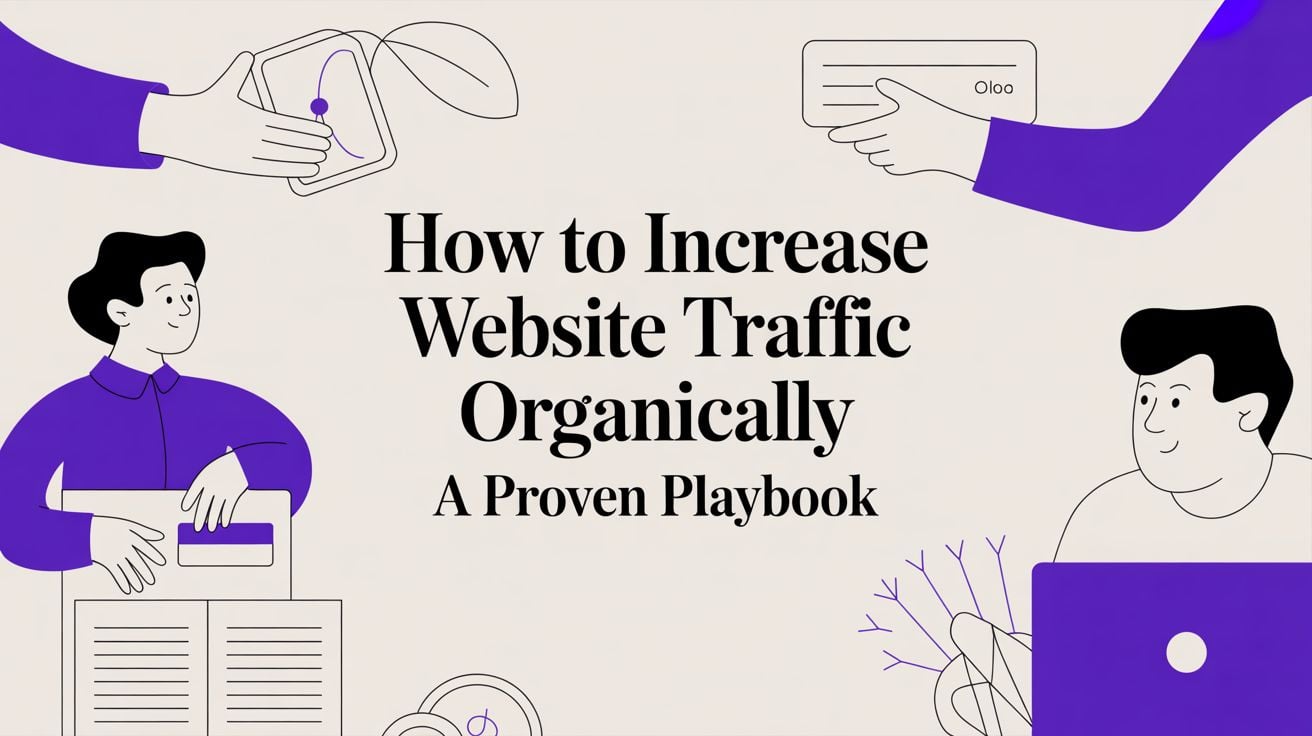
How to Increase Website Traffic Organically: A Strategic Playbook
Many business owners believe the path to more website traffic is paved with ad spend. This perception frames digital marketing as a cost center, where visibility is rented one click at a time. The real goal, however, is to build a sustainable asset focused on search intent and authority.
The core issue is dependency. If your website traffic vanishes the moment you pause ad campaigns, you don't have a traffic problem. You have an asset problem. This dependency creates a cycle of escalating costs for temporary attention, diverting resources that could be building permanent equity.
Relying solely on paid ads is like renting your audience. You pay for access, but you never own the relationship. When the spending stops, the visibility disappears, leaving you with no compounding return on your investment.
This guide reframes that challenge. It moves from the tactical question of "how do I get more traffic?" to the strategic imperative of "how do I build a permanent, traffic-generating system?" We will analyze why a paid-ad-only approach fails long-term and outline the structural elements required to create an asset that lasts.

Table of Contents
The True Cost of Rented Attention
Paid ads have a tactical place for short-term promotions or to quickly test a market. As a foundation for growth, however, they are fragile. Each click has a direct cost that rises with competition, forcing you to continuously feed the machine just to maintain position.
Organic traffic, by contrast, is an asset you own. The strategic work invested in SEO and relevant content today continues to attract qualified customers for months and years, generating a compounding return.
The difference is fundamental. Here is a practical breakdown for a local business owner.
Paid Ads vs. Organic Traffic: A Local Business Perspective
This table contrasts the immediate but temporary nature of paid advertising with the sustainable growth engine of an organic presence.
| Attribute | Paid Advertising (PPC) | Organic Traffic (SEO) |
|---|---|---|
| Time to Results | Immediate. Clicks start as soon as the campaign is live. | Long-term. Takes months to build momentum, but results are lasting. |
| Cost Model | Pay-per-click. You pay for every visitor, every time. | Upfront investment. Pay for strategy & implementation, not for clicks. |
| Longevity | Temporary. Traffic stops the moment you stop paying. | Sustainable. An owned asset that generates traffic 24/7. |
| Trust & Credibility | Lower. Users recognize it is an ad and often bypass it. | Higher. Users trust organic results more, leading to better leads. |
| Return on Investment | Direct but diminishing. ROI is tied directly to ad spend. | Compounding. The value grows over time as authority builds. |
| Customer Intent | Broad. Can target users at various stages of awareness. | High. Catches users actively searching for solutions right now. |
While PPC provides speed, SEO delivers sustainability and authority. A business that cannot generate leads without paid ads is operating on an unstable foundation.
Where Your Best Customers Are Actually Searching
Industry benchmarks show that organic search drives over 53% of all website traffic, significantly outpacing paid search and social media combined.
The critical insight is the intent behind the search. Visitors from organic search are often problem-aware and solution-focused. They are actively looking for help, using queries like ‘emergency plumber near me’ or ‘weekend chiropractor appointment’. You can review these organic traffic industry benchmarks to see the data.
This is the transition from chasing cold prospects to attracting qualified customers who are already seeking your services. The following sections provide the blueprint for building the systems that make this possible, moving your business from a state of rented visibility to one of owned authority.
At City Web Company, we help businesses build these foundational assets. The goal is simple: when a potential customer in your area has a problem, your business becomes the most visible and logical solution.
Your Digital Foundation: The Underperforming Website
A common scenario involves a business investing in a visually appealing website, launching it, and then waiting for customers who never arrive. The misconception is that traffic is something you acquire after the site is built. This reverses the proper sequence.
An underperforming website is like a well-designed storefront with a locked door. It doesn't matter how much traffic you send to it if visitors cannot easily enter and find what they need.
The starting point for learning how to increase website traffic organically is the structural integrity of your website. Slow load times, confusing navigation, or a poor mobile experience are not minor annoyances. They are negative signals to Google, indicating your site is not a high-quality result for its users.

This is not about chasing technical perfection. It is about ensuring your digital foundation is strong enough to support all subsequent marketing efforts.
The Mobile Experience Is Not Optional
Over 60% of all online searches occur on a mobile device. If your website requires users to pinch and zoom or makes it difficult to find a phone number, you are effectively closed for business for the majority of your potential customers.
A "mobile-first" approach is a market requirement. It means designing the site experience primarily for mobile users, ensuring buttons are easy to tap, text is readable, and contact information is immediately accessible. This is a non-negotiable factor that directly impacts how Google ranks your website.
Service Pages That Align with Customer Needs
Most local business websites have a single, generic "Services" page listing everything they offer. This is a significant missed opportunity. A customer searching for "emergency leak repair" has a different and more urgent need than someone researching "bathroom remodel costs."
An effective website is structured around these specific needs, with a dedicated page for each core service.
- Emergency AC Repair: This page must communicate urgency and availability, highlighting 24/7 service, fast response times, and a click-to-call phone number.
- New Roof Installation: This page should build trust and demonstrate quality. It should focus on material options, durability, warranty information, and a portfolio of completed projects.
- Commercial Landscaping: This page needs to address business owners, emphasizing reliability, improved curb appeal, and simple maintenance contracts.
This structure accomplishes two critical objectives: it provides the visitor with the precise information they are looking for, and it gives Google distinct, highly relevant pages to rank for valuable search terms. For more on this, see our guide on what makes a website search engine friendly.
Location Pages for Capturing "Near Me" Searches
If you serve multiple towns or neighborhoods, location-specific pages are essential for winning local searches. A roofer based in Denver who also serves Aurora and Littleton will struggle to appear in searches from a potential customer in Aurora.
By creating a dedicated page for each service area (e.g., "Roof Repair in Aurora, CO"), you signal your geographic relevance to Google. To enhance these pages, include localized content such as mentions of local landmarks, photos of jobs completed in that town, or testimonials from local clients. This strengthens the geographic signal.
Before you can effectively increase organic traffic, you must ensure your data is reliable. A solid first step is to use an ultimate web analytics audit checklist to confirm your tracking is accurate. Without clean data, you're flying blind.
Fixing these foundational elements transforms your website from a passive brochure into an active lead-generation tool. It is the necessary preparation that allows all other organic traffic efforts to succeed.
Winning Local Search with Your Google Business Profile
Most local business owners treat their Google Business Profile as a simple directory listing. They create it, add a logo, and then neglect it. This is a quiet but significant strategic error.
That neglected profile is the primary reason competitors appear in the valuable "map pack" results while your business remains invisible. The difference between visibility and obscurity is not luck; it is treating your Google Business Profile as the strategic asset it is. For many customers, it is their first impression of your business.
A well-managed profile can generate phone calls and appointments before a potential customer even visits your website. It is your digital storefront, and it must be optimized for business.

Beyond Basic Information
Correct name, address, and phone number are the absolute minimum. True optimization involves using every feature Google provides to signal your relevance, activity, and authority to both the algorithm and potential customers.
Google's objective is to show users the most active, helpful, and trustworthy local businesses. A profile that is consistently updated with new photos, posts, and answered questions signals that you are an engaged and reliable choice.
This is a core component of any strategy for how to increase website traffic organically, as a strong Google Business Profile directly drives local search performance.
A Practical Guide to GBP Optimization
Optimizing your profile is an ongoing process, not a one-time task. Here is where to focus for immediate impact.
- Business Description: Write a clear, keyword-relevant description of who you are, what you do, and where you do it. Avoid promotional language and focus on being helpful.
- Categories: Be specific. Do not just choose "Contractor." Your primary category should be your main service, such as "HVAC Contractor," with secondary categories like "Air Conditioning Repair Service" and "Heating Contractor." This helps Google match you to specific searches.
- Services: Use the "Services" feature to list every service you offer with detailed descriptions. A plumber offers "Drain Cleaning," "Water Heater Installation," and "Emergency Leak Repair," not just "Plumbing." List them all.
An HVAC Company Scenario
Consider an HVAC company in Colorado. A basic profile may only list its name and phone number. An optimized profile tells a complete story.
It features high-quality photos of the team on job sites. It has a recent Google Post announcing a "Summer AC Tune-Up Special." It includes a Q&A section where the owner has proactively answered common questions like, "How often should I change my furnace filter?" and "What does a SEER rating mean?"
When a homeowner in that city searches for "AC repair near me," Google will feature the business that is more active, informative, and has demonstrated its expertise.
A complete and active Google Business Profile is the most powerful lever a local service business can pull for immediate search visibility. It is not just a listing; it is your primary local marketing channel.
Leverage Interactive Features
Your Google Business Profile is an interactive hub for engaging with potential customers and managing your reputation.
- Google Posts: Use these to share offers, company news, or helpful tips directly on your search listing. They expire every seven days, so consistent posting signals to Google that you are open and active.
- Q&A Feature: Proactively populate this section by asking and answering the most common questions you receive. This helps potential clients and can get your answers featured in search results.
- Reviews: Actively request and respond to all reviews, both positive and negative. A steady flow of recent, positive reviews is a powerful local ranking factor, and responding demonstrates that you value customer feedback.
This shift from a passive listing to an active marketing hub is what separates businesses that dominate local search from those that remain invisible. To dig deeper, you can learn more about the impact of a Google Business Profile on Local SEO in our detailed guide.
By giving your GBP the strategic attention it deserves, you begin meeting customers directly where they are searching.
Creating Content That Attracts Qualified Customers
The term "content" often leads business owners to create a blog with random tips and company updates, which fails to produce results. This reflects a misunderstanding of what strategic content is.
The goal is not to fill a blog. It is to build a system of assets that intercepts customers at every stage of their buying journey. The common scattergun approach is disconnected from business goals and customer search behavior, wasting time and resources.
A strategic content framework is engineered to generate qualified leads. The failure of most content marketing for local businesses stems from a lack of this strategic structure.
Answering Questions vs. Capturing Intent
The first step is understanding the two primary types of content your website needs.
Top-of-funnel content consists of helpful, problem-aware blog posts. These address the "why" or "how" questions a potential customer asks before they are ready to hire someone.
Bottom-of-funnel content includes your core service and location pages. Their purpose is to capture buying intent by targeting searches that signal an immediate need.
A local HVAC company can illustrate this:
- Top-of-Funnel (Blog Post): "Why Is My AC Unit Making a Whistling Noise?" This article attracts a homeowner in the research phase, building trust and positioning your company as an expert.
- Bottom-of-Funnel (Service Page): "Emergency AC Repair Denver" This page is designed for someone who has already decided to hire a professional and is actively searching for one.
A website with only service pages misses the opportunity to build authority with early-stage researchers. A website with only a blog fails to convert ready-to-buy searchers. An effective strategy requires both working in concert.
A Practical Scenario: The Fort Collins Roofer
Imagine you are a roofing contractor in Fort Collins, Colorado, an area prone to hail storms. Instead of a generic "Roof Repair" page, you can build a powerful content funnel.
First, identify what your customers search for after a storm. Research reveals specific, high-intent keywords:
- "hail damage roof inspection fort collins"
- "how to file a roof insurance claim for hail"
- "best roofing company for hail damage"
With this information, you can build content assets that directly answer these queries.
Create a Problem-Aware Blog Post: Write a detailed guide titled, "A Fort Collins Homeowner's Guide to Handling Hail Damage." This post walks readers through assessing damage, documenting it for insurance, and selecting a contractor. The focus is on providing value, not on selling.
Optimize a High-Intent Service Page: Create a dedicated service page for "Hail Damage Roof Repair in Fort Collins." This page is action-oriented, featuring clear calls-to-action, testimonials from local clients with hail damage, and details on your insurance claim assistance process.
Connect the Two: Within your helpful blog post, create a logical transition to your service page. For example: "Once you have documented the damage, the next step is a professional inspection. You can learn more about our no-obligation hail damage assessments here."
This structure nurtures a potential customer from being problem-aware to solution-ready. You intercepted their initial research, provided value, established trust, and then offered a clear path to solving their problem.
This is the core of a content strategy that drives organic traffic and generates leads. It is a deliberate system that attracts, educates, and converts your ideal customers, turning your website into a reliable engine for growth.
Building Authority and Trust Beyond Your Website
A common misconception is that a website exists in isolation. Business owners invest heavily in perfecting their site, forgetting that Google's algorithm values external validation far more than self-promotion.
Think of it as a reputation engine. A technically flawless website can remain buried in search results if it lacks "votes of confidence" from the rest of the web. This absence of off-page signals is the invisible barrier preventing many businesses from reaching the top positions.
To break through, you must demonstrate to Google that you are a legitimate and trusted entity within your local community.

Demystifying Local Link Building
For a local business, "link building" is not about technical manipulation; it is about relationships and community involvement. A link from another website is a vote of confidence. When that vote comes from a relevant, authoritative source, it carries significant weight with Google.
Consider these practical examples for a local contractor:
- Sponsor a local youth sports team. This often results in a link from the team’s website or a mention in a local news roundup.
- Partner with a non-competing business. A kitchen remodeler could host a workshop with a local interior designer, with each business linking to the other as a trusted partner.
- Get featured in local media. Pitch your expertise for a story on a topic like "5 tips for winterizing your home." A feature on a local news site provides a high-authority link.
These are smart business development activities that also build the digital footprint Google rewards.
The Critical Importance of Citations
Beyond links, search engines use another key signal to verify your business: citations. A citation is any online mention of your business's Name, Address, and Phone number (NAP).
Absolute consistency is crucial. When your NAP information is identical across dozens of trusted directories like Yelp, Angi, and industry-specific sites, it signals legitimacy to Google. Inconsistencies, such as an old address or an incorrect phone number, create confusion and erode trust.
Consistent citations are the foundation of local SEO. They directly impact your ability to appear in the map pack for high-value, ready-to-buy searches.
The reward for optimizing these off-page signals is substantial. Securing the #1 organic position on Google commands an average 28.5% click-through rate, according to industry data. You can see more data on how search position impacts traffic at SEOinc.com. This illustrates the immense value of earning top rankings.
Building this off-page authority solidifies your position in the market. It is how your website transitions from a digital brochure to a recognized local authority that Google trusts to put in front of its users.
From Traffic Spikes to Sustainable Business Growth
Achieving sustainable organic traffic is not a one-time project; it is an ongoing, strategic process. The elements covered—a technically sound website, a dominant Google Business Profile, strategic content, and off-page authority—are pillars of an integrated system that builds long-term business equity.
Many businesses chase fleeting traffic spikes, but real growth comes from an asset that produces qualified leads consistently. This requires a shift from disconnected tactics to a cohesive strategy where each element supports the others. For a deeper look at specific tactics, you can explore these 12 proven ways to increase website traffic based on real-world experiments.
At City Web Company, we specialize in implementing these proven systems. We act as a strategic partner to bring clarity to your marketing and focus on the outcomes that matter. If you are ready to build a reliable engine for long-term growth, it may be time for us to speak.
Frequently Asked Questions About Organic Traffic
Here are the most common questions business owners have about what it takes to get results from SEO, answered directly.
How Long Does It Take to See Results from SEO?
The honest answer is: it depends. SEO is a long-term investment in a business asset, not a quick fix.
Typically, you can expect to see initial positive movement in rankings and traffic within 3 to 6 months. This is the period when foundational work, such as technical optimization and Google Business Profile enhancements, begins to take effect.
Significant, business-altering results that generate a steady stream of leads often take closer to 6 to 12 months. During this timeframe, your site's authority builds and compounds, creating a durable competitive advantage.
What Is the Most Important Ranking Factor for a Local Business?
For a local service business, Google's algorithm prioritizes relevance and proximity. The single most powerful tool to influence this is your Google Business Profile (GBP).
A fully optimized, active, and review-rich GBP is essential for appearing in the local map pack.
Beyond the GBP, these factors are also critical:
- On-Page Signals: Your service and location pages must clearly and consistently communicate what you do and where you do it.
- Local Citations: A consistent Name, Address, and Phone (NAP) footprint across the web confirms you are an established local entity.
- High-Quality Reviews: A steady stream of recent, positive reviews builds trust with both Google and potential customers.
Can I Increase Organic Traffic Without a Blog?
Yes, but you will be at a strategic disadvantage. Your core service and location pages are essential for capturing high-intent searchers who are ready to act now. They are the foundation of your lead-generation system.
A blog, however, allows you to build true authority. It answers the "why" and "how" questions customers ask before they are ready to buy. This establishes you as an expert, builds trust, and attracts a wider audience. Without a blog, you concede this valuable early-stage traffic to your competitors.
The most effective system combines optimized service pages for immediate lead capture with helpful blog content for long-term authority.
At City Web Company, we build the integrated systems that turn your website into a reliable source of customers. If you're ready for a clear, strategic plan focused on long-term growth, schedule a no-obligation discovery call with us.
These articles were popular with other readers too: