Learn what Google Ads are, how law firms use them compliantly in 2026, and best practices for attracting clients while following state bar advertising rules.
How Top Franchises Win Locally: A Scalable SEO Playbook
Many franchises invest heavily in national brand campaigns, assuming high-level recognition automatically translates into foot traffic at every local store. This is a common and costly misconception. The reality is that local branches often remain invisible to customers in their own neighborhoods who are actively searching for their services.
A strong national brand is an asset, but it does not guarantee visibility in local search results. This disconnect creates a significant gap between broad brand awareness and the specific, local transactions that drive revenue.
Table of Contents
The Disconnect in Franchise Marketing
The fundamental problem for most franchise systems is a structural disconnect between corporate marketing efforts and the mechanics of local customer acquisition. While large-scale national advertising builds brand equity, it does very little to capture customers using searches like "near me."
This oversight leads directly to missed revenue opportunities and inefficient marketing spend.
Consider the moment a potential customer searches for "HVAC repair in Denver" or "pizza place nearby." They have immediate, high purchase intent. If a local franchise branch fails to appear in Google's Map Pack, the multimillion-dollar national ad budget becomes irrelevant at the most critical point of decision.
The True Cost of Local Invisibility
A fragmented digital presence has tangible consequences for both the franchisor and each franchisee. This structural weakness manifests in several ways:
- Wasted Spend: Corporate campaigns generate demand, but without a strong local SEO foundation, the system fails to capture that demand at the community level where transactions occur.
- Inconsistent Customer Experience: When potential customers find conflicting information, or no information at all, for different locations, it erodes trust and dilutes brand integrity.
- Lost Revenue: Every "near me" search won by a local competitor represents a direct loss of a sale and foot traffic for a franchise unit.
This issue often originates before a new location even opens. Insufficient business planning, such as understanding the local market and competition as detailed in guides on how to start a gym business, makes it difficult to deploy a marketing strategy that is effective on the ground.
It becomes clear that a national-level strategy alone is insufficient for driving growth at the local level. A system is needed that specifically addresses how customers search and find businesses within their own communities.
National Branding vs. Local Visibility
The table below clarifies the distinction between a top-down branding approach and a bottom-up local visibility strategy.
| Marketing Effort | Typical Focus (National Branding) | Required Focus (Local SEO) |
|---|---|---|
| Primary Goal | Build brand recognition and equity | Drive qualified leads, calls, and foot traffic |
| Target Audience | Broad demographic segments | Customers within a specific service area |
| Key Channels | TV, radio, national PR, print | Google Business Profile, local directories, on-page SEO |
| Core Message | "We are a trusted, leading brand." | "We are the best solution for you, right here." |
| Success Metric | Brand recall, market share | Local rankings, phone calls, direction requests |

This comparison highlights why a national strategy is incomplete. An effective local SEO framework is what bridges the gap, converting brand awareness into measurable customer action.
This is the point where many business owners realize their marketing is missing a critical component. They have brand awareness but lack the mechanism to convert that awareness into local sales. The solution is not to run dozens of disconnected campaigns, but to build a unified system.
This system gives individual franchise locations the tools to win locally while maintaining brand consistency. A strategic approach to local SEO for franchises creates a cohesive network where each location can dominate its market. It begins with standardizing foundational business information. Correcting inconsistencies in Name, Address, and Phone (NAP) data across online platforms is a critical first step that provides immediate leverage.
The objective is to transform a scattered collection of stores into an interconnected network that commands local search. A strong national brand should be the foundation, not the entire structure. By addressing this core weakness, a franchise can ensure its brand awareness translates into local action, making each location the logical choice for customers in its neighborhood.
Google Business Profile: The Foundational Asset
Many franchises misallocate their local marketing resources. They prioritize social media or paid ads, overlooking the single most critical asset for driving local revenue: the Google Business Profile (GBP).
For any multi-location brand, the collection of GBP listings is the digital foundation. It functions as the modern phone book, digital storefront, and business card combined. Leaving these profiles unclaimed or unmanaged is a direct path to brand inconsistency and lost customers.
The Problem of Digital Disarray
Without central oversight, a costly and disorganized situation arises. Individual owners often create their own profiles with inconsistent names, list incorrect services, or abandon the listing entirely. This digital disarray creates a fractured brand presence that undermines marketing goals.
When a customer in one city sees a polished profile while another finds an unverified listing with an old phone number, it signals to Google that the brand is an unreliable source of information. This lack of consistency can negatively impact visibility for all locations. This is the first problem a local SEO for franchises strategy must solve.
Centralizing Control Through Business Groups
The solution is to establish corporate control over every location's Google Business Profile. This is not about removing autonomy from franchisees; it is about building a consistent foundation that benefits the entire system. The proper tool for this is a Business Group within a primary GBP account.
This feature allows a central marketing team or agency to:
- Manage all locations from a single, unified dashboard.
- Perform bulk verification for new locations, saving significant time.
- Distribute standardized updates for holiday hours, core services, and brand-wide announcements.
- Prevent unauthorized profiles from being created or claimed.
By centralizing control, the franchise builds a uniform brand presence that produces measurable results. The logic is straightforward: consistent, complete, and optimized profiles rank higher and generate more customer actions.
The Value of an Optimized Profile
Optimizing GBP listings delivers a significant return. Data shows that the top three positions in Google's Map Pack capture the vast majority of clicks. Businesses in these top spots receive substantially more web traffic and customer actions than those ranked just a few positions lower.
The details are important. Adding high-quality photos can increase direction requests and website clicks. A complete profile makes a business more likely to be considered for a future purchase. When these gains are multiplied across dozens or hundreds of locations, the opportunity for revenue growth becomes substantial.
Establishing a standardized and fully optimized Google Business Profile for every location is the non-negotiable first step. Without it, all other local SEO efforts are built on an unstable foundation. To explore this topic further, you can learn more about the direct impact of a Google Business Profile on local SEO in our detailed guide.
Creating High-Converting Franchise Location Pages
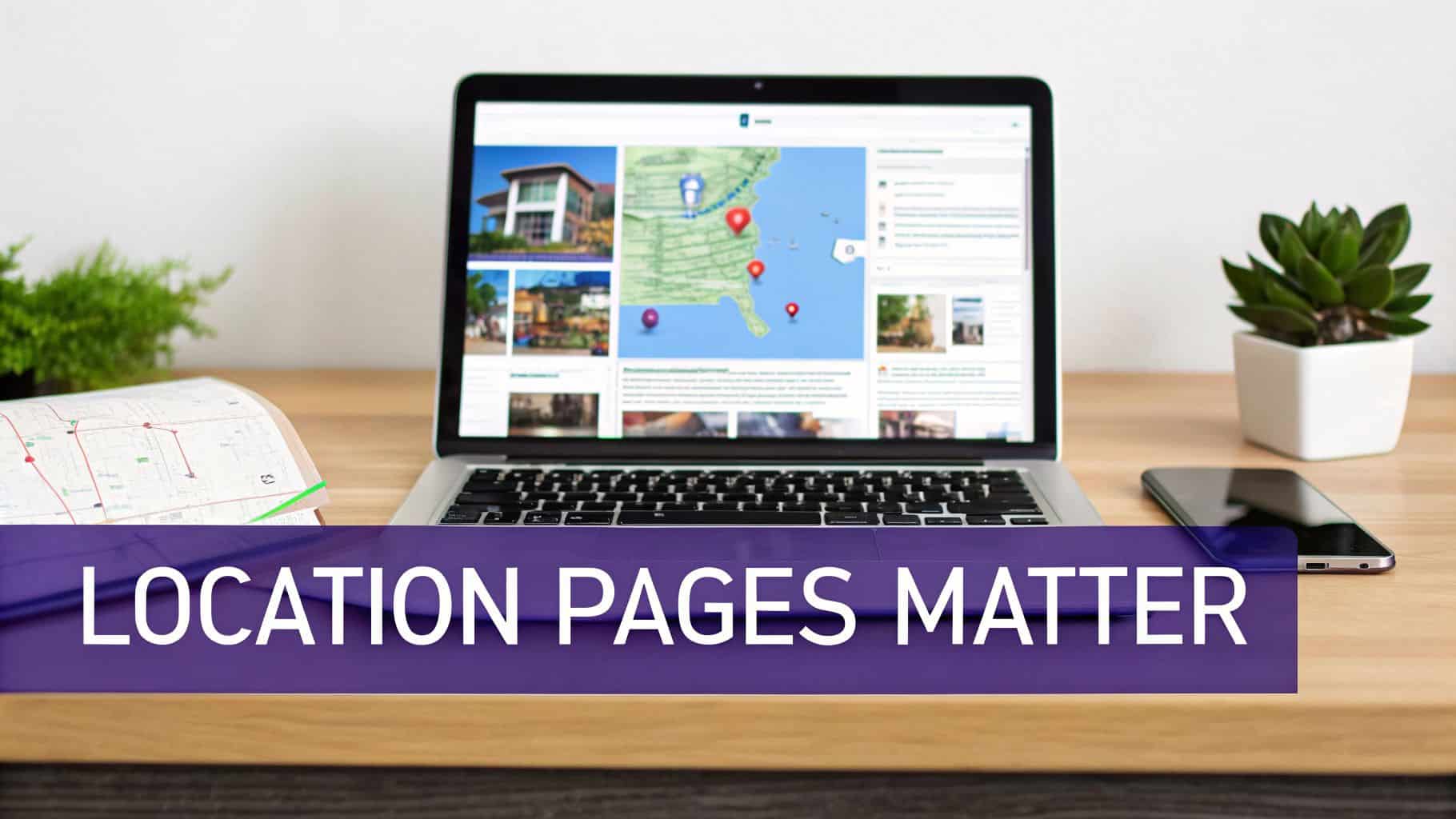
A frequent and costly mistake made by franchises is relying on a single, generic "locations" page. This approach forces numerous distinct local businesses to share one digital address, creating a bottleneck for new customers and revenue.
Each franchise location is an independent business serving a unique community. It requires its own dedicated digital storefront.
The core issue is relevance. When a homeowner in Denver searches for "plumber in Denver," Google seeks the single best page to answer that query. A corporate homepage or a simple list of addresses is not specific enough. This common setup diminishes search relevance, reduces conversion rates, and cedes business to local competitors.
The solution is to build a templated yet locally focused page for every location. This is an essential component of any serious local SEO for franchises strategy. These pages become dedicated assets that capture high-intent, location-specific searches that a corporate site typically misses.
Anatomy of an Optimized Location Page
Creating these pages at scale requires a solid blueprint. The template provides brand consistency and efficiency, while unique local details make each page effective. The key is to balance standardization with meaningful customization.
A successful blueprint must include these elements:
- Localized On-Page SEO: Each page needs a unique title tag and H1 heading that clearly communicates its purpose (e.g., “Professional HVAC Repair in Boulder, CO”).
- Unique Local Content: Instead of duplicating service descriptions, feature bios of the local team, showcase projects in specific neighborhoods, or mention nearby landmarks to create a local feel.
- Embedded Google Map: A map showing the business's exact location provides a visual cue for proximity and serves as a strong trust signal.
- Location-Specific Reviews: Displaying testimonials from customers in that specific service area is more persuasive than generic reviews from other states.
- Clear Calls-to-Action (CTAs): Each page must feature a prominent local phone number and a contact form that routes leads directly to the correct franchisee.
This structure demonstrates to both users and search engines that the location is an active part of the local community. It is the digital equivalent of a clean, welcoming storefront.
A Tale of Two Approaches
Imagine a 50-location pest control franchise. In one approach, all search traffic is directed to the corporate homepage. A potential customer in Phoenix lands on a site discussing services in Florida and New York. The lack of relevance causes them to leave, likely for a local competitor's site. That lead is lost.
Now, consider the correct approach. The same Phoenix customer searches and lands directly on the "pest-control-phoenix-az" location page. They immediately see the local phone number, read reviews from Phoenix residents, and perhaps see a photo of the local manager. The relevance is perfect, trust is established, and the probability of a phone call increases dramatically.
The purpose of a location page is to close the gap between a customer's local search and the franchisee's front door. It is the critical final step in converting digital visibility into measurable revenue. These pages are the engine of local lead generation for a multi-location business. To learn more, see our guide on creating location-specific landing pages that convert.
Building Scalable Authority and Trust
Once the on-site strategy is in place, the focus shifts to building authority beyond the franchise's own digital properties. Many franchises overlook this opportunity, treating their online reputation as an afterthought by manually adjusting a few directories or simply hoping for good reviews.
This scattered approach is ineffective for local search. Real online authority is not accidental. It is the result of a deliberate system that proves to Google that your business is legitimate, active, and trusted by customers. For a franchise, this system must be scalable and centrally managed.
The Power of Consistent Citations
A citation is any online mention of a local business's Name, Address, and Phone number (NAP). These mentions appear across hundreds of online directories, from major platforms like Yelp and Apple Maps to niche, industry-specific sites. Google uses these citations to verify business information. When it finds the exact same NAP for a location across dozens of trusted sources, it confirms the business's data is reliable.
Inconsistency creates confusion. When different directories show old addresses, wrong phone numbers, or slight name variations, it signals unreliability. This erodes Google’s trust and harms the location's ranking potential.
Managing NAP data manually for multiple locations is not only inefficient but also structurally flawed. A centralized citation management platform is essential for any serious franchise. It ensures that when a location moves or a phone number changes, the update is distributed correctly across the entire ecosystem, protecting the brand's authority.
Building Trust Through Reputation Management
The second pillar of authority is reputation, built primarily through customer reviews. A steady flow of positive, recent reviews is a powerful signal to both Google and potential customers. It demonstrates that the business is active and delivers consistent quality.
Many businesses struggle with this because they make leaving a review inconvenient. They wait too long to ask, use clunky email links, or fail to ask at all. This leaves their online reputation to be defined by only the most motivated customers, who are often the most dissatisfied.
The solution is to integrate the review request seamlessly into the customer journey.
A strong reputation is about more than a five-star rating. It is about demonstrating consistent, recent, and authentic customer satisfaction at the local level.
For example, an HVAC franchise can use a system that automatically triggers an SMS message to a customer shortly after a job is marked as "complete." The text can simply ask, "How was your service today?" with a direct link to leave a review on that location's Google Business Profile. This immediate follow-up makes it easy for satisfied customers to share their feedback.
Effective loyalty programs can also drive customer retention and encourage reviews, particularly in industries where repeat business is vital. For example, specialized loyalty applications tailored for restaurants are designed to create a cycle of repeat visits and positive feedback.
By systemizing the approach to both citations and reviews, a franchise creates a powerful feedback loop. Clean citations build Google's trust and improve visibility. Increased visibility brings more customers, and a streamlined review process turns those customers into advocates. This strengthens authority and drives more business, building a dominant and scalable local presence.
Local Content and Link Building Strategies
Many franchises establish the basics, like a clean Google Business Profile and location pages, and then stop. This is where more agile local competitors gain an advantage. Having an online presence is not the same as being the authoritative choice in a community.
The problem is that foundational SEO gets a business on the map but does not make it the most relevant or trusted option. Generic corporate blog posts about an industry do not resonate at the local level. This is where franchise marketing often stalls, leaving individual locations vulnerable.
Creating Hyper-Local Content
To effectively compete in a local market, content must speak directly to the community. Corporate can empower franchisees by providing a framework for creating hyper-local content that connects the brand to specific, timely events and needs in their service area.
Consider a roofing franchise. A generic post titled "Signs You Need a New Roof" is easy to ignore. A more specific article, such as "Hail Damage Repair After the Recent Denver Storm," offers an immediate solution to a current problem. The first is forgettable; the second positions the local branch as an expert.
This strategy is effective across industries:
- A cleaning service franchise could create content on "Post-Construction Cleanup for New Homes in the [Neighborhood Name] Development."
- An HVAC franchise might write about "Preparing Your AC for [City's] Summer Heatwave."
- A fitness franchise could promote "Joining Our [Town] 5k Training Group."
This approach transforms a location from a pin on a map into a responsive, engaged local business. It demonstrates that the franchise is part of the community, not just operating within it. This geo-targeted content boosts a location’s authority and ranking for valuable, high-intent keywords.
Earning Authoritative Local Links
Equally important are the trust signals earned from other local organizations. In SEO, these are called local backlinks, and they are powerful endorsements in Google's view. A link from the national headquarters is expected. A link from the local Chamber of Commerce or a neighboring small business carries significant local weight.
A scalable strategy for local link building involves creating real-world community partnerships that translate into digital authority. Corporate should guide franchisees on how to identify and secure these opportunities.
Some of the best sources for high-value local links include:
- Local Event Sponsorships: Sponsoring a local charity run or little league team often results in a link from their website, providing a direct SEO benefit.
- Chamber of Commerce and Business Associations: Membership typically includes a business listing and a link from a trusted local domain.
- Partnerships with Non-Competing Businesses: A local mortgage broker could link to a trusted home inspection franchise. A wedding planner could link to a partner catering franchise.
Generic content and a weak local link profile suggest a location is merely a name on a corporate roster. In contrast, hyper-local content and links from genuine community engagement prove the franchise is a vital part of the local economy. This is how a franchise becomes an undeniable presence in its market.
Implementing a Franchise SEO Governance Model
Many franchise networks operate in a state of controlled chaos. Headquarters has a brand vision, but local marketing execution is inconsistent. This results in a few high-performing locations alongside many digital ghost towns.
This occurs when responsibilities are not clearly defined.
Winning at local SEO for franchises requires more than just the right tools. It requires a clear governance model that balances corporate brand control with local franchisee autonomy. Without it, a franchise risks internal conflicts, brand dilution, and wasted marketing spend.
The key is to build a framework that defines roles and responsibilities from the outset. A single source of truth is needed for both the corporate team and local owners.
Centralized Control vs. Local Flexibility
A successful model must draw clear lines, defining what is managed centrally and what is delegated locally. This structure is essential for maintaining brand consistency while empowering franchisees to connect with their communities.
Here is a breakdown that has proven effective:
Corporate-Managed (The Foundation):
- Google Business Profile Ownership: Corporate must own every GBP listing. This is non-negotiable for brand control.
- Website & Location Pages: The main website, design templates, and technical SEO are handled by corporate to ensure performance and a consistent user experience.
- Citation Management: All NAP (Name, Address, Phone) data is managed from one central platform to maintain accuracy at scale.
Franchisee-Managed (Local Execution):
- Review Responses: Franchisees should respond to local reviews with a personal, authentic voice.
- GBP Updates & Posts: Local owners are best positioned to share updates about community events, special offers, and new photos.
- Local Content Creation: Franchisees possess the local knowledge to create hyper-local content, such as sponsoring a team or highlighting a local project.
This diagram illustrates how local activities build upon the corporate foundation to create lasting authority.
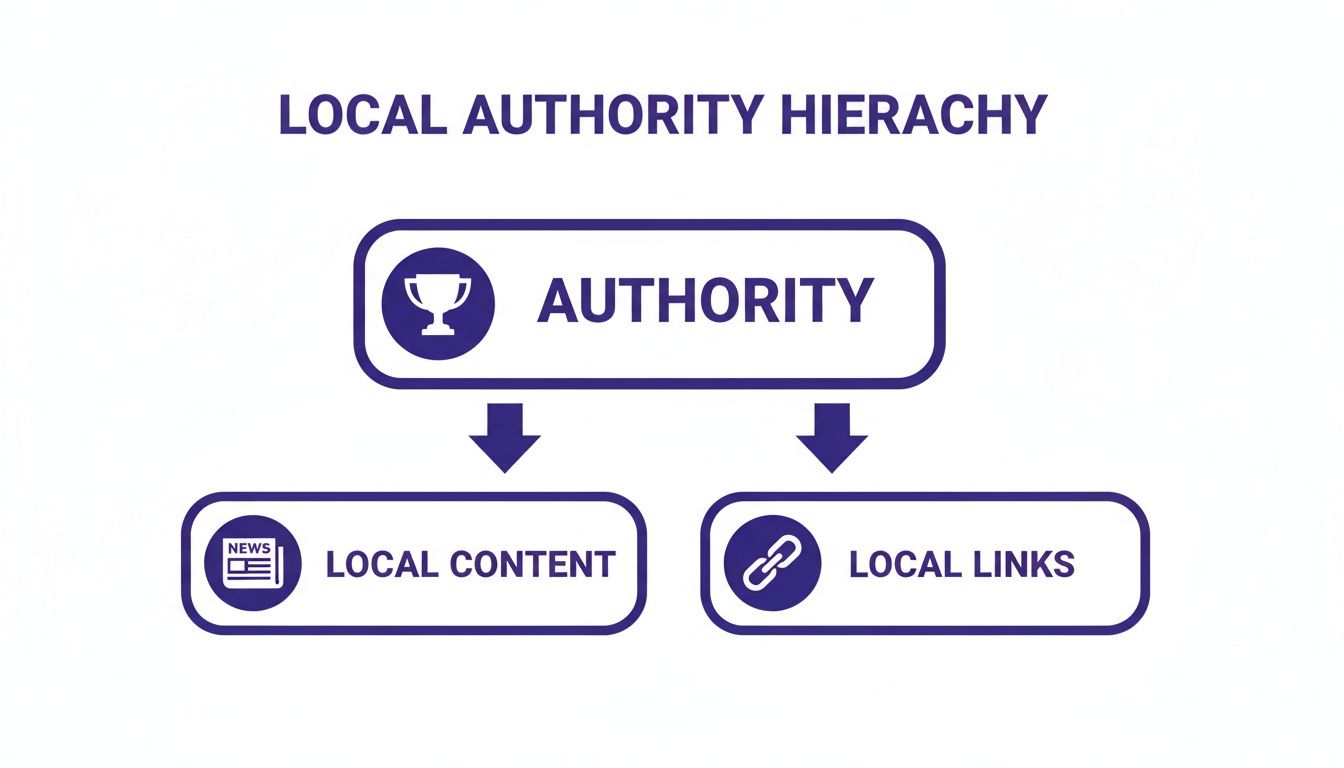
True authority is built by combining local content with local link building, both of which are most powerful when executed at the community level.
By clearly defining these roles, guesswork is eliminated. Corporate provides the vehicle, and the franchisee drives it, following a clear road map. This structured approach turns a scattered group of businesses into a coordinated, high-growth machine.
Designing and implementing such a system is a strategic project. It requires a deep understanding of the franchise’s dynamics and building workflows that serve both corporate’s need for control and the franchisee’s need for flexibility. City Web Company specializes in building these growth systems. We act as a strategic partner to help brands achieve sustainable dominance in every local market.
If you are ready to bring clarity and real results to your network, let’s discuss building the right governance model for your brand.
Common Questions About Local SEO for Franchises
Even with a clear playbook, questions arise. Franchise owners and corporate marketing leaders face the challenge of scaling a brand while empowering local operators.
Here are answers to the most common questions we hear about building a powerful franchise SEO strategy.
Can Each Franchisee Handle Their Own Local SEO?
While letting each franchisee manage their own local marketing might seem empowering, this decentralized approach almost always leads to brand chaos, inconsistent business information, and a missed opportunity for system-wide authority.
A centralized strategy ensures every location speaks with one powerful brand voice. It also allows for pooled resources for top-tier SEO tools and expertise, creating a digital presence far stronger than any single franchisee could build alone. The most effective model is a hybrid one: corporate governs foundational SEO and brand strategy, while franchisees execute hyper-local community engagement.
How Is ROI for Franchise SEO Measured?
The return on investment for franchise SEO is determined by tracking key metrics at both the corporate and individual location levels. We focus on actions that directly lead to revenue.
Success is measured by tracking:
- Aggregate growth in organic traffic to individual location pages.
- The number of phone calls and driving direction requests from Google Business Profiles.
- An increase in qualified leads from contact forms on each location's page.
We also monitor keyword rankings for high-intent terms like “AC repair in [city].” When these rankings climb, we know we are capturing market share for that franchisee.
How Long Does It Take to See Results?
SEO is a long-term investment, but early signs of progress are visible. After foundational work like cleaning up directory listings and optimizing every Google Business Profile, noticeable improvements in Google Map Pack visibility can be seen within 60 to 90 days.
Achieving dominant, lasting rankings in a competitive market takes time. Building a true competitive advantage through consistent content, review generation, and local link building is a strategic process. Significant, sustainable growth should be planned for within 6 to 12 months.
This playbook provides a blueprint for transforming a scattered group of locations into a unified network that dominates local search. It comes down to a clear governance model, the right tools, and a focus on making it easy for local customers to find and choose you.
At City Web Company, we specialize in building and executing these integrated growth systems for franchises. If you are ready to implement a clear, scalable, and effective local SEO strategy that drives real results, we can help. Schedule your free discovery call with us today.
These articles were popular with other readers too: