Learn what Google My Business is, how it impacts local rankings, and proven steps to optimize your profile for maximum visibility and customer engagement in 2026.
Google Ads for Plumbers: A Guide to Generating Local Leads
Most plumbers running Google Ads share a common frustration: a budget that vanishes with little to show for it. You invest in campaigns, bid on keywords like 'plumber near me,' and watch your spend get consumed by a flood of clicks that never convert into paying jobs.
This isn't a sign that advertising is failing. It's a symptom of a flawed approach.
Table of Contents
Why Your Plumbing Ad Budget Is Draining
The core issue is a single, costly assumption: that more visibility automatically equals more jobs. When plumbing businesses treat Google Ads like a digital billboard, they create a campaign designed to attract everyone. This means you pay for clicks from price shoppers, DIY enthusiasts searching for "how-to" videos, and even job applicants.
The business impact is not theoretical. It shows up as clear financial waste:
- Wasted Ad Spend: A significant portion of your budget is spent on clicks from individuals who were never going to hire you.
- High Cost-Per-Lead: With so many irrelevant clicks, the actual cost to acquire a single, profitable customer becomes unsustainable.
- Unpredictable Lead Flow: The phone may ring, but the calls are inconsistent. You get a string of low-margin repairs instead of the high-value installations or emergency calls that drive growth.
The problem is a lack of precision. A generic campaign structure is like a leaky faucet, constantly dripping money because it fails to filter out the wrong traffic. It is this structural gap that leads many plumbers to conclude that online advertising is a waste.
A successful campaign is not about attracting everyone; it is about strategic exclusion. It’s about becoming invisible to time-wasters while being highly visible to the homeowner with a burst pipe at 2 AM who needs a professional immediately.
The path to a profitable campaign is not about giving more money to Google. It's about spending smarter by building a system designed to capture only high-intent customers. You can learn more about how to maximize ad spend with local PPC strategies in our detailed guide.
This guide provides the framework to stop the financial leaks. It will help you shift from being a passive advertiser to an active strategist, building a campaign that delivers profitable jobs, not just a high volume of worthless clicks.
Building A Campaign That Captures High-Value Jobs
A profitable Google Ads campaign is not an accident. Many plumbers make the same costly error: lumping all their services into one large, generic "Plumbing Services" campaign.
This approach guarantees you will burn through your budget on a mix of low-quality clicks, damaging your return on investment from the start. The foundation of a successful campaign is deliberate segmentation.
Instead of a single ad group, you must create dedicated campaigns or ad groups for each high-value service. Think ‘Emergency Drain Cleaning,’ ‘Water Heater Repair,’ and ‘Slab Leak Detection,’ with each functioning as its own focused mini-campaign.
This structure allows you to achieve perfect message match. When a homeowner searches for "emergency plumber for burst pipe," they see an ad that speaks directly to that crisis, not a generic ad about your company's history.
Isolate High-Intent Keywords
Profitability depends on distinguishing a search from someone who needs to hire a professional now from someone who is just gathering information. A well-constructed campaign is designed to capture the former while actively filtering out the latter.
Consider the difference in intent:
- High-Intent Keyword: "24/7 plumber for overflowing toilet" — This person has an urgent, expensive problem and needs an immediate solution. They are not shopping around; they are ready to hire.
- Low-Intent Keyword: "how to fix running toilet" — This searcher is in a DIY mindset. A click from this query is a waste of your ad budget because this person is actively trying to avoid hiring you.
Your task is to build a keyword list that focuses exclusively on phrases signaling a customer is prepared to hire a professional. This is your first line of defense against wasted ad spend.
The infographic below illustrates how this process transforms a wasteful, broad approach into a streamlined system that attracts and converts the right customers.
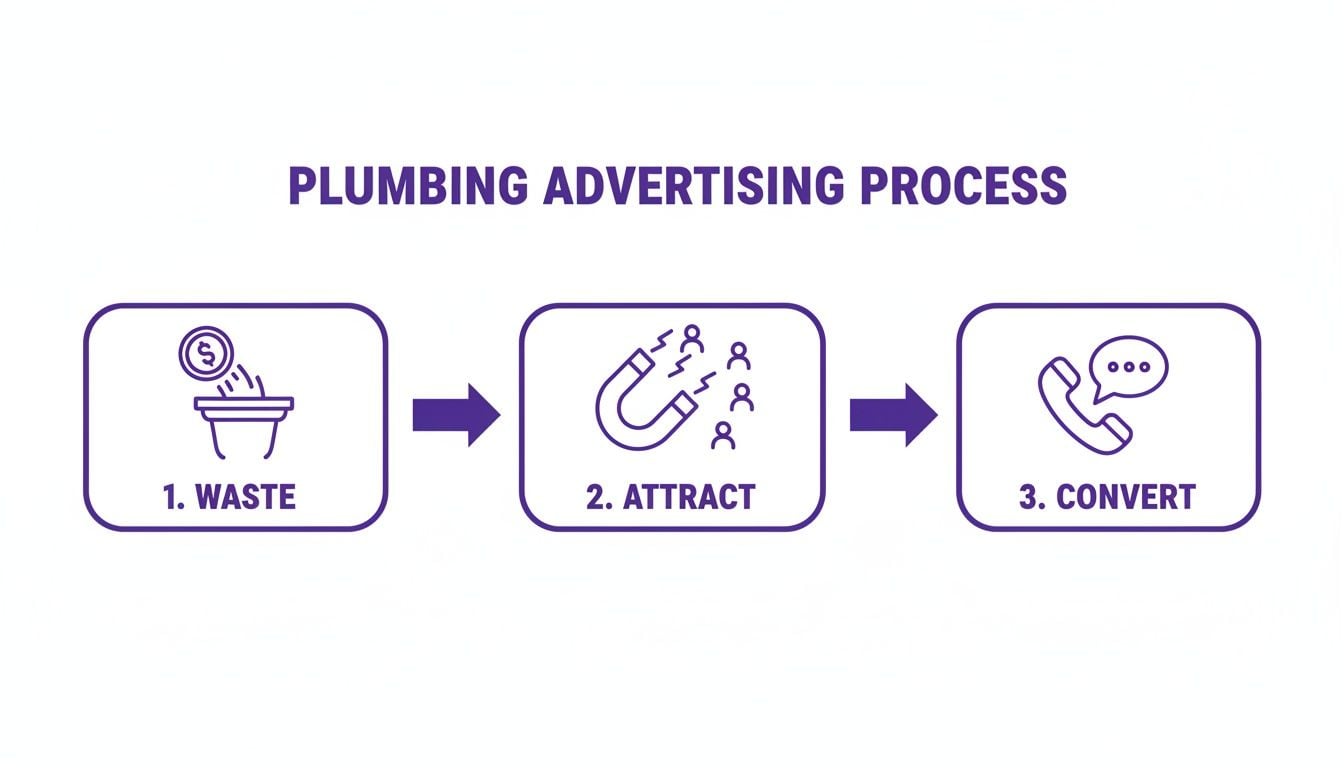
This is how you move from burning cash to efficiently generating high-value leads that grow your business.
Use Keyword Match Types as a Filter
Once you have your list of high-intent keywords, Google's match types become your primary filter. Using them incorrectly is like leaving the floodgates open for irrelevant clicks. Used correctly, they provide precise control.
Here are the three main types and how to use them:
- Broad Match: Avoid this match type. It gives Google too much latitude to match your ad to irrelevant searches and will drain your budget quickly.
- Phrase Match: This is a solid starting point. Your ad appears for searches that include the meaning of your keyword, offering a good balance of reach and relevance.
- Exact Match: This is the most restrictive and often most profitable match type. Your ad will only appear for searches with the exact same meaning or intent as your keyword.
A strategic combination of phrase and exact match keywords ensures your ads are shown to the right people and remain invisible to time-wasters.
A profitable campaign is defined not just by the clicks it gets, but by the irrelevant clicks it successfully avoids. This is the structural element most plumbing ad campaigns are missing.
Paid search remains a powerful channel for lead generation. Google Ads drives approximately 40% of all online leads in the plumbing industry, with an average cost per lead around $45 to $50. It works because it places you in front of homeowners at the exact moment they need a solution.
For a deeper analysis of honing your ad campaigns, you can explore the strategies for mastering Google Ads for plumbing service business growth.
Ultimately, a well-built campaign structure is the difference between an ad budget that disappears and one that generates a predictable flow of valuable jobs. It requires a strategic, deliberate approach, but the clarity and profitability it delivers are worth the effort.
Using Negative Keywords to Block Wasted Spend
A successful Google Ads campaign is defined as much by the traffic it blocks as the traffic it attracts. Most business owners focus entirely on which keywords to bid on, overlooking the fact that a strong defense is the best offense for protecting an ad budget.
This is where a robust negative keyword list becomes your most powerful tool for profitability.

Adding negative keywords instantly stops your ads from appearing for irrelevant searches. Every worthless query you block prevents a click that would have been a complete waste of money. This single action directly lowers your cost per qualified lead and improves your campaign's overall return.
Without negative keywords, you are paying for clicks from job seekers, students doing research, and DIY enthusiasts. None of these individuals are going to hire you.
Start With an Essential Blocker List
Every plumbing ad campaign should launch with a foundational negative keyword list. These are the commonsense terms that almost universally attract the wrong clicks.
Over time, you will expand this list based on your campaign's search term reports. This starter list, however, will immediately plug the most obvious leaks in your ad spend.
Here is a breakdown of the most common categories of negative keywords we add to every new plumbing campaign.
| Category | Example Negative Keywords | Reason for Exclusion |
|---|---|---|
| DIY & How-To | how to, DIY, fix myself, tutorial, video, diagram |
These users are looking for instructions, not to hire a professional plumber. |
| Employment | jobs, hiring, career, salary, resume, employment |
You'll block job seekers who are looking for a position, not your services. |
| Education & Training | school, training, classes, certification, apprentice |
This filters out students and aspiring plumbers researching the trade. |
| Parts & Supplies | parts, tools, supply store, rental, manual, faucet, pvc pipe |
These searchers want to buy materials, not hire a service professional. |
| Cheap & Free | cheap, free, lowest cost, affordable |
This helps filter out price-shoppers who are unlikely to be profitable customers. |
Adding these terms tells Google Ads clearly: "Do not show my ad if someone is looking for a plumbing job or wants to fix their own sink." This is a critical step to ensure your budget is reserved for actual customers.
A well-curated negative keyword list acts as a high-quality filter for your ad spend. It ensures your budget is only spent attracting homeowners with a problem, not people looking for information.
This proactive approach to campaign management transforms your ads from a passive expense into an active process of optimization. It’s not just about spending money; it’s about directing every dollar with precision.
Refine Your Geographic Targeting
Just as important as blocking the wrong keywords is blocking the wrong locations. Many plumbers make the mistake of targeting an entire metro area, only to pay for clicks from homeowners who live an hour outside their service radius.
This is another significant source of wasted ad spend.
Instead of broad, city-wide targeting, you must be more precise. Use radius targeting around your office or, even better, zip code targeting to draw an exact digital boundary around the neighborhoods you serve.
At the same time, you should actively exclude the zip codes, towns, or counties you do not work in. This guarantees you never pay for a click from a customer you cannot service, which tightens your campaign's efficiency and maximizes your return.
Crafting Ads and Landing Pages That Convert Callers
Getting a click is only half the task. A click that does not convert into a phone call from a real customer is just a budget expense. The critical function of any plumbing ad campaign is to turn that initial interest into a profitable service call.
This is where your ad copy and landing page must work in perfect alignment. Your ad makes a promise, and your landing page needs to deliver on it instantly. If there is any disconnect, that potential customer, especially one in a panic on their phone, is gone in seconds.
Writing Ad Copy That Solves a Problem
When a homeowner has water pouring into their basement, they do not care about your company’s origin story. They need speed, trust, and a solution now. Your ad copy must speak directly to that urgent need.
Pack your headlines and descriptions with value that offers an immediate fix:
- Urgency and Availability: Use phrases like “24/7 Emergency Service” and “Fast Response Times.” This tells them you can solve their problem immediately.
- Trust and Professionalism: Build credibility with terms like “Licensed & Insured” and “Certified Plumbers.”
- Clear Call to Action: Do not make them think. “Call Now for a Free Estimate” is direct and leaves no room for confusion.
To succeed, you have to craft messages that get results. You can learn more about How to Write Ad Copy That Actually Converts and see how to make a homeowner in crisis feel they have found the right solution.
The Anatomy of a High-Converting Landing Page
Once someone clicks your ad, they must land on a page that continues the conversation. Sending traffic to your generic homepage is one of the most common and costly mistakes. You need a dedicated landing page built for one purpose: generating a call or a form submission.
A landing page isn’t a digital brochure; it’s a conversion tool. Every single element should steer the user toward contacting you.
Your page must be optimized for the 73% of search ad clicks that happen on mobile. That means it needs to be clean, load fast, and be incredibly easy to use.
Here are the non-negotiable elements your page must have:
- Prominent Click-to-Call Button: Your phone number should be the most obvious element on the page, especially at the top. On mobile, this must be a tappable button that instantly opens the phone’s dialer.
- Simple Contact Form: For less urgent jobs, include a short form. Only ask for the essentials: name, phone, and a brief note about the problem.
- Reinforce Trust Signals: Display customer reviews, testimonials, and badges like “Google Guaranteed” or your BBB rating.
- Clear Service Descriptions: Briefly list the services you offer. This confirms to the user that you can handle their specific issue.
By creating this seamless journey from ad to landing page, you dramatically increase the probability that a click becomes a paying customer. This alignment separates campaigns that make the phone ring from those that just burn through your budget.
Ready to Move Beyond Clicks? It's Time for Local Services Ads
Once your traditional search campaigns are optimized, it is time to advance to a more direct, powerful method of generating plumbing leads. Most business owners are tired of paying for clicks, a metric that does not guarantee a ringing phone.
This is where Google Local Services Ads (LSAs) are relevant. They represent a fundamental shift in how you pay for leads.
Unlike the pay-per-click model, LSAs operate on a pay-per-lead basis. You are only charged when a real customer calls or messages you directly through the ad. This model aligns your ad spend with your actual business objective: acquiring qualified jobs, not just website traffic.
The Power of the Google Guaranteed Badge
What makes LSAs so effective is the trust they build instantly. To qualify, your plumbing business must pass Google's background check and show proof of license and insurance.
Once approved, your ad receives a significant credibility boost: the “Google Guaranteed” badge.
For a homeowner concerned about a burst pipe, that badge is a powerful, third-party endorsement signaling you are a legitimate, trustworthy professional. It is why Google places these ads at the absolute top of the search results, even above traditional paid ads.
The “Google Guaranteed” badge cuts through a customer’s biggest fear: hiring a shady or unqualified contractor. It builds instant credibility and dramatically shortens the path from a search to a phone call.
How LSAs Differ from Traditional Search Ads
Understanding the difference between these two ad types is crucial for your budget and the quality of leads you receive. While both have a place, they serve different functions.
- Cost Model: LSAs are pay-per-lead. You pay for a direct contact. Traditional search is pay-per-click. You pay for a website visit, whether they call you or not.
- Ad Placement: LSAs occupy the premium real estate at the very top of the page, the first thing a potential customer sees.
- Control: With traditional ads, you have complete control over ad copy, keywords, and landing pages. With LSAs, Google creates the ad for you based on your business profile and customer reviews.
This structure makes LSAs the perfect tool for capturing high-intent, emergency service calls. The data supports this. Local Service Ads now attract around 13% of all local search clicks, and some plumbing companies using them report seeing 3 to 5 times more leads than from their other search campaigns. You can learn more about how to get more leads, not just clicks, with Google Local Service Ads in our complete guide.
For any established plumbing business with a solid reputation, adding LSAs to your marketing mix is the logical next step. It shifts your focus from attracting clicks to acquiring profitable jobs with a predictable ROI. The 'Google Guaranteed' badge alone can boost leads by up to 20%. You can read up on these and other key plumbing marketing statistics to see the full picture.
Common Questions About Google Ads for Plumbers
It is normal to have questions before investing in Google Ads. Even with a clear plan, most plumbing business owners want to know the real cost, how quickly it works, and what kind of return to expect.
Getting direct answers to these questions is the only way to move forward with confidence. Let's break down what you need to know.
What Is a Realistic Budget for a Plumber?
For a serious local campaign, you should plan to invest between $1,500 and $3,000 per month. This is the range where you will acquire enough data for Google’s algorithm to learn and enough traffic to see what is actually working.
Anything less, and you are providing data so slowly that it is nearly impossible to make good decisions. You remain stuck, unable to justify the investment because the results are too thin.
The budget is a matter of simple math. If a qualified lead costs you $50 and your goal is to get 40 leads a month, you need a $2,000 budget. It is about working backward from your revenue goals, not picking a number at random.
How Long Does It Take to See Results?
You can get clicks and even calls within hours of launching your ads. But "results" and "clicks" are two different things. Getting traffic is easy; getting profitable, predictable leads takes time.
It typically takes a good 60 to 90 days to gather enough performance data to properly dial in a campaign. This initial period is for learning and refinement.
This is when you build out your negative keyword list to stop wasting money on bad clicks, test different ad headlines, and determine which services drive the best ROI. Patience during this phase provides significant long-term benefits.
Thinking of Google Ads as a 30-day trial is a setup for failure. True ROI comes from the consistent optimization that occurs over the first few months, turning raw data into a predictable lead-generation system.
Can I Run Google Ads Myself?
Yes, you can. The platform is open for anyone to use. The real question is whether you have the time and specialized expertise to run it profitably.
A successful campaign is not "set it and forget it." It requires daily monitoring, ongoing keyword research, constant bid adjustments, and knowing how to interpret performance data to make smart decisions.
For most business owners, the time spent trying to master the complexities of Google Ads is better spent running their company. The money wasted on irrelevant clicks from a poorly managed campaign almost always costs more than hiring a professional. It comes down to what you value more: your time or the cost of mistakes.
Navigating the details of google ads for plumbers is much simpler with a partner who knows how to turn ad spend into real business growth. At City Web Company, we build and manage campaigns designed for profitability, not just clicks.
If you’re ready to switch from guesswork to a clear, data-driven advertising strategy, we should talk. Schedule a free discovery call with us, and we will help you outline a plan that’s built around your specific revenue goals.
These articles were popular with other readers too: